
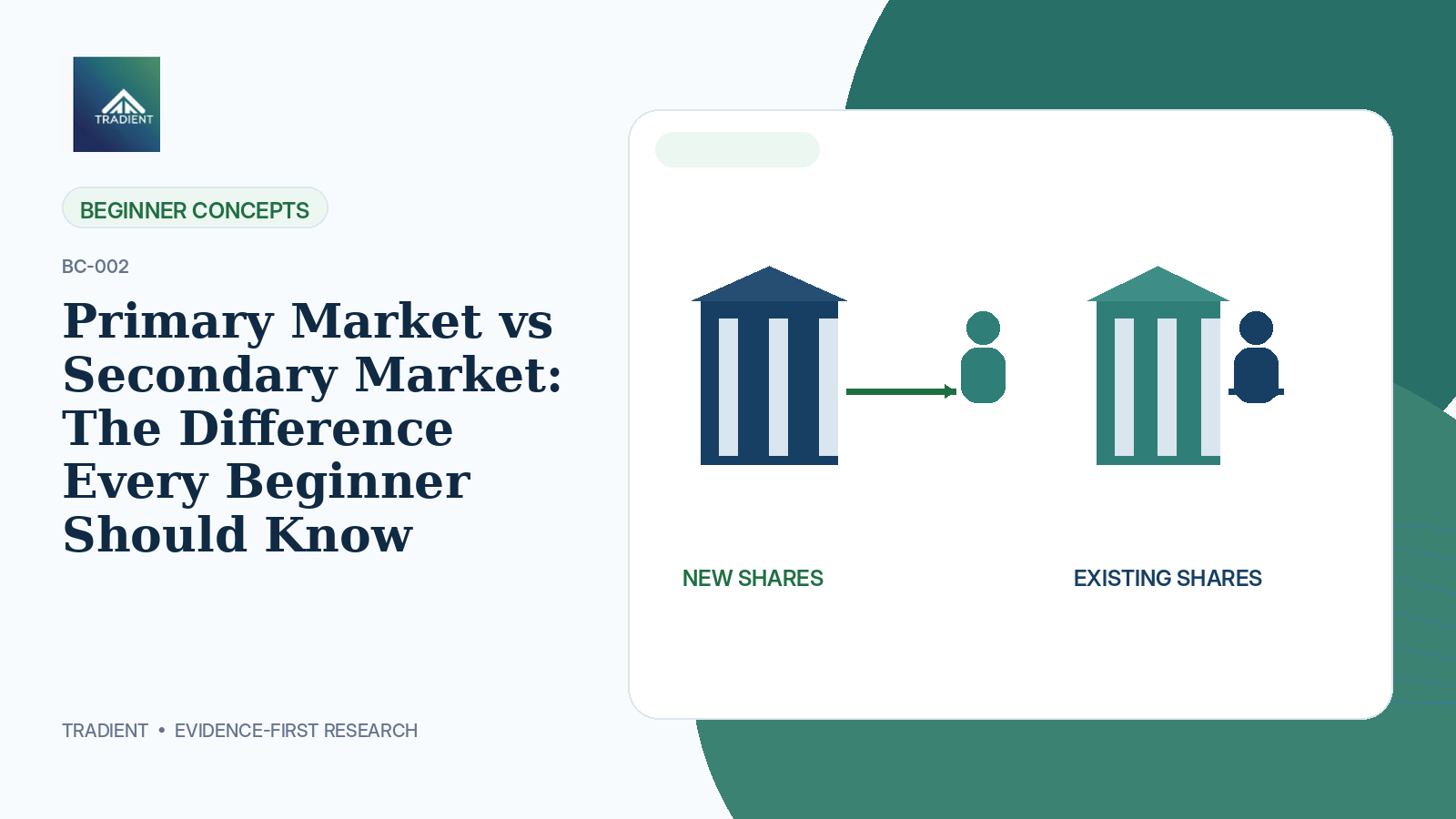
At a glance: The primary market is where securities are created or newly issued and capital can flow to the issuer. The secondary market is where investors buy and sell securities that already exist. One finances issuance; the other provides liquidity and continuous price discovery.
Many beginners assume that every time they buy a share, the company receives their money. That is usually not what happens. The answer depends on whether the transaction is taking place in the primary market or the secondary market.
This distinction is one of the foundations of securities markets. It explains why an IPO is different from buying the same stock six months later on NSE or BSE, why companies can raise equity capital without repaying it like a loan, and why investors can later exit without asking the company to return their money.
The primary market: where securities are issued
The primary market is the part of the capital market in which an issuer offers securities to investors. Depending on the transaction, those securities may be newly created shares, debt securities or another permitted instrument.
For an equity IPO, investors subscribe to an issue under the terms described in the offer documents. Subject to the issue structure and applicable expenses, the capital raised through a fresh issue goes to the company. If the offer also contains an offer-for-sale component, the proceeds for that component go to the selling shareholders rather than to the company.
The central idea is that the primary market is an issuance market. Its job is to connect issuers that need capital with investors willing to provide it.
- Initial public offerings (IPOs)
- Follow-on public offers and certain additional equity issues
- Rights issues offered to existing shareholders
- Public or private issuance of debt securities, depending on the instrument and framework
The secondary market: where existing securities trade
Once a listed share is available for trading, investors normally buy and sell it in the secondary market. A buyer pays a seller; the company whose share is being traded generally does not receive the purchase price from that transaction.
In India, stock exchanges such as NSE and BSE provide organised venues and systems through which orders can be matched. Brokers provide access, clearing corporations manage obligations, and depositories support the transfer of securities between accounts.
This secondary market is what most people mean when they say they are ‘buying stocks in the market’. It is also where the market continuously forms prices through the interaction of orders, information, expectations and liquidity.
A simple example
Suppose Sunrise Manufacturing issues 1 crore new shares in an IPO at ₹100 each as a fresh issue. Ignoring costs and other structuring details, that issuance can raise ₹100 crore of equity capital for the company.
After listing, Investor A may sell 500 Sunrise shares to Investor B at ₹112 on the exchange. The ₹56,000 consideration for that secondary-market trade moves between the investors through the market infrastructure. Sunrise Manufacturing does not receive ₹56,000 merely because its share changed hands.
The company benefited from access to the primary market; the investors benefit from the liquidity of the secondary market. The same security therefore connects two distinct economic functions at different times.
Why the secondary market matters to the primary market
A primary market without a functioning secondary market would be far less attractive. Investors would hesitate to commit capital if they had no practical way to sell later.
Liquidity does not eliminate investment risk, but it makes ownership transferable. That transferability can increase investor willingness to participate in new issues. The possibility of later price discovery also helps investors assess how the market values comparable businesses and risks.
This is why the two markets reinforce each other. Primary issuance supports capital formation; secondary trading supports liquidity, valuation and the recycling of savings into new opportunities.
Primary-market price and secondary-market price are not the same thing
An issue price is determined through the issue process and the rules applicable to that transaction. A secondary-market price is formed continuously after listing through the interaction of market orders and limit orders.
A stock can list above, near or below its issue price. Nothing in an IPO guarantees a listing gain. Likewise, an attractively priced IPO can later perform poorly if business fundamentals disappoint, while an initially weak listing can recover if expectations improve.
Treat the issue price as one transaction price in the life of a security, not as a permanent definition of value.
What beginners often misunderstand
- Buying a listed share on the exchange usually does not fund the company directly.
- An IPO may combine a fresh issue and an offer for sale, so not all headline issue proceeds necessarily go to the issuer.
- A liquid secondary market is valuable, but liquidity can change sharply during stress.
- Listing does not make a security safe; it makes it tradable within a regulated market framework.
- Primary and secondary markets are different stages of the same capital-market ecosystem, not competing alternatives.
How to use this concept when reading the market
Treat primary market vs secondary market: the difference every beginner should know as a framework rather than a prediction. When you see the concept mentioned in a market headline, identify the exact variable being measured, the relevant time period and the institution or methodology behind the number.
Then connect it to the decision you are actually making. A benchmark concept may help you compare performance; a market-structure concept may explain how an order is processed; a valuation concept may help you interpret a ratio. The concept is useful only when it improves the quality of a specific question.
- Primary market means issuance; secondary market means trading of existing securities.
- Fresh-issue proceeds can raise capital for the issuer, while secondary trades generally transfer money between investors.
- Check the current official methodology or rule when the definition can change.
- Separate what the measure tells you from what it does not tell you.
Common beginner mistakes to avoid
A common mistake is converting a descriptive market concept into a buy-or-sell signal. Indices, liquidity measures, exchange rules and return calculations describe part of the system; they do not by themselves establish expected return.
Another mistake is memorising a current constituent count, lot size, weight or operational rule and treating it as permanent. Market infrastructure and index methodologies are maintained over time. Build the habit of checking the latest primary source when precision matters.
A five-minute verification routine
- Identify the official source: SEBI, NSE, BSE/NSE Indices, depository or issuer as relevant.
- Confirm the date of the factsheet, circular or methodology.
- Check whether the figure is price return, total return, free-float weighted or another defined measure.
- Write one sentence describing what the number does not prove.
- Only then connect the concept to a portfolio, trading or research decision.
Key takeaways
- Primary market means issuance; secondary market means trading of existing securities.
- Fresh-issue proceeds can raise capital for the issuer, while secondary trades generally transfer money between investors.
- The secondary market provides liquidity and continuous price discovery.
- A strong secondary market can make primary issuance more attractive to investors.
- IPO issue price and later market price are determined in different settings.
- Understanding this distinction prevents the common mistake of assuming that every stock purchase sends money to the company.
Frequently asked questions
Is an IPO a primary-market transaction?
Yes. An IPO is a primary-market process through which securities are offered before listing. The exact flow of proceeds depends on whether the issue contains fresh shares, an offer for sale, or both.
Is NSE a primary market or secondary market?
NSE is a stock exchange whose everyday equity trading is a secondary-market function. Exchange infrastructure can also support listing and other market processes, but buying an already listed share through the order book is secondary-market trading.
Can a company raise money after its IPO?
Yes. Listed companies can use permitted routes such as further equity issuance, rights issues or debt issuance, subject to applicable rules and approvals.
Does a secondary-market buyer become an owner of the company?
A buyer of equity shares acquires the ownership rights attached to those shares, subject to settlement and the rights of that class of security. The fact that the money goes to the seller rather than the company does not change the ownership nature of the share.
This article is for educational purposes only and is not investment advice or a recommendation to buy or sell any security.
Sources and further reading