
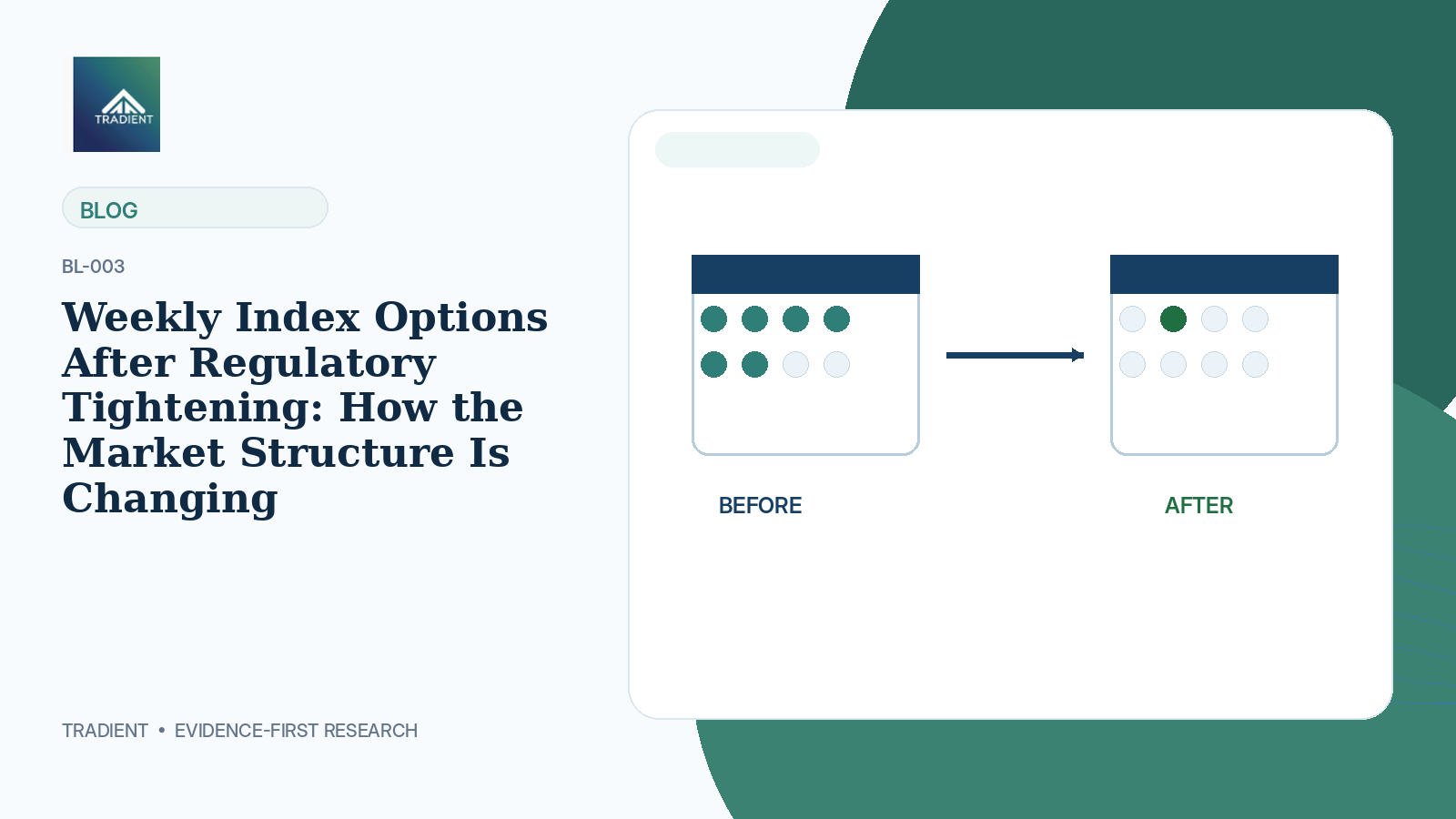
At a glance: The post-2024 derivatives framework is designed to reduce the intensity of very short-dated retail speculation without eliminating index derivatives. Weekly options still exist, but the product set and surrounding risk controls are materially tighter.
Weekly index options became one of the most visible parts of India’s retail trading boom. Their short maturity, low premium in far-out-of-the-money strikes and frequent expiries encouraged very high turnover.
SEBI’s response has been structural: reduce the number of weekly benchmark products, increase contract size, collect option premium upfront and strengthen monitoring. Traders should therefore treat old screenshots, expiry calendars and lot-size assumptions as potentially obsolete.
The key structural change: one weekly benchmark index option per exchange
SEBI’s derivatives framework rationalised weekly index derivatives so that an exchange can offer one weekly benchmark index-options contract rather than multiple weekly index expiries across several benchmarks.
The policy aims to reduce repeated expiry-day concentration while preserving a weekly hedging and trading instrument. Other benchmark and non-benchmark derivatives are subject to longer-tenor structures under the current framework.
Contract size was deliberately increased
The 2024 framework raised the minimum contract-value range for index derivatives. A larger contract makes a single lot a more meaningful exposure and reduces the ability to take very large effective leverage with a tiny account.
Because index levels change over time, exchanges periodically adjust lot sizes to keep contracts within regulatory value bands. Traders should always check current exchange files rather than memorising a historic lot size.
Upfront premium and expiry-day risk controls matter
Option buyers must fund the premium according to the applicable upfront collection framework, while expiry-day and intraday position-risk rules have become more granular.
These measures make it harder to rely on informal leverage or delayed collection practices and give clearing and risk systems more current information about concentrated exposures.
Current NSE specifications illustrate the new structure
NSE’s contract specifications, updated in August 2026, show Nifty 50 options with weekly expirations alongside monthly and longer-dated contracts. Other listed index-option products follow monthly or quarterly structures as specified.
The same page shows Tuesday as the expiry day for NSE’s listed equity-derivatives contracts, subject to the previous trading day when Tuesday is a holiday. This is why any article or strategy built around an older Thursday schedule needs to be revalidated.
What changes for a retail strategy
- Historical backtests must map old and new expiry structures correctly
- Lot-size changes alter rupee risk and margin per trade
- Fewer weekly products can concentrate activity in the permitted benchmark
- Expiry-day volatility cannot be assumed to behave like earlier regimes
- Broker product availability and risk rules may change faster than evergreen trading tutorials
The market is evolving, not disappearing
A tighter weekly-options framework does not mean index derivatives have lost economic purpose. They remain tools for hedging, price discovery and risk transfer.
The important shift is that retail speculation in repeated short-dated expiries now operates within stronger constraints. Strategy research must be regime-aware rather than treating the 2021–2024 market structure as permanent.
How to use this framework without making a one-variable trade
The subject in Weekly Index Options After Regulatory Tightening: How the Market Structure Is Changing should be treated as one input into a wider market process. Before taking a position, separate the policy or structural variable from earnings, valuation, positioning, liquidity and what the market had already priced.
A useful discipline is to write a base case, an upside case and a downside case. Identify which observable data would move the probability of each case. This prevents a headline—whether a circular, RBI operation or yield move—from becoming a complete investment thesis.
- What was expected before the event?
- What actually changed?
- Which cash-flow or risk channel is affected?
- What is already reflected in valuation?
- What evidence would make the current interpretation wrong?
What to verify before acting
Use primary sources for the rule or policy itself and current exchange specifications for contract-level details. Secondary reporting can be useful for context, but a trading system should not rely on a news summary when the operative circular or specification is available.
Also check the effective date. Indian market reforms are frequently phased, and an announcement date is not always the date on which every operational provision becomes active.
Key takeaways
- SEBI narrowed weekly benchmark index options to one contract per exchange.
- Contract-size and premium-collection rules make leverage more explicit.
- NSE’s current specifications show Tuesday expiry for its equity derivatives, subject to holiday rules.
- Old lot sizes and expiry calendars should never be hard-coded into a current strategy.
- Backtests spanning regulatory changes need regime-aware data treatment.
- Weekly options remain useful instruments, but the retail risk environment is materially different.
Frequently asked questions
Are weekly index options banned in India?
No. The framework permits one weekly benchmark index-options contract per exchange, subject to current exchange and SEBI specifications.
Is Nifty still weekly?
NSE’s August 2026 specifications show Nifty 50 options with weekly expirations. Check the current contract page before trading.
Why were weekly expiries restricted?
The reforms were introduced in the context of investor protection, market stability and concerns around excessive short-dated speculation.
Can an old options backtest still be used?
Only if it correctly accounts for historical product availability, expiry day, lot size, costs and other rule changes. Otherwise it may describe a market that no longer exists.
Regulatory positions, exchange specifications and macroeconomic conditions can change. This article was fact-checked against the cited sources available on 3 September 2026. It is intended for educational purposes only and does not constitute legal, compliance, financial or investment advice. Readers should verify the latest official documentation before acting.
Sources and further reading