
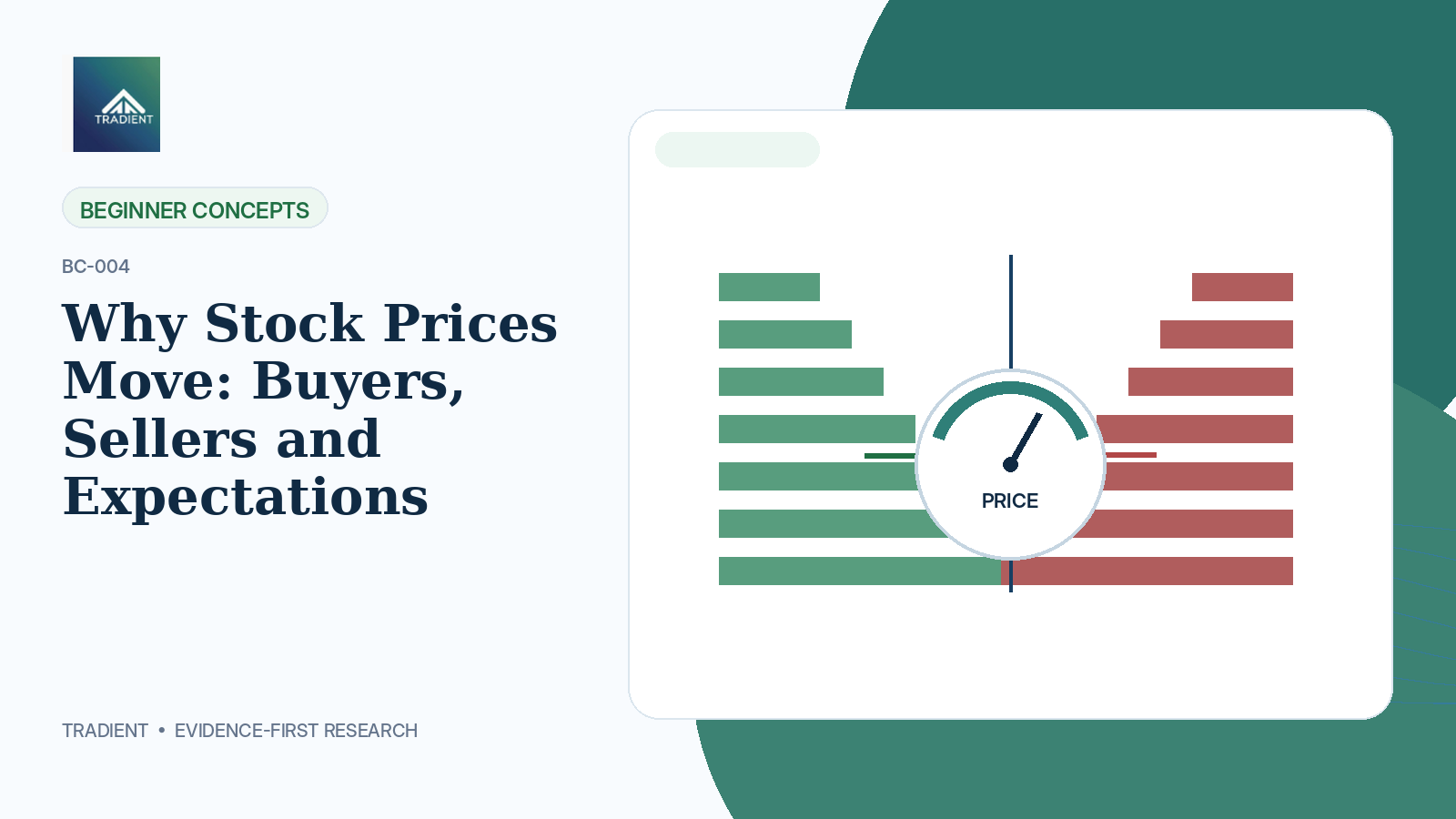
At a glance: A stock price is the outcome of price discovery. It changes when the balance of willing buyers and sellers changes, usually because information, expectations, risk perceptions, liquidity or required returns have changed.
A common beginner question is: ‘The company did nothing today, so why did the stock move?’ The answer is that markets price expectations, not just today’s visible events.
Every trade requires a buyer and a seller. What changes from moment to moment is the price at which enough buyers and sellers are willing to transact. That price can move because of company news, sector developments, interest rates, global markets, positioning, liquidity or simply a change in how investors interpret the same information.
Price discovery begins with orders
An exchange order book contains buy orders and sell orders at different prices and quantities. A marketable order interacts with available liquidity. When demand at the current best offers is exhausted, the next trades may occur at higher prices; when sell pressure consumes available bids, subsequent trades may occur lower.
This does not mean ‘more buyers than sellers’ in a literal completed-trade sense, because every executed trade has both sides. It means the urgency, size and price willingness of orders are imbalanced enough to move the clearing price.
Liquidity therefore matters. A large order in a very liquid stock may have little effect, while the same rupee amount in a thinly traded stock can move several price levels.
Markets price the future
A share represents a claim on a business whose economic value depends heavily on future outcomes. Investors therefore estimate future revenue, profit, cash flow, capital needs, risk and the return they require for bearing that risk.
If a company reports profit of ₹1,000 crore but the market expected ₹1,200 crore, the stock can fall even though the company made a large profit. If profit falls to ₹800 crore but investors feared ₹600 crore, the stock can rise. The direction of the surprise relative to expectations often matters more than whether the headline number is simply ‘good’ or ‘bad’.
What can change expectations?
- Quarterly results, guidance and management commentary
- Industry demand, commodity prices and competitive actions
- Interest rates, inflation and currency movements
- Regulatory changes and government policy
- Capital allocation decisions such as acquisitions, buybacks or large investments
- Global risk appetite and flows
- New information about governance, litigation or balance-sheet risk
Valuation changes even when earnings do not
A stock’s price can be thought of as a combination of business outcomes and the multiple investors are willing to pay for those outcomes. If required returns rise because interest rates or perceived risk rise, investors may assign a lower valuation multiple even before earnings change.
The reverse can also happen. Falling risk-free rates, improving liquidity or greater confidence in the durability of growth can support higher valuation multiples. This is why a stock can move sharply even when the current quarter’s earnings are unchanged.
Why prices sometimes move without obvious news
Not all information arrives through a single headline. Large investors rebalance portfolios, derivatives positions are hedged, index changes generate trading, passive funds adjust weights, and market participants react to developments elsewhere.
Sometimes the correct answer is simply that the marginal buyer and seller changed their reservation prices. Markets do not need a newspaper headline for every tick. The price itself is part of the information process.
Volatility is not the same as risk
Price volatility measures how much prices move. Investment risk is broader. A stable-looking stock can contain severe business or balance-sheet risk, while a financially strong business can have a volatile share price during a market panic.
For a trader, volatility directly affects position sizing, stop placement and execution. For a long-term investor, temporary volatility matters differently from permanent impairment of business value. The time horizon and process determine which risks matter most.
How to use this concept when reading the market
Treat why stock prices move: buyers, sellers and expectations as a framework rather than a prediction. When you see the concept mentioned in a market headline, identify the exact variable being measured, the relevant time period and the institution or methodology behind the number.
Then connect it to the decision you are actually making. A benchmark concept may help you compare performance; a market-structure concept may explain how an order is processed; a valuation concept may help you interpret a ratio. The concept is useful only when it improves the quality of a specific question.
- Every executed trade has a buyer and seller; prices move because the price needed to match them changes.
- Expectations about the future are central to stock valuation.
- Check the current official methodology or rule when the definition can change.
- Separate what the measure tells you from what it does not tell you.
Common beginner mistakes to avoid
A common mistake is converting a descriptive market concept into a buy-or-sell signal. Indices, liquidity measures, exchange rules and return calculations describe part of the system; they do not by themselves establish expected return.
Another mistake is memorising a current constituent count, lot size, weight or operational rule and treating it as permanent. Market infrastructure and index methodologies are maintained over time. Build the habit of checking the latest primary source when precision matters.
A five-minute verification routine
- Identify the official source: SEBI, NSE, BSE/NSE Indices, depository or issuer as relevant.
- Confirm the date of the factsheet, circular or methodology.
- Check whether the figure is price return, total return, free-float weighted or another defined measure.
- Write one sentence describing what the number does not prove.
- Only then connect the concept to a portfolio, trading or research decision.
Key takeaways
- Every executed trade has a buyer and seller; prices move because the price needed to match them changes.
- Expectations about the future are central to stock valuation.
- A result can be objectively good yet disappoint the market if expectations were higher.
- Liquidity affects how strongly orders move price.
- Valuation multiples can change because required returns and risk perceptions change.
- Not every price move has a single identifiable news headline.
Frequently asked questions
Why can a stock fall after good results?
Because the results may be weaker than expectations, guidance may disappoint, valuation may have been stretched, or investors may focus on a negative detail not captured by the headline profit number.
Can a stock rise even when a company reports lower profit?
Yes. If the decline is smaller than expected, if the outlook improves, or if another important risk is resolved, investors can revise the future upward despite a weak historical quarter.
Do foreign investors control stock prices?
No single investor class mechanically controls prices. Large flows can influence liquidity and demand, but prices reflect interaction among many market participants and expectations.
Is high trading volume always bullish?
No. High volume means substantial activity, not a guaranteed direction. It can accompany accumulation, distribution, news, index rebalancing, panic or euphoria.
This article is for educational purposes only and is not investment advice or a recommendation to buy or sell any security.
Sources and further reading