
At a glance: The cheapest time to manage emotional trading is before the trade is placed. The goal is not to eliminate emotion but to notice when emotion has begun changing the rules.
A trader rarely says, ‘I am now making an emotional decision.’ More often, the change appears as a small exception: one extra trade, a slightly wider stop, an entry that is ‘close enough’ or a position that is unusually large.
Those small deviations are valuable signals. If they are detected early, a trader can pause or reduce risk before a bad decision becomes an expensive sequence.
Emotion becomes dangerous when it changes behaviour
Fear, frustration, excitement and disappointment are normal. A disciplined trader can feel all of them while still following the plan.
The operational definition of emotional trading is therefore not ‘feeling something’. It is allowing the feeling to alter entry quality, size, exit rules, frequency or risk controls without evidence.
Common early warning signs
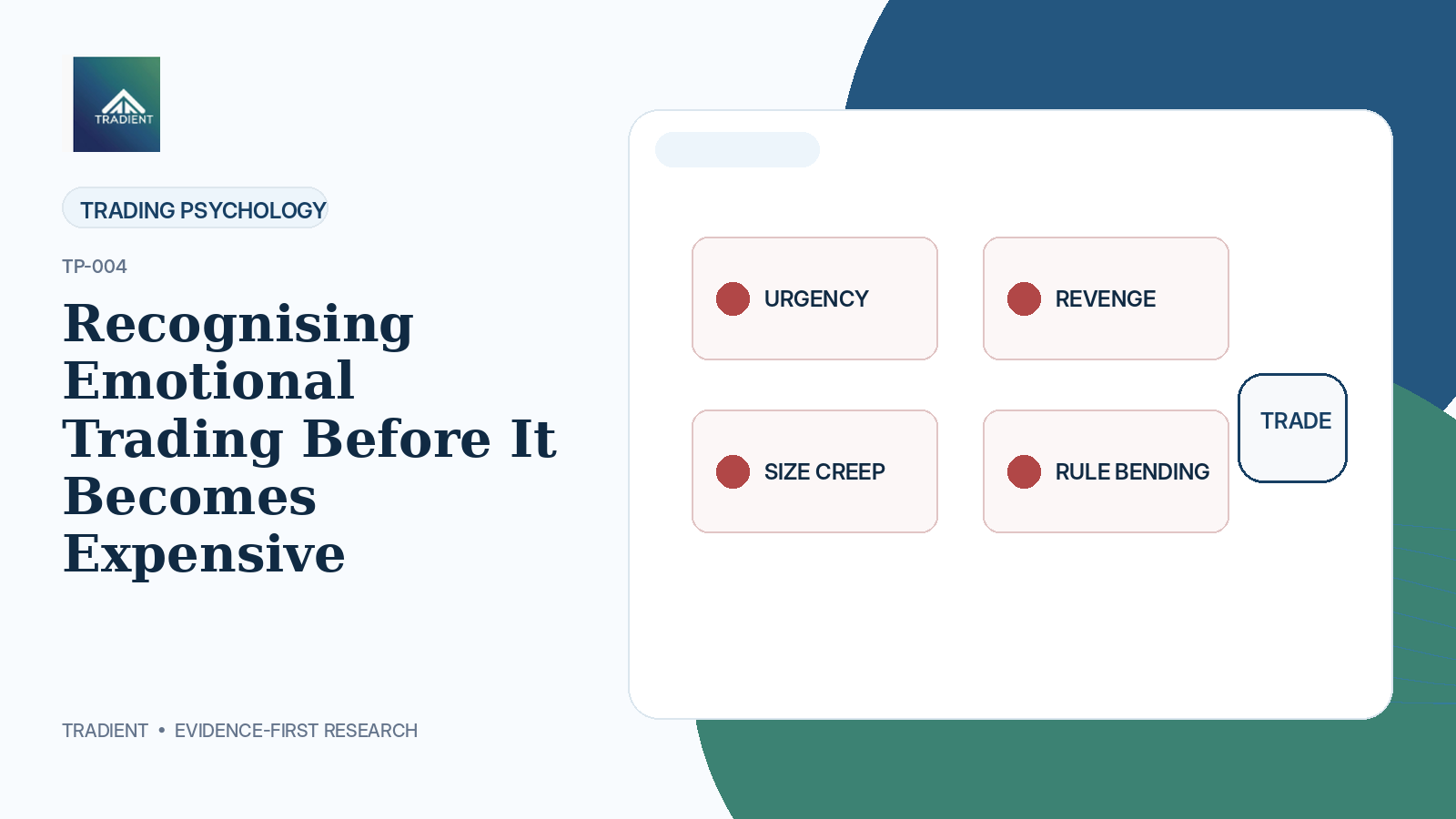
- Urgency: ‘I must enter before I miss it’
- Revenge language: ‘I need to make that loss back’
- Rule bargaining: ‘This one is different’
- Size creep after wins or losses
- Moving an invalidation level because exit feels painful
- Compulsive P&L checking that replaces market analysis
- Opening unrelated trades simply to stay active
Build a short interruption routine
A useful routine must be brief enough to use in real time. For example: identify the emotion, state the planned setup, check the risk, and ask whether any rule has changed since the last calm review.
If the answer is yes, the burden of proof should be high. A decision made under intense emotion should not receive an easier standard than a decision made calmly.
Use objective circuit breakers
Daily loss limits, maximum number of trades, mandatory breaks after a large win or loss, and restrictions on increasing size can act as behavioural guardrails.
These controls are valuable because they do not require the trader to correctly diagnose every emotion in the moment. They restrict the damage that emotion can cause.
Record process violations separately from losing trades
A losing trade that followed the plan is not the same event as a profitable trade that broke every rule. If the journal records only rupee profit and loss, the second trade may be wrongly rewarded.
Track whether the setup qualified, whether size was correct, whether the exit rule was followed and whether any unplanned action occurred. Process data exposes emotional patterns that P&L can hide.
Repeated patterns deserve structural fixes
If the same emotion repeatedly causes the same mistake, more willpower is not a complete solution. Change the environment: reduce size, remove a trigger, simplify the strategy or automate a risk control.
Good trading psychology is often good system design. The aim is to make disciplined behaviour easier and expensive impulsive behaviour harder.
A practical drill for the next 20 trades
Do not try to change the behaviour after one observation. For the next 20 relevant trades, record the trigger, the emotion or urge, the planned action and the action actually taken. Keep the form short enough that it is completed consistently.
At the end of the sample, look for repeated conditions rather than isolated stories. The purpose is to discover whether the behaviour appears after losses, after wins, at a particular time of day, at larger size or in fast-moving instruments. A repeated pattern is easier to redesign than a vague belief that discipline is weak.
- Setup grade before entry
- Planned rupee risk
- Dominant emotion or urge
- Any rule change after entry
- Process grade independent of P&L
What improvement should look like
Improvement does not require the emotion to disappear. A better standard is behavioural: emotion is normal; rule-changing under emotion is the real risk. The trader should be able to recognise the relevant state without automatically converting it into an order.
Track fewer rule violations, more stable position sizing and a smaller gap between planned and actual actions. Profitability is important over a meaningful sample, but process improvement can be observed earlier than the equity curve.
When to step back from live risk
If the behaviour repeatedly produces outsized losses, cancelled stops, uncontrolled leverage or an inability to follow a daily risk limit, the appropriate response may be to reduce or pause live exposure while the process is rebuilt.
Psychology work is not a justification for enduring unsafe risk. A trader should also investigate whether strategy design, platform mechanics, sleep, workload or position size is creating a problem that self-talk alone cannot solve.
Key takeaways
- Emotion is normal; rule-changing under emotion is the real risk.
- Urgency, revenge thoughts and rule bargaining are early warning signals.
- Use a short interruption routine before the next action.
- Objective circuit breakers can limit damage without perfect self-awareness.
- Judge process separately from P&L.
- Repeated emotional mistakes should lead to system redesign, not only promises of more discipline.
Frequently asked questions
Does emotional trading always lose money?
No. An impulsive trade can make money, which is why it can reinforce a bad habit. Judge the decision process separately from the outcome.
Should I stop trading whenever I feel anxious?
Not automatically. The key question is whether anxiety is changing your ability to follow the plan. If it is, reducing risk or stepping aside can be appropriate.
What is the fastest warning sign to check?
Ask whether you are about to break a rule that was clear when you were calm. That captures many emotional deviations quickly.
Can a journal really help?
Yes if it records behaviour, not just P&L. Setup grade, size, rule adherence and emotional state can reveal recurring patterns.
This article is for educational purposes only and is not investment advice or a recommendation to buy or sell any security.
Sources and further reading