
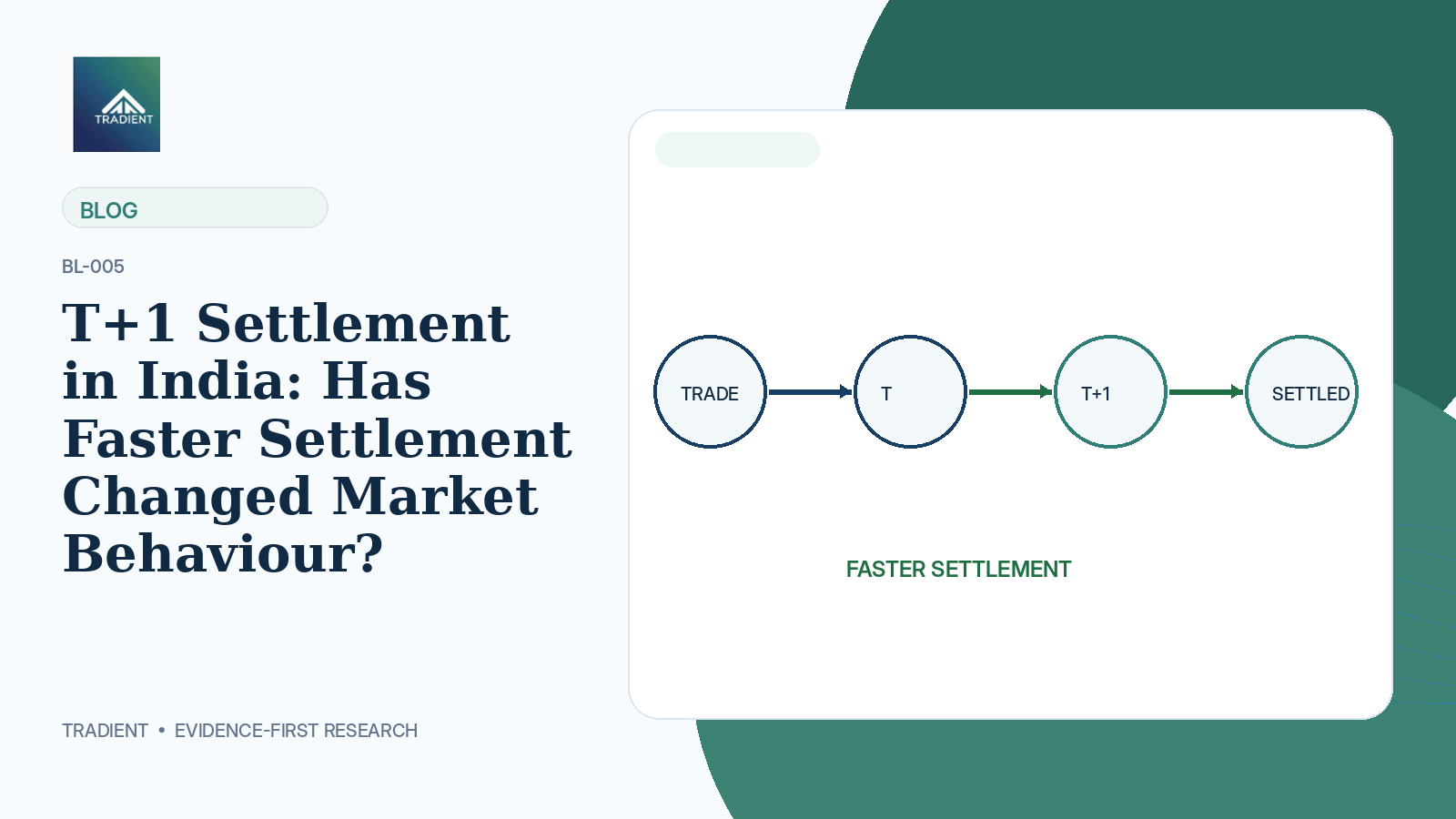
At a glance: Settlement speed changes plumbing more than investment fundamentals. T+1 reduces the time that obligations remain outstanding; optional T+0 goes further for eligible activity, but neither regime changes whether a stock is fundamentally attractive.
A trade is not fully complete merely because the exchange matches a buy and sell order. Funds and securities still need to move through clearing and settlement.
India completed its transition to standard T+1 cash-equity settlement in 2023 and subsequently introduced an optional T+0 path in phases. That makes Indian market infrastructure an important case study in shorter settlement cycles.
What T+1 means
T is the trade date. Under standard T+1 settlement, the clearing and settlement obligations are completed on the next working settlement day, subject to the market’s rules and holiday calendar.
Compared with T+2, the period during which counterparties and intermediaries carry unsettled exposure is shorter. Securities and funds also become available sooner under the applicable process.
Why markets moved from T+2 to T+1
Shorter settlement can reduce counterparty and replacement-cost exposure, lower some collateral needs and return assets to investors more quickly.
The trade-off is operational intensity. Brokers, custodians, clearing members, depositories and investors have less time to correct funding, allocation or settlement issues.
Where optional T+0 fits
SEBI introduced an optional T+0 settlement cycle in addition to the existing T+1 cycle and subsequently expanded the framework and implementation timelines.
T+0 is not the same thing as saying every Indian equity trade now settles instantly. Eligibility, broker systems, investor participation and operational rules matter. Investors should check what their broker and the current SEBI/exchange framework actually support.
Has faster settlement changed stock-price behaviour?
The strongest direct impact is on post-trade risk and operations rather than on the fundamental value of listed companies. A one-day faster settlement cycle does not mechanically increase earnings or change long-term cash flows.
There can be secondary effects through liquidity, capital efficiency and operational behaviour, but claims that T+1 alone makes stocks permanently more or less volatile require evidence rather than intuition.
What retail investors notice
- Earlier completion of delivery and payment obligations
- Quicker recycling of settled securities and funds under applicable broker rules
- Less time to resolve a funding or delivery mistake
- Need to understand auction/short-delivery consequences
- Different operational availability for T+1 and optional T+0 routes
The bigger trend is post-trade compression
Globally, major markets have been shortening settlement cycles as technology and risk management improve. India’s T+1 and T+0 initiatives belong to that broader effort to reduce time-at-risk.
For investors, the correct response is operational awareness—not using settlement speed as a substitute for investment analysis.
How to use this framework without making a one-variable trade
The subject in T+1 Settlement in India: Has Faster Settlement Changed Market Behaviour? should be treated as one input into a wider market process. Before taking a position, separate the policy or structural variable from earnings, valuation, positioning, liquidity and what the market had already priced.
A useful discipline is to write a base case, an upside case and a downside case. Identify which observable data would move the probability of each case. This prevents a headline—whether a circular, RBI operation or yield move—from becoming a complete investment thesis.
- What was expected before the event?
- What actually changed?
- Which cash-flow or risk channel is affected?
- What is already reflected in valuation?
- What evidence would make the current interpretation wrong?
What to verify before acting
Use primary sources for the rule or policy itself and current exchange specifications for contract-level details. Secondary reporting can be useful for context, but a trading system should not rely on a news summary when the operative circular or specification is available.
Also check the effective date. Indian market reforms are frequently phased, and an announcement date is not always the date on which every operational provision becomes active.
Key takeaways
- T+1 is the standard Indian cash-equity settlement framework.
- Shorter settlement reduces the time obligations remain outstanding.
- Optional T+0 exists alongside T+1 for eligible activity under an evolving framework.
- Faster settlement creates operational benefits and tighter deadlines.
- The direct effect is on market plumbing, not company fundamentals.
- Always verify the broker and current official rules before assuming T+0 availability.
Frequently asked questions
Does T+1 mean shares appear instantly after I buy?
Execution may appear immediately in the trading interface, but final settlement follows the applicable clearing and depository process.
Is T+0 mandatory for all stocks?
No. It has been introduced as an optional framework with eligibility and implementation conditions.
Does T+1 reduce all risk?
No. It reduces time-related counterparty exposure but does not eliminate market, operational, settlement or investment risk.
Can I sell a stock before settlement?
Broker and exchange rules determine available mechanisms and risk controls. Do not assume the same treatment across all products or brokers.
Regulatory positions, exchange specifications and macroeconomic conditions can change. This article was fact-checked against the cited sources available on 3 September 2026. It is intended for educational purposes only and does not constitute legal, compliance, financial or investment advice. Readers should verify the latest official documentation before acting.
Sources and further reading