
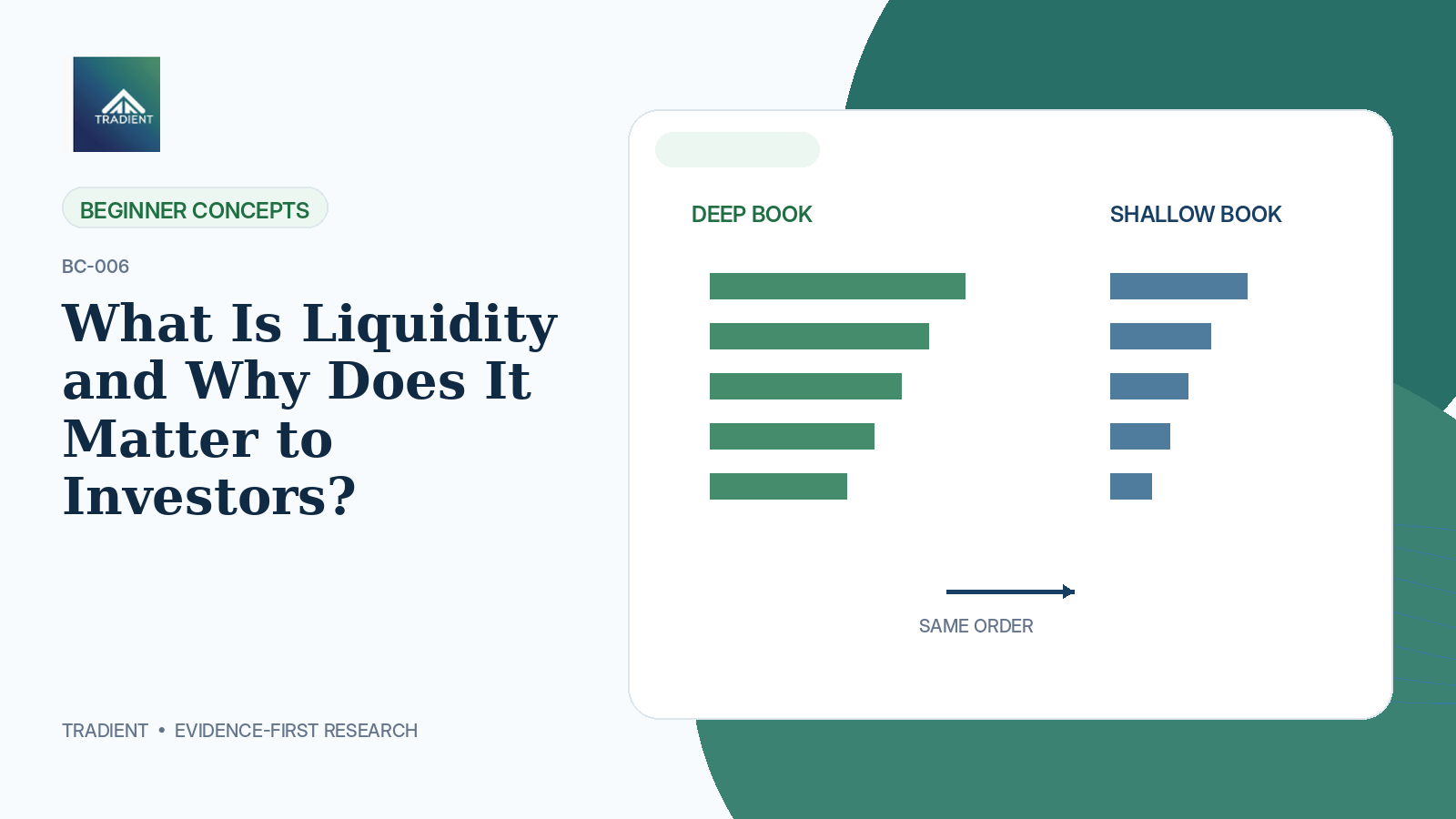
At a glance: A liquid market lets investors transact quickly and in meaningful quantity with relatively low price impact. Liquidity is not just ‘high volume’; it also involves tight spreads, order-book depth and resilience after trades.
You can own a profitable investment on paper and still have a difficult exit if there are too few willing buyers near the quoted price. That is liquidity risk.
Liquidity matters to long-term investors, traders, fund managers and index providers because it affects the cost and practicality of turning an investment into cash or acquiring a position without disturbing the market.
Four dimensions of liquidity
Liquidity is easier to understand when broken into dimensions rather than reduced to one number.
Tightness refers to the gap between the best available buying and selling prices. Depth refers to how much quantity can be traded near those prices. Immediacy refers to how quickly a trade can be executed. Resilience refers to how quickly the market recovers after a large order temporarily moves prices.
- Tight bid-ask spreads
- Meaningful quantity available near the market price
- Fast execution under normal conditions
- Limited price impact for ordinary trade sizes
Bid-ask spread is an immediate trading cost
If the best buyer is bidding ₹99.90 and the best seller is asking ₹100.10, the visible spread is ₹0.20. A trader who urgently buys at the ask and immediately sells at the bid would lose that spread before other costs.
Highly liquid securities often have relatively tight spreads, while illiquid securities can show wide gaps. The spread can widen sharply during news events or market stress even in normally liquid stocks.
Depth and impact cost
A narrow spread can be misleading if only a tiny quantity is available at the best price. A larger order may consume several levels of the order book, resulting in an average execution price worse than the first quote.
Impact cost is one way of thinking about this slippage. BSE Indices describes impact cost as the cost a buyer or seller incurs for a particular order quantity at a given point in time. Index methodologies often include liquidity filters for precisely this reason: a benchmark should be reasonably replicable by investors.
Why liquidity can disappear when you need it most
Liquidity is state-dependent. During a calm market, participants may provide tight quotes because they feel confident about risk. During a shock, market makers and investors can widen prices, reduce order sizes or step away.
This means historical average volume is not a guarantee that you can exit a large position at a fair price during stress. Position sizing should consider a conservative estimate of tradable liquidity, not just a normal-day observation.
Liquidity and investment horizon
A long-term investor may care less about minute-to-minute spread than an intraday trader, but liquidity still matters for entering, rebalancing and eventually exiting. Illiquidity can also increase the gap between observed market price and the price obtainable for a large transaction.
For traders, liquidity is often central to strategy design. Stops, market orders and short holding periods can behave very differently in a stock whose order book is thin.
Practical liquidity checks
- Look at average traded value, not just share volume.
- Observe the bid-ask spread in rupees and as a percentage of price.
- Check order-book depth around the best quotes.
- Compare your intended position size with normal market turnover.
- Assume liquidity can deteriorate during market stress or company-specific news.
- Avoid interpreting a single closing price as proof that a large quantity could have been traded there.
How to use this concept when reading the market
Treat what is liquidity and why does it matter to investors? as a framework rather than a prediction. When you see the concept mentioned in a market headline, identify the exact variable being measured, the relevant time period and the institution or methodology behind the number.
Then connect it to the decision you are actually making. A benchmark concept may help you compare performance; a market-structure concept may explain how an order is processed; a valuation concept may help you interpret a ratio. The concept is useful only when it improves the quality of a specific question.
- Liquidity is the ability to transact with speed, size and limited price impact.
- Volume alone is not enough; spread, depth and resilience matter.
- Check the current official methodology or rule when the definition can change.
- Separate what the measure tells you from what it does not tell you.
Common beginner mistakes to avoid
A common mistake is converting a descriptive market concept into a buy-or-sell signal. Indices, liquidity measures, exchange rules and return calculations describe part of the system; they do not by themselves establish expected return.
Another mistake is memorising a current constituent count, lot size, weight or operational rule and treating it as permanent. Market infrastructure and index methodologies are maintained over time. Build the habit of checking the latest primary source when precision matters.
A five-minute verification routine
- Identify the official source: SEBI, NSE, BSE/NSE Indices, depository or issuer as relevant.
- Confirm the date of the factsheet, circular or methodology.
- Check whether the figure is price return, total return, free-float weighted or another defined measure.
- Write one sentence describing what the number does not prove.
- Only then connect the concept to a portfolio, trading or research decision.
Key takeaways
- Liquidity is the ability to transact with speed, size and limited price impact.
- Volume alone is not enough; spread, depth and resilience matter.
- Illiquidity increases implicit trading costs and exit risk.
- A position can be easy to buy but difficult to sell during stress.
- Index providers use liquidity-related criteria because benchmarks need to be investable and replicable.
- Position size should be chosen with expected exit liquidity in mind.
Frequently asked questions
Is high volume the same as high liquidity?
Not always. High volume is helpful evidence, but a liquid market also requires reasonable spreads and sufficient depth for the size you want to trade.
Why do spreads widen during volatile markets?
Uncertainty and inventory risk rise. Liquidity providers demand more compensation and may quote smaller quantities, which can widen the gap between bids and offers.
Can a large-cap stock be illiquid?
Large-cap stocks are often liquid, but liquidity can deteriorate around news, trading halts or severe market stress. Size does not guarantee a particular execution quality at every moment.
How does liquidity affect valuation?
All else equal, investors may demand compensation for bearing illiquidity, but valuation relationships are complex. Liquidity should be considered alongside business and financial risk rather than as a standalone rule.
This article is for educational purposes only and is not investment advice or a recommendation to buy or sell any security.
Sources and further reading