
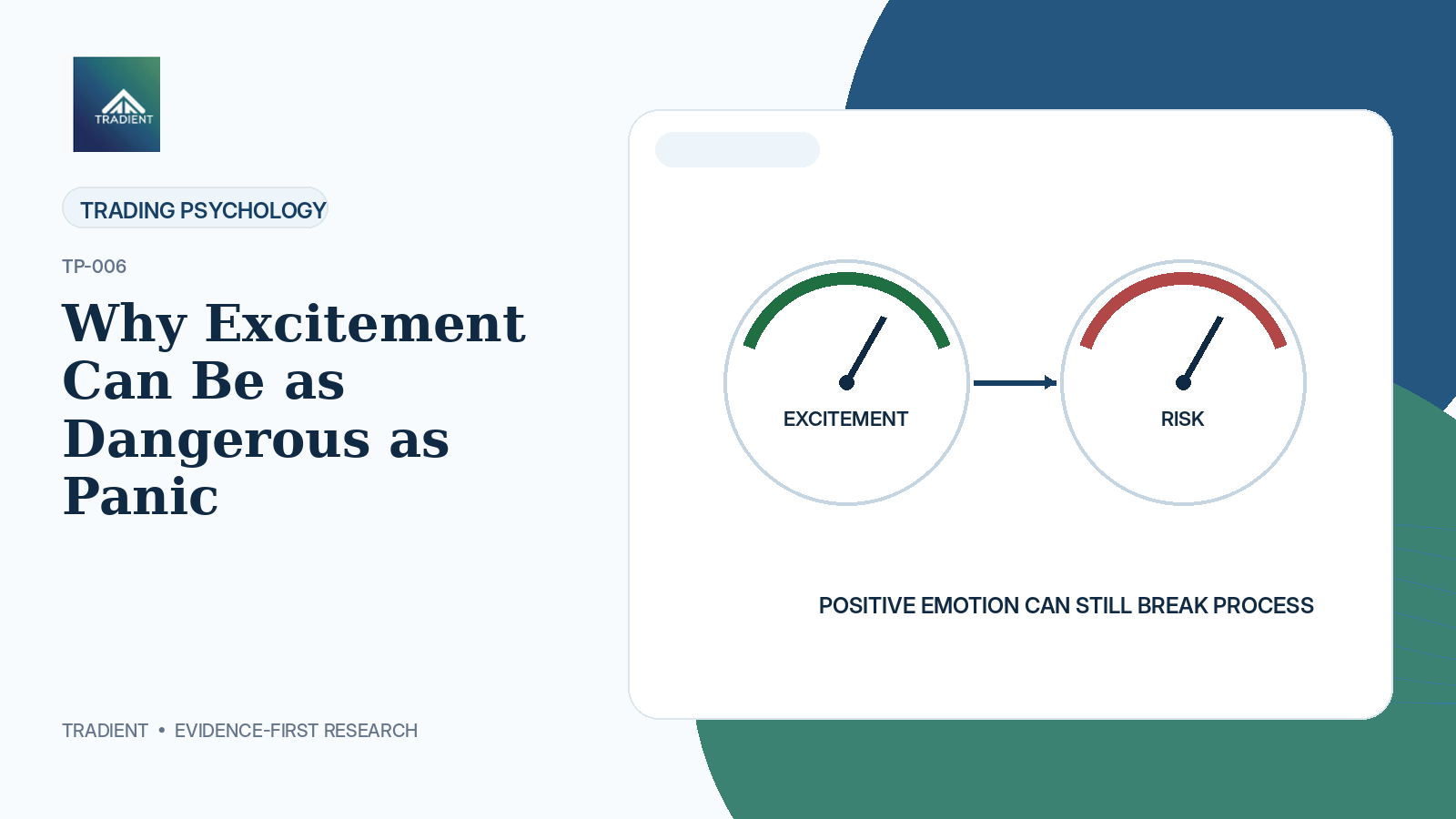
At a glance: Panic makes risk feel too large; excitement can make the same risk feel invisible. Both emotions can push a trader away from the plan, which is why positive emotion deserves the same governance as negative emotion.
A breakout works, social media turns bullish and the account is green. This can feel like the easiest environment in which to trade. It may also be the environment in which selectivity deteriorates fastest.
Excitement is dangerous not because opportunity is bad, but because emotional arousal can change how quickly a trader acts and how generously evidence is interpreted.
Excitement compresses the decision process
A trader who normally checks trend, liquidity, entry location and risk may suddenly skip steps because the opportunity feels urgent. The emotional story is positive, but the operational failure is similar to panic: action arrives before verification.
This is why a checklist should be used on the best-looking days, not only after losses.
FOMO turns observation into obligation
Seeing other traders profit can create the sense that being flat is itself a loss. That is a category error. A missed move changes opportunity cost, not account equity.
When every rising instrument feels mandatory, the trader begins chasing price and accepting worse reward-to-risk simply to participate.
Positive P&L can reduce perceived risk
When the account is up for the day, an additional trade may feel as though it is being financed by prior profits. Economically, however, the new position still has real downside.
Daily profit should not automatically expand risk limits. If the strategy has a scaling rule, it should be explicit and tested rather than improvised under euphoria.
Control frequency as well as position size
A trader can keep each position small and still accumulate excessive risk by opening many correlated trades or repeatedly re-entering the same theme.
Set limits on simultaneous exposure, number of attempts per setup and total risk across related positions. Excitement often hides in frequency rather than one obviously oversized trade.
Create a ‘best day’ protocol
- Do not raise the daily risk ceiling after an early profit
- Require the normal setup grade for every new trade
- Take a short break after an unusually large win
- Check correlation before adding another position in the same theme
- Stop if trade frequency exceeds the plan even when P&L is positive
Calm is not the absence of ambition
A disciplined trader can participate aggressively when a tested strategy genuinely calls for it. The difference is that risk expansion comes from evidence, not from the emotional atmosphere.
The objective is not to dampen enthusiasm. It is to prevent enthusiasm from rewriting the rules.
A practical drill for the next 20 trades
Do not try to change the behaviour after one observation. For the next 20 relevant trades, record the trigger, the emotion or urge, the planned action and the action actually taken. Keep the form short enough that it is completed consistently.
At the end of the sample, look for repeated conditions rather than isolated stories. The purpose is to discover whether the behaviour appears after losses, after wins, at a particular time of day, at larger size or in fast-moving instruments. A repeated pattern is easier to redesign than a vague belief that discipline is weak.
- Setup grade before entry
- Planned rupee risk
- Dominant emotion or urge
- Any rule change after entry
- Process grade independent of P&L
What improvement should look like
Improvement does not require the emotion to disappear. A better standard is behavioural: positive emotion can distort decisions just as negative emotion can. The trader should be able to recognise the relevant state without automatically converting it into an order.
Track fewer rule violations, more stable position sizing and a smaller gap between planned and actual actions. Profitability is important over a meaningful sample, but process improvement can be observed earlier than the equity curve.
When to step back from live risk
If the behaviour repeatedly produces outsized losses, cancelled stops, uncontrolled leverage or an inability to follow a daily risk limit, the appropriate response may be to reduce or pause live exposure while the process is rebuilt.
Psychology work is not a justification for enduring unsafe risk. A trader should also investigate whether strategy design, platform mechanics, sleep, workload or position size is creating a problem that self-talk alone cannot solve.
Key takeaways
- Positive emotion can distort decisions just as negative emotion can.
- FOMO converts a missed opportunity into a false sense of financial loss.
- Green P&L is still real capital and should not automatically increase risk.
- Excitement often appears as excess frequency and correlated exposure.
- Use the same checklist on strong days as on difficult days.
- Risk should expand because of tested rules, not because the market feels easy.
Frequently asked questions
Is FOMO always irrational?
No. A move may represent a valid setup. The problem is entering because participation feels compulsory rather than because the setup meets the rules.
Should I stop after a large win?
A mandatory pause can be useful if large wins reliably trigger overtrading. The exact rule should fit your strategy.
Can excitement improve performance?
Energy and attention can help, but only if they do not weaken verification, sizing and exit discipline.
Why do I trade more when I am winning?
Recent success can increase confidence and reduce perceived risk. Tracking trade count and setup quality can make that behavioural drift visible.
This article is for educational purposes only and is not investment advice or a recommendation to buy or sell any security.
Sources and further reading