
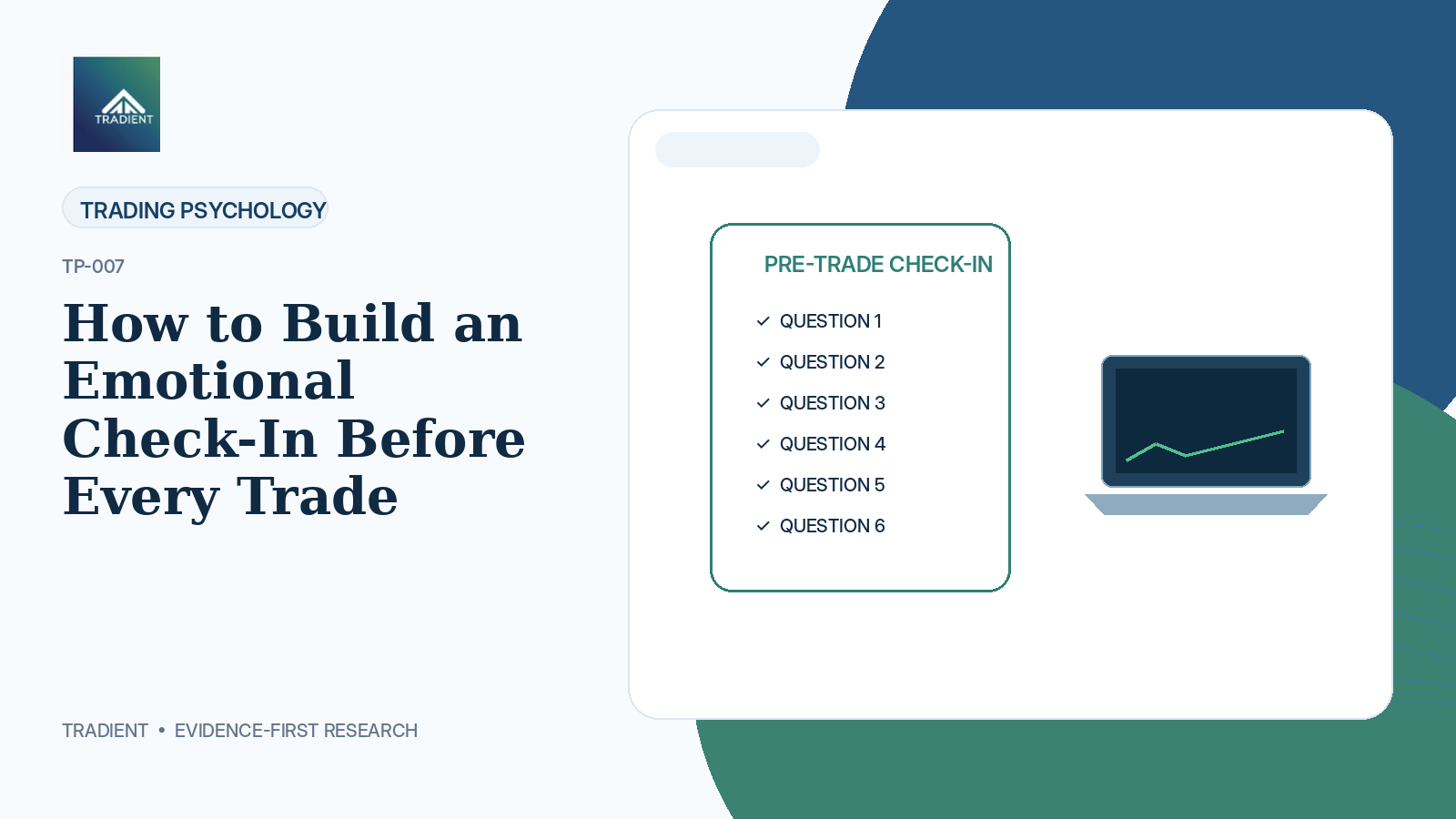
At a glance: An emotional check-in is a short risk-control step: identify the current state, compare it with the plan and decide whether the emotion is changing behaviour. It should take seconds, not become a ritual that delays every trade.
Trading journals often describe emotion after the damage is done. A pre-trade check moves the observation to the point where it can still affect risk.
The best check-in is concrete. ‘Am I calm?’ is too vague. Questions about urgency, recent losses, size and rule changes produce more actionable answers.
Question 1: Why this trade, now?
State the setup in one sentence. If the explanation is mainly ‘it is moving’ or ‘everyone is talking about it’, the trade may be driven more by urgency than by a defined edge.
A clear setup label also makes later review possible. You cannot evaluate a strategy if every trade is classified differently after the outcome is known.
Question 2: What is my emotional state?
Name the dominant state without judging it: calm, anxious, frustrated, excited, bored or eager to recover a loss. The label is not a prediction of whether the trade will win.
Its purpose is to identify conditions that have historically changed your behaviour. A trader who knows that frustration leads to size creep can treat frustration as a risk flag.
Question 3: Has recent P&L changed my standards?
Ask whether you would take exactly this setup if the previous trade had not happened. This is a powerful test after both wins and losses.
If the setup only feels acceptable because you are trying to recover, press an advantage or avoid ending the day flat, the decision is contaminated by recency.
Question 4: Can I accept the planned loss?
Before entry, convert the stop or risk condition into a rupee amount. If that amount feels intolerable, the position is too large or the trade should be skipped.
Acceptance does not mean liking a loss. It means the possible loss is within the financial and psychological range assumed by the plan.
Question 5: What would make me change the plan?
Define the legitimate reasons for changing size or exit logic after entry. New material information may justify adaptation; discomfort alone may not.
This protects the trade from post-entry bargaining while preserving room for genuine evidence.
Question 6: Is standing aside allowed?
A trading process becomes fragile when every scan must produce an order. The check-in should explicitly allow ‘no trade’ as a valid outcome.
The ability to skip a marginal setup is one of the clearest signs that opportunity and action have been separated.
A practical drill for the next 20 trades
Do not try to change the behaviour after one observation. For the next 20 relevant trades, record the trigger, the emotion or urge, the planned action and the action actually taken. Keep the form short enough that it is completed consistently.
At the end of the sample, look for repeated conditions rather than isolated stories. The purpose is to discover whether the behaviour appears after losses, after wins, at a particular time of day, at larger size or in fast-moving instruments. A repeated pattern is easier to redesign than a vague belief that discipline is weak.
- Setup grade before entry
- Planned rupee risk
- Dominant emotion or urge
- Any rule change after entry
- Process grade independent of P&L
What improvement should look like
Improvement does not require the emotion to disappear. A better standard is behavioural: keep the check-in short and behaviour-focused. The trader should be able to recognise the relevant state without automatically converting it into an order.
Track fewer rule violations, more stable position sizing and a smaller gap between planned and actual actions. Profitability is important over a meaningful sample, but process improvement can be observed earlier than the equity curve.
When to step back from live risk
If the behaviour repeatedly produces outsized losses, cancelled stops, uncontrolled leverage or an inability to follow a daily risk limit, the appropriate response may be to reduce or pause live exposure while the process is rebuilt.
Psychology work is not a justification for enduring unsafe risk. A trader should also investigate whether strategy design, platform mechanics, sleep, workload or position size is creating a problem that self-talk alone cannot solve.
Key takeaways
- Keep the check-in short and behaviour-focused.
- State the setup before naming the emotion.
- Ask whether recent P&L changed the quality threshold.
- Size the trade so the planned loss is genuinely acceptable.
- Pre-define valid reasons for changing the plan after entry.
- Make ‘no trade’ an explicit permissible outcome.
Frequently asked questions
Will a check-in make me miss fast trades?
It should be designed to take roughly 30 seconds or less. If the strategy cannot tolerate that, key checks can be built into an order template or automated risk control.
What if I am always a little nervous?
Normal nervousness is not a failure. Track whether it changes execution. The goal is behavioural consistency, not emotional perfection.
Should I score emotions numerically?
A simple 1–5 scale can help if it is used consistently. The score is useful mainly when linked to actual behaviour and outcomes.
Can this replace a trading checklist?
No. It complements the market and risk checklist. A trader can be emotionally calm and still take a technically poor trade.
This article is for educational purposes only and is not investment advice or a recommendation to buy or sell any security.
Sources and further reading