
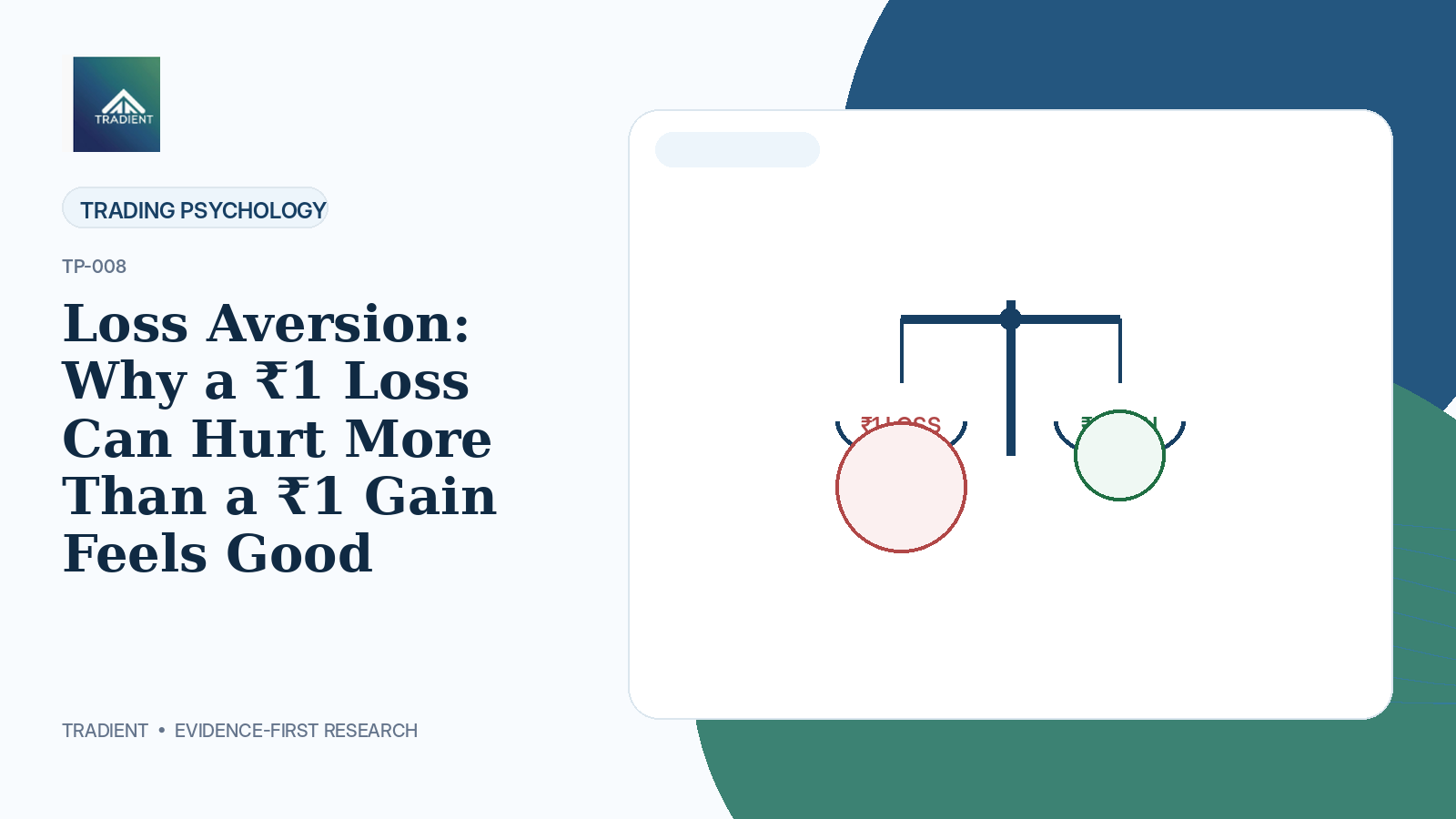
At a glance: Loss aversion is not the claim that every person always values a loss exactly twice as much as an equal gain. It is the broader behavioural tendency for losses to carry unusually strong psychological weight, which can distort decisions around exits and risk.
A trader can know intellectually that losses are part of a probabilistic strategy and still experience a small loss as a threat that demands action. That gap between knowledge and feeling is where loss aversion becomes operationally important.
The objective is not to enjoy losses. It is to design decisions so that the discomfort of loss does not rewrite the process.
Loss aversion changes the reference point
People often evaluate outcomes relative to a reference point: entry price, recent account high, yesterday’s close or an expected profit. Once the reference point is emotionally important, moving below it can feel like a distinct loss even if the broader position remains profitable.
This is why a trader can feel distressed when a ₹20,000 unrealised gain falls to ₹10,000. Economically the position is still profitable, but psychologically ₹10,000 has been ‘lost’ from the peak.
It can encourage holding losers
Selling a losing position converts an unrealised loss into a realised one. That can make delay emotionally attractive even when the original thesis has failed.
Odean’s research on the disposition effect documented the tendency of investors to realise gains more readily than losses. The behaviour is not universal in every strategy, but it is a useful warning sign for discretionary decision-making.
It can also encourage selling winners too early
A profitable position offers relief: the gain can be locked in and the possibility of watching it disappear is removed. This can produce exits that are emotionally comfortable but inconsistent with the tested strategy.
The result is an asymmetric pattern—losses are given extra time while gains are cut short—which can damage payoff structure even if the trader’s entry ideas are reasonable.
Pre-define risk before ownership changes the mind
Before entering, record the thesis, invalidation condition and maximum acceptable risk. The trader has less psychological attachment to the position at that point and can usually reason more clearly.
After entry, changes to the plan should require new evidence. This does not make the original plan infallible; it simply prevents pain from being treated as new evidence.
Measure decisions in units of process, not rupees alone
A rupee loss can feel large because of personal circumstances even when it is statistically ordinary for the strategy. Position sizing should translate strategy volatility into an amount the trader can tolerate without abandoning rules.
Journals can also express outcomes in R-multiples or another consistent risk unit, helping distinguish a normal planned loss from an unusually large process failure.
Loss aversion is managed, not eliminated
No checklist can remove the sting of loss. The practical objective is to build enough distance between the feeling and the action that rules remain stable.
Diversification, smaller size, written invalidation criteria and delayed review of non-actionable P&L can all reduce the number of opportunities for loss aversion to dominate.
A practical drill for the next 20 trades
Do not try to change the behaviour after one observation. For the next 20 relevant trades, record the trigger, the emotion or urge, the planned action and the action actually taken. Keep the form short enough that it is completed consistently.
At the end of the sample, look for repeated conditions rather than isolated stories. The purpose is to discover whether the behaviour appears after losses, after wins, at a particular time of day, at larger size or in fast-moving instruments. A repeated pattern is easier to redesign than a vague belief that discipline is weak.
- Setup grade before entry
- Planned rupee risk
- Dominant emotion or urge
- Any rule change after entry
- Process grade independent of P&L
What improvement should look like
Improvement does not require the emotion to disappear. A better standard is behavioural: loss aversion gives losses disproportionate psychological weight. The trader should be able to recognise the relevant state without automatically converting it into an order.
Track fewer rule violations, more stable position sizing and a smaller gap between planned and actual actions. Profitability is important over a meaningful sample, but process improvement can be observed earlier than the equity curve.
When to step back from live risk
If the behaviour repeatedly produces outsized losses, cancelled stops, uncontrolled leverage or an inability to follow a daily risk limit, the appropriate response may be to reduce or pause live exposure while the process is rebuilt.
Psychology work is not a justification for enduring unsafe risk. A trader should also investigate whether strategy design, platform mechanics, sleep, workload or position size is creating a problem that self-talk alone cannot solve.
Key takeaways
- Loss aversion gives losses disproportionate psychological weight.
- Reference points such as entry price or account high can intensify the feeling of loss.
- It can contribute to holding losers and selling winners too early.
- Define invalidation and risk before entering the position.
- Use consistent risk units to separate normal losses from process failures.
- The goal is stable behaviour despite discomfort, not emotional numbness.
Frequently asked questions
Does loss aversion mean losses hurt exactly twice as much as gains feel good?
No. That popular shorthand should not be treated as a universal constant. The important idea is that losses often carry asymmetric psychological weight.
Is refusing to sell a loss always irrational?
No. A position can remain valid after a price decline. The issue is whether the decision is supported by the thesis and risk plan or merely by reluctance to realise the loss.
Can stop-loss orders eliminate loss aversion?
They can automate an exit rule, but stop placement and later cancellation can still be influenced by emotion. The rule must be well designed and governed.
Do long-term investors face loss aversion too?
Yes. The bias can affect both traders and investors, though the relevant time horizon and invalidation criteria differ.
This article is for educational purposes only and is not investment advice or a recommendation to buy or sell any security.
Sources and further reading