
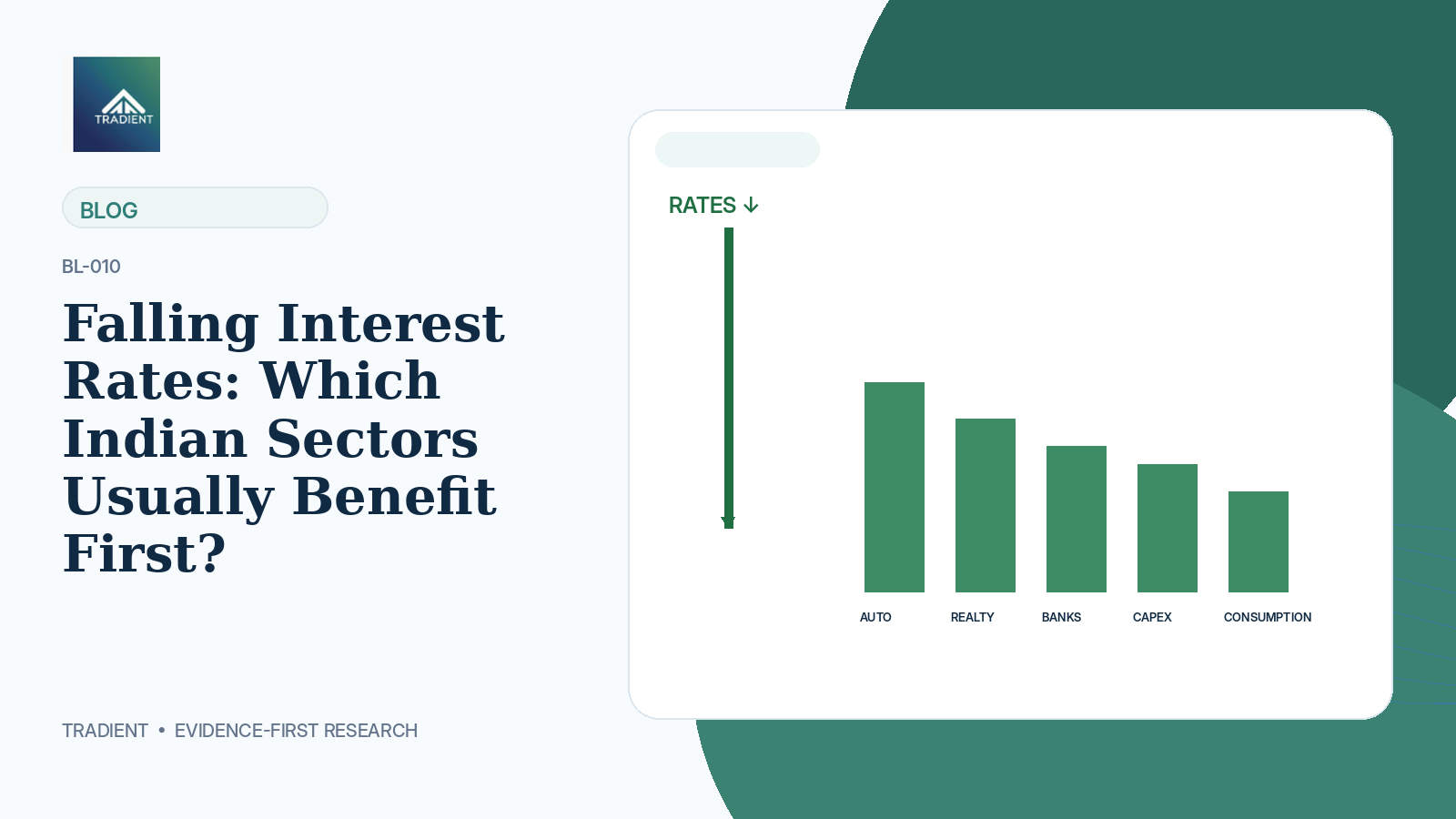
At a glance: There is no universal ‘rate-cut basket’. Falling rates change borrowing costs and valuation inputs, but the winning sectors depend on the cause of the easing cycle and how quickly policy transmits into real-world funding and demand.
The popular market narrative says lower rates help banks, autos, real estate and other rate-sensitive sectors. That can be directionally useful, but it leaves out important second-order effects.
An investor should ask four questions: why are rates falling, who has floating-rate assets or liabilities, which customers are financing-sensitive, and how much of the benefit is already priced.
Autos and consumer durables: financing can support demand
Lower loan rates can improve affordability for vehicles and high-ticket durable goods. If household incomes and confidence are stable, financing-sensitive demand can respond.
But a rate cut delivered because demand is collapsing may not be enough to offset weak income expectations. Volume response matters more than the policy headline.
Real estate: lower mortgage cost meets project fundamentals
Lower home-loan rates can improve affordability and sentiment, while developers with debt may benefit from lower funding costs.
The outcome still depends on inventory, local pricing, project execution and household confidence. Rate sensitivity is strongest when financing cost is actually a binding constraint.
Banks and NBFCs: the effect is not one-directional
Credit growth may benefit from lower borrowing rates, and borrower stress can ease. At the same time, asset yields can reprice faster than deposit or borrowing costs, compressing spreads for some lenders.
The balance depends on deposit mix, loan benchmarks, liability duration, competition and credit quality.
Utilities, infrastructure and leveraged businesses
Capital-intensive companies with meaningful debt can benefit if refinancing costs decline and project hurdle rates fall.
However, leverage magnifies risk as well as benefit. A weak project does not become strong merely because interest expense falls slightly.
Long-duration growth equities and discount rates
When market discount rates fall, distant future cash flows can become more valuable in present-value terms. This can support higher-multiple growth equities.
But valuation begins from the current price. If the market already anticipated large cuts, actual easing may not produce further multiple expansion.
Build a rate-sensitivity scorecard
- Customer financing sensitivity
- Company net debt and refinancing schedule
- Fixed versus floating-rate assets and liabilities
- Working-capital dependence
- Operating leverage and demand elasticity
- Starting valuation
- Reason for the rate decline: disinflation or growth stress
How to use this framework without making a one-variable trade
The subject in Falling Interest Rates: Which Indian Sectors Usually Benefit First? should be treated as one input into a wider market process. Before taking a position, separate the policy or structural variable from earnings, valuation, positioning, liquidity and what the market had already priced.
A useful discipline is to write a base case, an upside case and a downside case. Identify which observable data would move the probability of each case. This prevents a headline—whether a circular, RBI operation or yield move—from becoming a complete investment thesis.
- What was expected before the event?
- What actually changed?
- Which cash-flow or risk channel is affected?
- What is already reflected in valuation?
- What evidence would make the current interpretation wrong?
What to verify before acting
Use primary sources for the rule or policy itself and current exchange specifications for contract-level details. Secondary reporting can be useful for context, but a trading system should not rely on a news summary when the operative circular or specification is available.
Also check the effective date. Indian market reforms are frequently phased, and an announcement date is not always the date on which every operational provision becomes active.
Key takeaways
- Falling rates help sectors through both financing and valuation channels.
- Autos, housing and durables can benefit when financing affordability improves and demand remains healthy.
- Banks have a two-sided sensitivity because asset and liability yields reprice differently.
- Leveraged companies may benefit from lower funding cost, but business quality still matters.
- Growth-stock valuation can respond to lower discount rates.
- Always distinguish benign disinflationary easing from emergency cuts caused by weak growth.
Frequently asked questions
Which sector benefits most from a rate cut?
There is no universal answer. The impact depends on starting valuations, transmission, demand and each sector’s funding structure.
Are banks always beneficiaries?
No. Lower rates can support credit and asset quality but may compress margins depending on deposit and loan repricing.
Why do growth stocks care about rates?
A lower discount rate increases the present value of distant future cash flows, all else equal.
What is the biggest mistake in rate-cut investing?
Treating the cut as isolated information. The reason for easing and the market’s prior expectations are often more important.
Regulatory positions, exchange specifications and macroeconomic conditions can change. This article was fact-checked against the cited sources available on 3 September 2026. It is intended for educational purposes only and does not constitute legal, compliance, financial or investment advice. Readers should verify the latest official documentation before acting.
Sources and further reading