
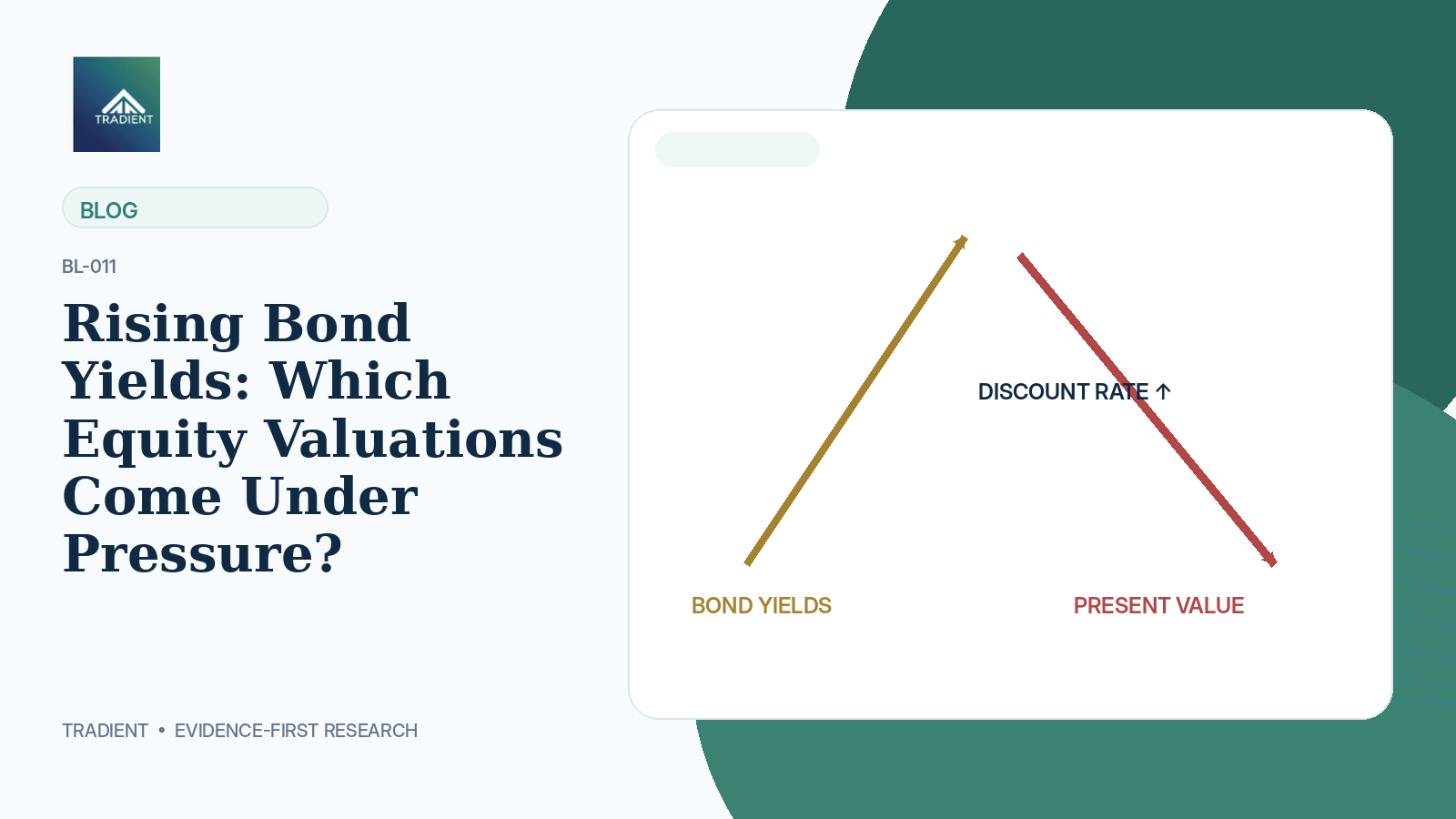
At a glance: A bond-yield rise is not automatically bearish for every stock. It changes the opportunity cost of capital and discount rate, while the reason for the yield increase determines what happens to earnings.
Equity valuation and bond yields are connected because investors compare expected returns across assets and because discounted cash-flow models use rates that are influenced by the risk-free curve.
The most important distinction is whether yields are rising because growth is improving, inflation risk is increasing, fiscal supply is changing or policy expectations are tightening. The same 50-basis-point move can have different equity implications.
Higher yields raise the valuation hurdle
When the risk-free rate rises, investors generally require more return from risky assets. All else equal, that increases the discount rate applied to future corporate cash flows and reduces present value.
The effect is strongest when much of a company’s expected value lies far in the future rather than in current cash generation.
Long-duration growth stocks can be more sensitive
A business valued on distant future profits can experience meaningful multiple compression when discount rates rise, even if near-term earnings are unchanged.
This does not mean every technology or growth company must fall. Faster earnings revisions can offset the rate effect, but the valuation burden is higher.
Highly leveraged businesses face a second channel
Rising yields can increase refinancing costs for companies whose debt reprices or matures. That can reduce free cash flow available to equity holders.
Companies with strong balance sheets, long fixed-rate debt or the ability to pass costs through may be less exposed than businesses dependent on continuous refinancing.
Banks can behave differently
Higher rates may improve asset yields, but they can also raise deposit costs, slow credit demand and increase credit risk if borrowers are stressed.
The yield-curve shape and pace of repricing therefore matter. A bank is not simply a ‘higher yields are good’ trade.
Bond-proxy equities face competition from fixed income
Stable high-dividend or utility-like equities are sometimes held partly for income. When safer bond yields rise, investors may demand a higher dividend yield or lower equity price to justify the risk.
Again, earnings growth can offset this relative-value pressure. The framework describes a valuation channel, not a deterministic price rule.
A yield-move checklist
- Which maturity on the government curve is moving?
- Is the move driven by inflation, growth, supply or policy expectations?
- How much debt must the company refinance?
- How distant are the expected cash flows supporting valuation?
- Can earnings estimates rise enough to offset multiple pressure?
- What return is now available on lower-risk alternatives?
How to use this framework without making a one-variable trade
The subject in Rising Bond Yields: Which Equity Valuations Come Under Pressure? should be treated as one input into a wider market process. Before taking a position, separate the policy or structural variable from earnings, valuation, positioning, liquidity and what the market had already priced.
A useful discipline is to write a base case, an upside case and a downside case. Identify which observable data would move the probability of each case. This prevents a headline—whether a circular, RBI operation or yield move—from becoming a complete investment thesis.
- What was expected before the event?
- What actually changed?
- Which cash-flow or risk channel is affected?
- What is already reflected in valuation?
- What evidence would make the current interpretation wrong?
What to verify before acting
Use primary sources for the rule or policy itself and current exchange specifications for contract-level details. Secondary reporting can be useful for context, but a trading system should not rely on a news summary when the operative circular or specification is available.
Also check the effective date. Indian market reforms are frequently phased, and an announcement date is not always the date on which every operational provision becomes active.
Key takeaways
- Higher bond yields generally raise the equity return hurdle and discount rate.
- Long-duration valuations are more sensitive to discount-rate changes.
- Leverage adds a refinancing-cost channel.
- Banks have mixed exposure through assets, deposits, credit growth and quality.
- Income-oriented equities can face stronger competition from bonds.
- Interpret the cause and maturity of the yield move before making a sector call.
Frequently asked questions
Do stocks always fall when bond yields rise?
No. Strong growth and earnings revisions can outweigh valuation compression, especially when yields rise for benign growth reasons.
Which yield should equity investors watch?
The relevant curve depends on the valuation horizon, but government-bond yields across maturities provide the risk-free reference. Avoid relying on one point alone.
Why are growth stocks called long-duration?
A larger share of their estimated value may come from cash flows far in the future, which are more sensitive to discount-rate changes.
Can banks benefit from rising rates?
They can, but deposit repricing, credit demand and asset quality determine the net effect.
Regulatory positions, exchange specifications and macroeconomic conditions can change. This article was fact-checked against the cited sources available on 3 September 2026. It is intended for educational purposes only and does not constitute legal, compliance, financial or investment advice. Readers should verify the latest official documentation before acting.
Sources and further reading