
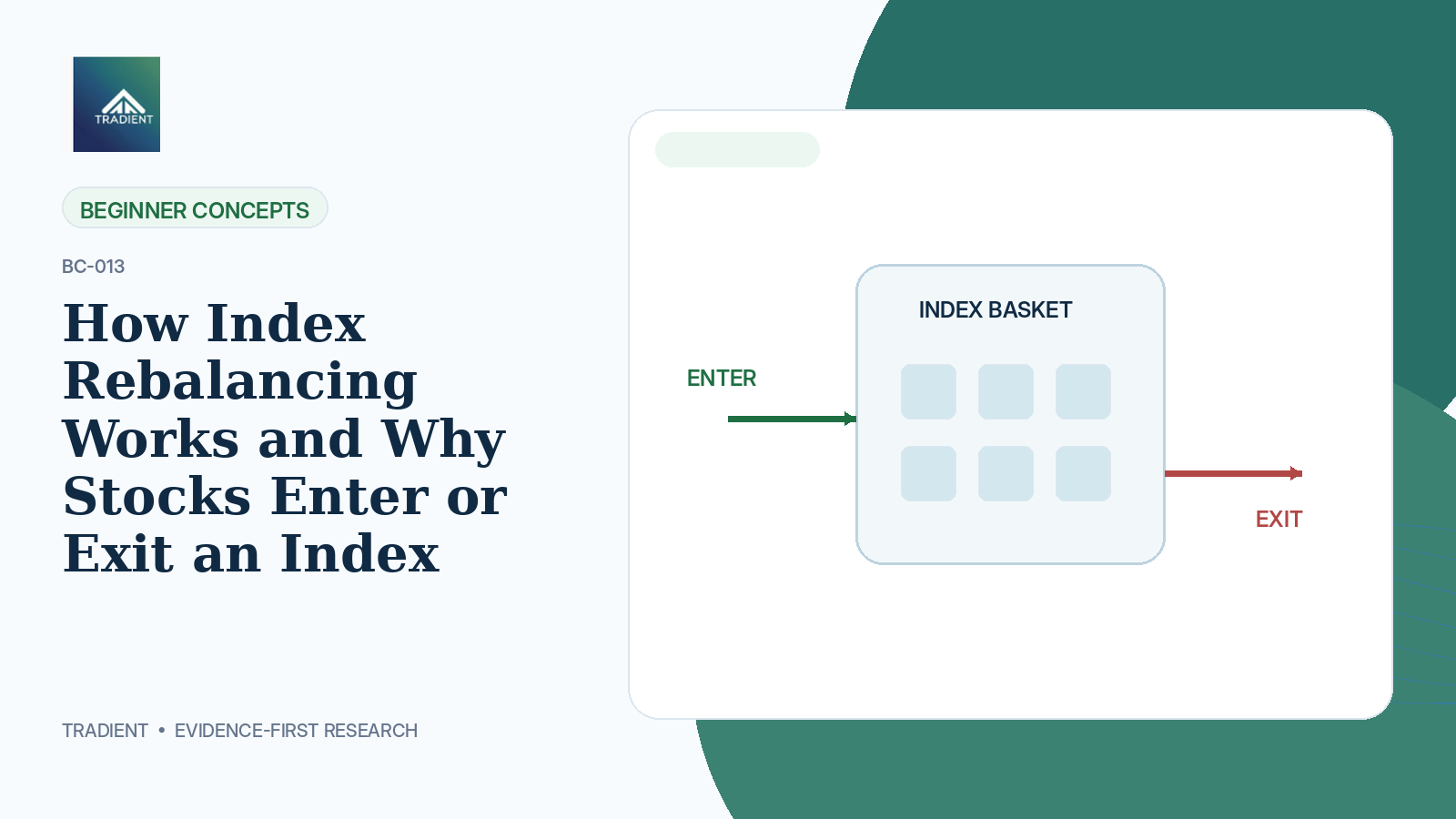
At a glance: An index is maintained under a methodology, not frozen forever. At scheduled reviews the provider checks eligibility and may change constituents or weights so the benchmark continues to represent its stated market segment.
Headline index changes often attract dramatic commentary: one company is ‘promoted’ into a benchmark while another is ‘removed’. The language can make the event sound like a verdict on corporate quality. In reality, index changes are primarily the result of a published methodology.
Understanding rebalancing helps investors separate mechanical index effects from fundamental business analysis. It also explains why passive funds can generate predictable trading demand around an effective date.
Index construction begins with eligibility rules
Every serious index has a defined universe and selection rules. These can include listing history, free-float market capitalisation, liquidity, trading frequency, sector classification or other criteria appropriate to the benchmark.
A company can be profitable and well managed yet fail an index rule. Conversely, index inclusion does not certify that a share is attractively valued or suitable for every investor.
Review is different from continuous price movement
Index values move whenever constituent prices move, but constituent membership is usually reviewed on a defined schedule. At a review date, the index provider uses the methodology and relevant data cut-offs to determine whether changes are required.
Some methodologies include buffers designed to reduce unnecessary turnover. A stock may need to exceed a threshold by a meaningful margin before replacing an existing constituent, which helps keep the benchmark investable and stable.
What happens when a stock enters or exits?
On the announced effective date, the index portfolio changes. An entering stock receives a weight and an exiting stock’s weight falls to zero. The remaining weights are recalculated according to the methodology.
Funds that explicitly track the index must adjust their portfolios so their holdings continue to match the benchmark. That can create buying demand for additions and selling demand for deletions, especially in widely tracked indices.
Why passive flows can affect prices
Index funds and ETFs attempt to minimise tracking error. When a benchmark changes, they cannot simply ignore the event because their mandate is to replicate the new index composition.
Markets often anticipate announced changes, so part of the expected flow can be reflected in prices before the effective date. The final auction or closing session can still show elevated volume, but an index event is not a guarantee of a lasting price rise or fall.
Free float and weight changes matter too
Rebalancing is not only about entries and exits. A constituent’s free-float factor, capped weight or shares used in the index calculation can also change under the rules.
For a free-float market-capitalisation index, changes in publicly available float or relative market value can alter weights even when every constituent remains the same.
Do not confuse index inclusion with investment merit
A benchmark answers a measurement question: which securities represent this segment under the methodology? An investor asks additional questions about valuation, business quality, balance-sheet risk, competitive position and expected return.
Index membership can improve visibility and passive ownership, but it does not eliminate downside risk. History contains many index constituents that later underperformed or were eventually removed.
How to use this concept when reading the market
Treat how index rebalancing works and why stocks enter or exit an index as a framework rather than a prediction. When you see the concept mentioned in a market headline, identify the exact variable being measured, the relevant time period and the institution or methodology behind the number.
Then connect it to the decision you are actually making. A benchmark concept may help you compare performance; a market-structure concept may explain how an order is processed; a valuation concept may help you interpret a ratio. The concept is useful only when it improves the quality of a specific question.
- Indices are maintained under published methodologies and scheduled reviews.
- Stocks enter or exit because eligibility and ranking rules change, not because the provider is issuing a buy or sell recommendation.
- Check the current official methodology or rule when the definition can change.
- Separate what the measure tells you from what it does not tell you.
Common beginner mistakes to avoid
A common mistake is converting a descriptive market concept into a buy-or-sell signal. Indices, liquidity measures, exchange rules and return calculations describe part of the system; they do not by themselves establish expected return.
Another mistake is memorising a current constituent count, lot size, weight or operational rule and treating it as permanent. Market infrastructure and index methodologies are maintained over time. Build the habit of checking the latest primary source when precision matters.
A five-minute verification routine
- Identify the official source: SEBI, NSE, BSE/NSE Indices, depository or issuer as relevant.
- Confirm the date of the factsheet, circular or methodology.
- Check whether the figure is price return, total return, free-float weighted or another defined measure.
- Write one sentence describing what the number does not prove.
- Only then connect the concept to a portfolio, trading or research decision.
Key takeaways
- Indices are maintained under published methodologies and scheduled reviews.
- Stocks enter or exit because eligibility and ranking rules change, not because the provider is issuing a buy or sell recommendation.
- Passive funds must adapt to benchmark changes, which can create mechanical flows.
- Markets may anticipate additions and deletions before the effective date.
- Weights can change even without constituent changes.
- Always distinguish benchmark mechanics from fundamental investment analysis.
Frequently asked questions
Does a stock always rise after index inclusion?
No. Inclusion can create passive demand, but price performance still depends on expectations, valuation, market conditions and how much of the event was anticipated.
Why would a good company leave an index?
It may fall below size or liquidity thresholds, be displaced by a larger eligible company, change classification, merge, delist or fail another methodology rule.
Do active investors have to rebalance when an index changes?
No. An active portfolio may use the index only as a benchmark and can choose different holdings, subject to its mandate.
Where can I see upcoming index changes?
Use official announcements and methodology pages from the relevant index provider, such as NSE Indices or BSE Indices.
This article is for educational purposes only and is not investment advice or a recommendation to buy or sell any security.
Sources and further reading