
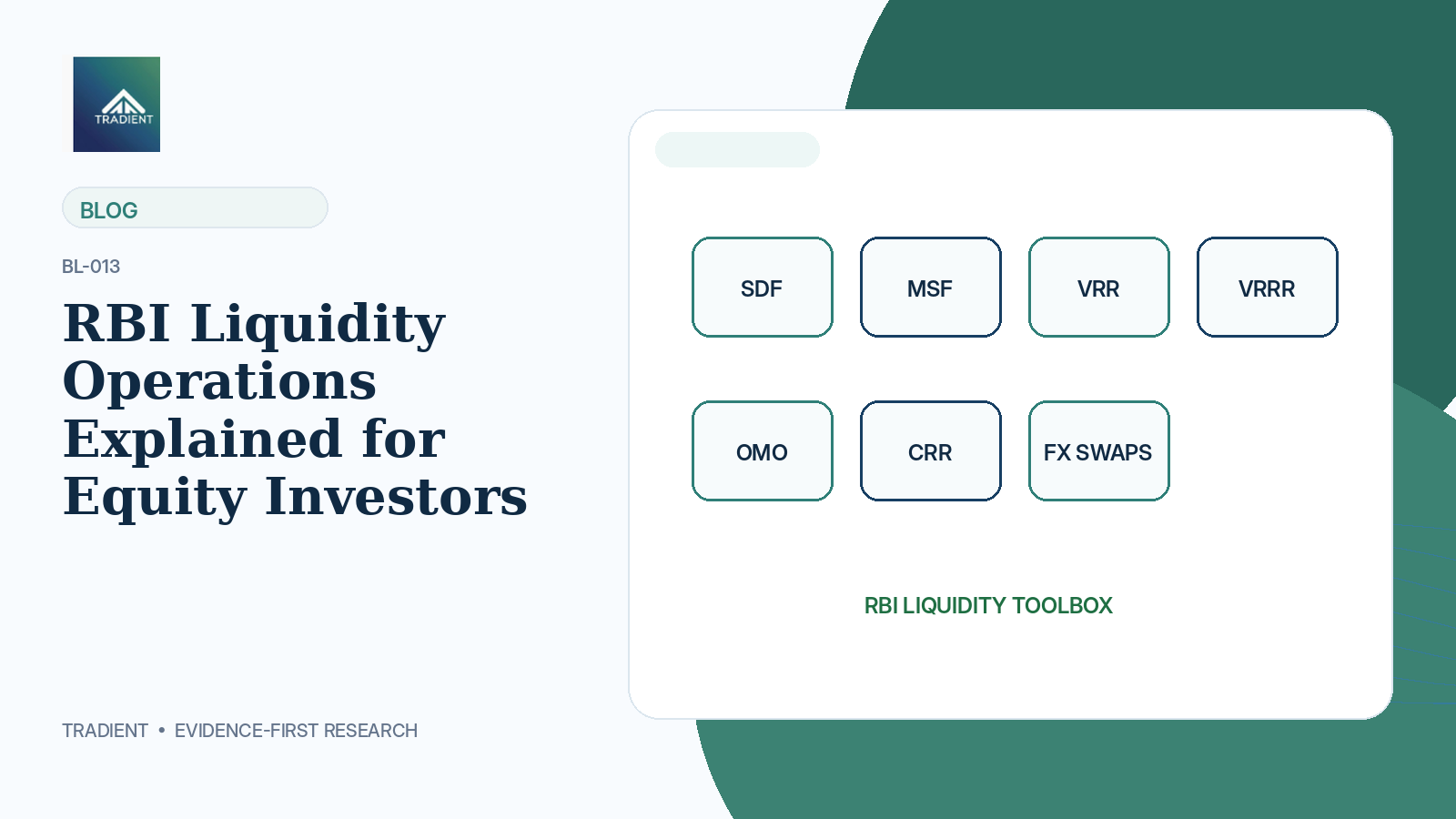
At a glance: An RBI liquidity operation is not automatically a change in the monetary-policy stance. Many operations are designed to keep money-market conditions aligned with the existing stance by offsetting temporary or durable liquidity imbalances.
When RBI announces a repo auction, OMO purchase or foreign-exchange swap, market headlines often translate it immediately into ‘liquidity injection’ or ‘liquidity withdrawal’. That is directionally useful but incomplete.
The investor needs to know which instrument was used, whether the liquidity effect is temporary or durable, and what problem RBI was addressing.
SDF: the standing absorption floor
The Standing Deposit Facility allows eligible banks to place surplus liquidity with RBI without the need for collateral. It forms the floor of the operating corridor.
When system liquidity is abundant, use of the facility can absorb overnight surplus while keeping the short-term rate structure consistent with policy.
MSF: the standing injection ceiling
The Marginal Standing Facility provides an overnight borrowing backstop to eligible banks at a rate above the policy repo rate, subject to the framework and collateral conditions.
It is designed as a safety valve for unexpected liquidity needs rather than a normal source of cheap funding.
Variable-rate repo and reverse repo
RBI can conduct variable-rate repo operations to inject liquidity for specified tenors and variable-rate reverse-repo operations to absorb it.
These auctions are flexible tools for frictional conditions and can be sized and timed according to RBI’s assessment of system liquidity.
Open-market operations for durable liquidity
Outright purchases of government securities add durable rupee liquidity, while outright sales can absorb it. OMOs also interact with the bond market because RBI becomes a buyer or seller of sovereign securities.
That means the operation can affect both system cash and the government yield curve.
CRR and FX swaps are powerful system tools
A change in the Cash Reserve Ratio directly alters how much cash banks must maintain with RBI, producing a durable liquidity effect.
Foreign-exchange swaps can also add or absorb rupee liquidity while addressing FX-market conditions. Their interpretation therefore requires both currency and money-market context.
How equity investors should read an operation
- Was the operation temporary or durable?
- Was it routine fine-tuning or a response to stress?
- How did WACR and government yields react?
- What did it imply for bank funding conditions?
- Did the operation change policy stance or merely improve transmission?
- Was the equity reaction consistent with earnings fundamentals or only a liquidity narrative?
How to use this framework without making a one-variable trade
The subject in RBI Liquidity Operations Explained for Equity Investors should be treated as one input into a wider market process. Before taking a position, separate the policy or structural variable from earnings, valuation, positioning, liquidity and what the market had already priced.
A useful discipline is to write a base case, an upside case and a downside case. Identify which observable data would move the probability of each case. This prevents a headline—whether a circular, RBI operation or yield move—from becoming a complete investment thesis.
- What was expected before the event?
- What actually changed?
- Which cash-flow or risk channel is affected?
- What is already reflected in valuation?
- What evidence would make the current interpretation wrong?
What to verify before acting
Use primary sources for the rule or policy itself and current exchange specifications for contract-level details. Secondary reporting can be useful for context, but a trading system should not rely on a news summary when the operative circular or specification is available.
Also check the effective date. Indian market reforms are frequently phased, and an announcement date is not always the date on which every operational provision becomes active.
Key takeaways
- Liquidity operations implement and support monetary policy; they do not all change the stance.
- SDF absorbs overnight surplus and MSF provides a standing liquidity backstop.
- Variable-rate repo/reverse-repo auctions manage short-term mismatches.
- OMOs, CRR and some FX operations can have durable system-liquidity effects.
- Interpret each operation through money-market and bond-market transmission.
- Equity investors should avoid treating every injection headline as automatically bullish.
Frequently asked questions
Is an OMO purchase the same as a repo-rate cut?
No. An OMO changes durable liquidity and government-securities holdings; the policy repo rate is a separate MPC decision.
What is the difference between repo and MSF?
Repo operations are part of RBI’s liquidity toolkit, while MSF is a standing overnight facility at the upper end of the corridor for eligible banks.
Why would RBI absorb liquidity?
To keep short-term money-market rates aligned with the stance and prevent persistent surplus from distorting transmission or financial conditions.
Do FX swaps affect equities?
They can influence rupee liquidity, currency conditions and yields, but the equity impact depends on context and expectations.
Regulatory positions, exchange specifications and macroeconomic conditions can change. This article was fact-checked against the cited sources available on 3 September 2026. It is intended for educational purposes only and does not constitute legal, compliance, financial or investment advice. Readers should verify the latest official documentation before acting.
Sources and further reading