
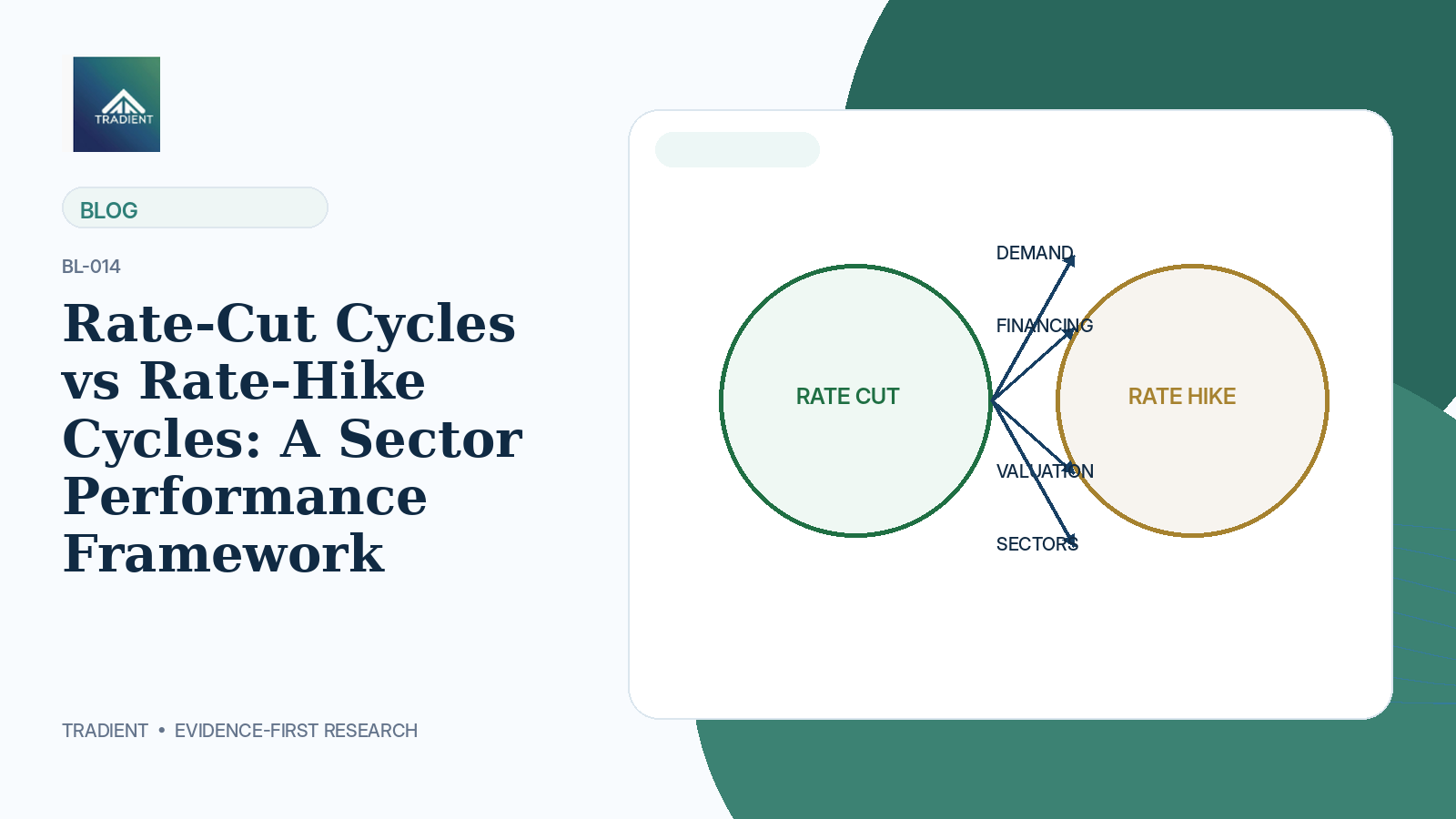
At a glance: The direction of policy rates is only one variable. Sector performance depends on why the cycle is changing, how much was already priced and whether earnings respond faster or slower than valuation multiples.
Investors like regime tables because they simplify complexity: ‘buy banks on hikes’ or ‘buy real estate on cuts’. Real cycles are messier.
A better framework starts with economic transmission channels and then asks which companies have the strongest exposure. That makes the analysis reusable when the next rate cycle differs from the last one.
Channel 1: customer financing sensitivity
Autos, housing and consumer durables can respond when loan affordability changes. Falling rates may support demand; rising rates can raise monthly payments and reduce affordability.
The effect is strongest when financing cost is a major purchase constraint and household income remains stable.
Channel 2: corporate funding and leverage
Capital-intensive and highly leveraged businesses can benefit when refinancing cost falls and face pressure when it rises.
Debt maturity, fixed-versus-floating mix and access to capital markets determine how quickly policy changes reach the income statement.
Channel 3: bank assets, liabilities and credit quality
Banks sit in the middle of transmission. Higher rates can lift asset yields but also increase deposit costs and borrower stress. Lower rates can support credit demand while compressing spreads.
Sector performance therefore depends on margin starting point, deposit franchise, loan mix and asset quality—not simply the sign of the rate move.
Channel 4: discount rates and equity duration
Lower discount rates can support high-duration growth valuations; higher rates can compress them. This channel matters even for companies with little debt.
The sensitivity is greatest when much of the valuation rests on cash flows expected far into the future.
Channel 5: the reason for the cycle
A rate-cut cycle caused by benign disinflation and stable growth can be supportive for risk assets. A rate-cut cycle caused by severe recession may coincide with falling earnings.
Likewise, hikes during strong nominal growth can produce different sector outcomes from hikes forced by an inflation shock and collapsing margins.
A reusable sector matrix
- Banks/NBFCs: margin repricing + credit growth + asset quality
- Autos/consumer durables: financing affordability + income confidence
- Real estate: mortgage rates + developer funding + inventory
- Utilities/infrastructure: debt cost + regulated returns + project pipeline
- IT/growth: discount-rate sensitivity + global demand + currency
- FMCG: pricing power + rural/urban demand + input inflation
- Industrials: capex cycle + working capital + commodity costs
Do not confuse cycle labels with timing signals
Markets often price an expected cycle months before the first official rate change. By the time a cut arrives, rate-sensitive sectors may already have rerated.
Use the framework to organise scenario analysis, then combine it with valuation, earnings revisions and market expectations.
How to use this framework without making a one-variable trade
The subject in Rate-Cut Cycles vs Rate-Hike Cycles: A Sector Performance Framework should be treated as one input into a wider market process. Before taking a position, separate the policy or structural variable from earnings, valuation, positioning, liquidity and what the market had already priced.
A useful discipline is to write a base case, an upside case and a downside case. Identify which observable data would move the probability of each case. This prevents a headline—whether a circular, RBI operation or yield move—from becoming a complete investment thesis.
- What was expected before the event?
- What actually changed?
- Which cash-flow or risk channel is affected?
- What is already reflected in valuation?
- What evidence would make the current interpretation wrong?
What to verify before acting
Use primary sources for the rule or policy itself and current exchange specifications for contract-level details. Secondary reporting can be useful for context, but a trading system should not rely on a news summary when the operative circular or specification is available.
Also check the effective date. Indian market reforms are frequently phased, and an announcement date is not always the date on which every operational provision becomes active.
Key takeaways
- Sector responses to rate cycles operate through demand, funding, bank margins, credit quality and valuation.
- The reason for the rate cycle can matter more than the direction alone.
- Banks have complex two-sided exposure.
- Leveraged and financing-sensitive sectors transmit rate changes through cash flows.
- Long-duration equities transmit them through discount rates.
- Market pricing often leads the first policy action, so valuation and expectations remain essential.
Frequently asked questions
Which sectors usually lead after the first rate cut?
There is no stable universal ranking. Markets may have anticipated the cut, and the growth context changes which sectors benefit.
Are rate hikes always bad for banks?
No. Asset yields can improve, but deposit cost and credit risk can rise. The net effect varies by bank and stage of the cycle.
How should I use this framework?
Score each sector or company on financing sensitivity, leverage, pricing power, demand elasticity, discount-rate duration and starting valuation.
What is the biggest regime mistake?
Assuming the next cycle will reproduce the last one. Regulatory structure, balance sheets, inflation and valuations can all be different.
Regulatory positions, exchange specifications and macroeconomic conditions can change. This article was fact-checked against the cited sources available on 3 September 2026. It is intended for educational purposes only and does not constitute legal, compliance, financial or investment advice. Readers should verify the latest official documentation before acting.
Sources and further reading