
Beginner Concepts
At a glance: Understand slippage in trading: why your fill can differ from the quoted price, how spreads, market depth, volatility and order size affect execution, and how to manage it.
Last reviewed: 14 September 2026
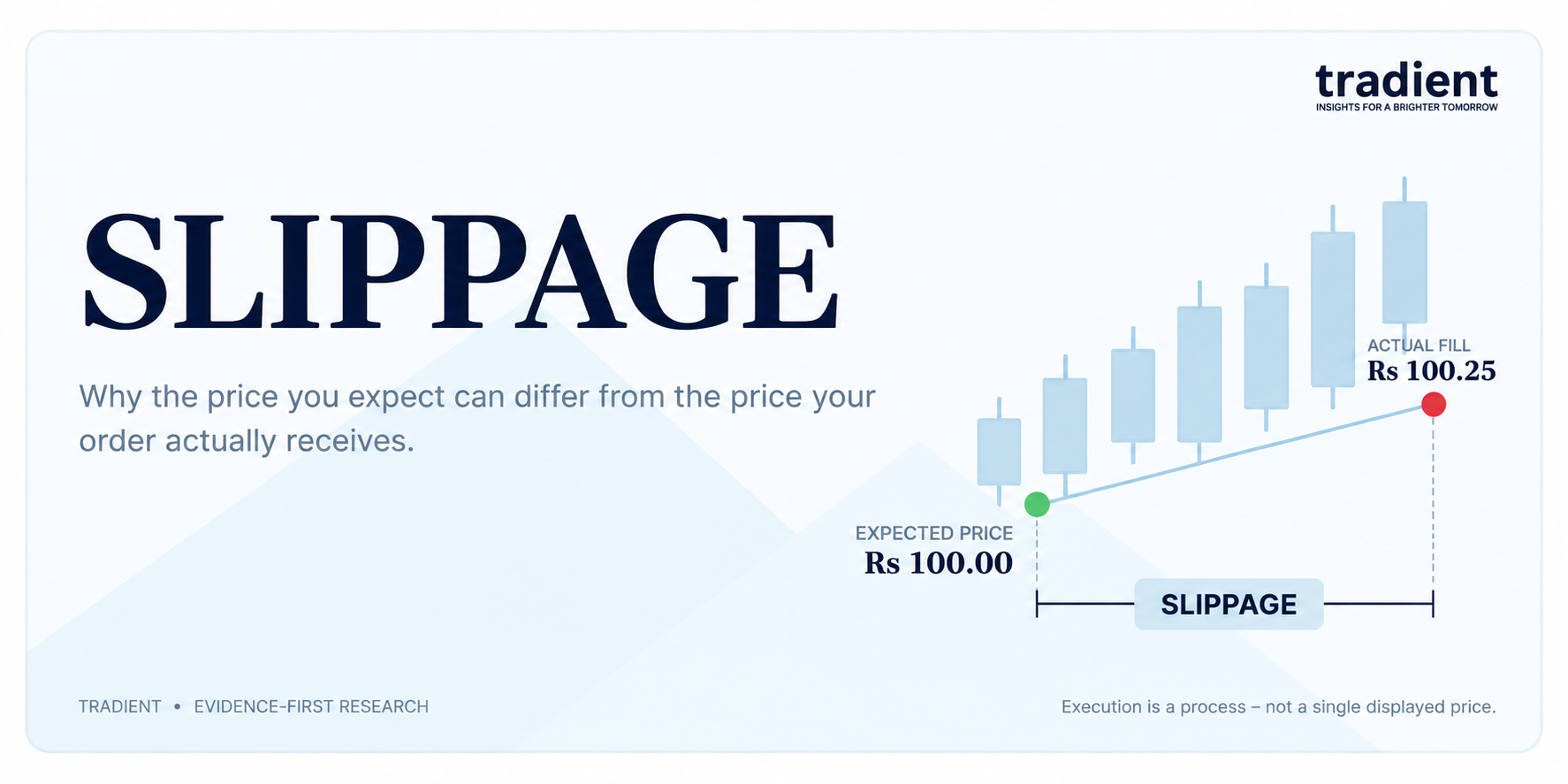
You click buy while the screen shows Rs 500, but your completed trade shows an average price of Rs 500.35. That difference is not automatically an error. It may be slippage – the gap between the price you expected and the price at which the order was actually executed.
Slippage is a feature of real markets because quotes change, liquidity is finite and orders consume available quantity. It becomes most visible during fast markets, in less-liquid securities and when the order is large relative to the quantity resting near the best bid or ask.
Quick Take
- Slippage is the difference between expected execution price and actual fill price.
- The bid-ask spread is one source of execution cost, but slippage can extend beyond the spread.
- Large orders may consume several price levels and create market impact.
- Volatility and latency can move quotes between decision and execution.
- Limit orders control the worst acceptable price but can create non-execution risk.
Slippage starts with an expectation
Every discussion of slippage needs a benchmark: the last traded price, best ask, best bid, midpoint or a modelled ‘ideal’ price. Different benchmarks produce different measured slippage.
For a buyer, paying above the relevant benchmark is adverse slippage. Paying below it is favourable slippage. For a seller, the signs reverse.
Spread is not the same as slippage
BC-025 explains that the bid and ask are different prices. Crossing from the bid side to the ask side already creates an immediate execution cost relative to the midpoint.
Slippage is broader. Even after accounting for the current ask, a buy order can execute higher if available quantity at the best ask is insufficient or the market moves before the order reaches the book.
Market depth turns size into price impact
Suppose the best ask is Rs 100.00 for 500 shares, the next ask is Rs 100.10 for 1,000 shares and the next is Rs 100.25 for 2,000 shares. A marketable buy for 200 shares may fill entirely at Rs 100.00. A buy for 2,000 shares may consume several levels and produce an average fill above Rs 100.00.
NSE describes impact cost as the transaction cost attributable to market liquidity. The concept captures the fact that larger trades can move away from an ideal price when liquidity is limited.
A simple execution example
| Order size | Illustrative average fill | Interpretation |
|---|---|---|
| 200 shares | Rs 100.00 | Fits inside best ask quantity; little additional slippage. |
| 800 shares | About Rs 100.04 | Consumes best ask and part of next level. |
| 2,000 shares | Above Rs 100.10 | Walks through multiple price levels. |
| Very large order | Potentially much higher | Execution depends on deeper liquidity and new orders arriving. |
Why slippage increases in fast markets
When volatility rises, prices can change between the moment you observe a quote and the moment the order reaches the matching engine. Even milliseconds matter for automated participants; for a retail investor, network delay, app processing and human reaction can all widen the gap.
News events, opening auctions, sharp breakouts and thinly traded periods can therefore produce more variable fills.
Order type changes the trade-off
A market order prioritises execution and accepts the best available prices. A limit order prioritises price and refuses to execute beyond the specified boundary. That can reduce adverse slippage, but it introduces a different risk: the order may fill only partly or not at all.
There is no universally superior choice. The correct decision depends on liquidity, urgency, order size and the cost of missing the trade.
Measuring your own slippage
- Record the quote or benchmark visible when the decision was made.
- Record order type, size, time sent and average fill.
- Calculate the difference in rupees and basis points.
- Separate spread cost from deeper market impact where possible.
- Compare slippage by security, time of day, volatility regime and order size.
- Use the data to decide whether execution rules or order sizing need adjustment.
Ways to manage slippage without pretending it can be eliminated
Trade liquid securities when strategy permits, avoid making order size large relative to visible depth, use limit prices when a worst-case price matters, and be cautious around known volatility events. Splitting an order can reduce immediate impact, but it can also expose the investor to price movement while the remaining quantity waits.
The objective is not zero slippage. The objective is predictable execution cost that is small enough for the strategy’s expected edge.
Key Takeaways
- Slippage is an execution outcome, not simply the bid-ask spread.
- Order size relative to market depth is a major driver of market impact.
- Volatility and latency can move prices before execution.
- Limit orders control price but cannot guarantee a fill.
- Tracking realised slippage is part of serious performance measurement.
FAQs
Is slippage always bad?
No. A trade can receive favourable slippage, although traders usually focus on adverse slippage because it reduces realised performance.
Why did I pay more than the last traded price?
The last trade may no longer represent available liquidity. Your buy executes against current asks, which can be higher.
Can a limit order eliminate slippage?
It can prevent execution beyond the limit price, but it cannot guarantee execution or prevent all differences relative to an earlier benchmark.
Is slippage more important for large orders?
Usually yes, because larger orders are more likely to consume several price levels or represent a meaningful share of available liquidity.
This article is for educational purposes only and is not investment advice or a recommendation to buy or sell any security.