
AT A GLANCE
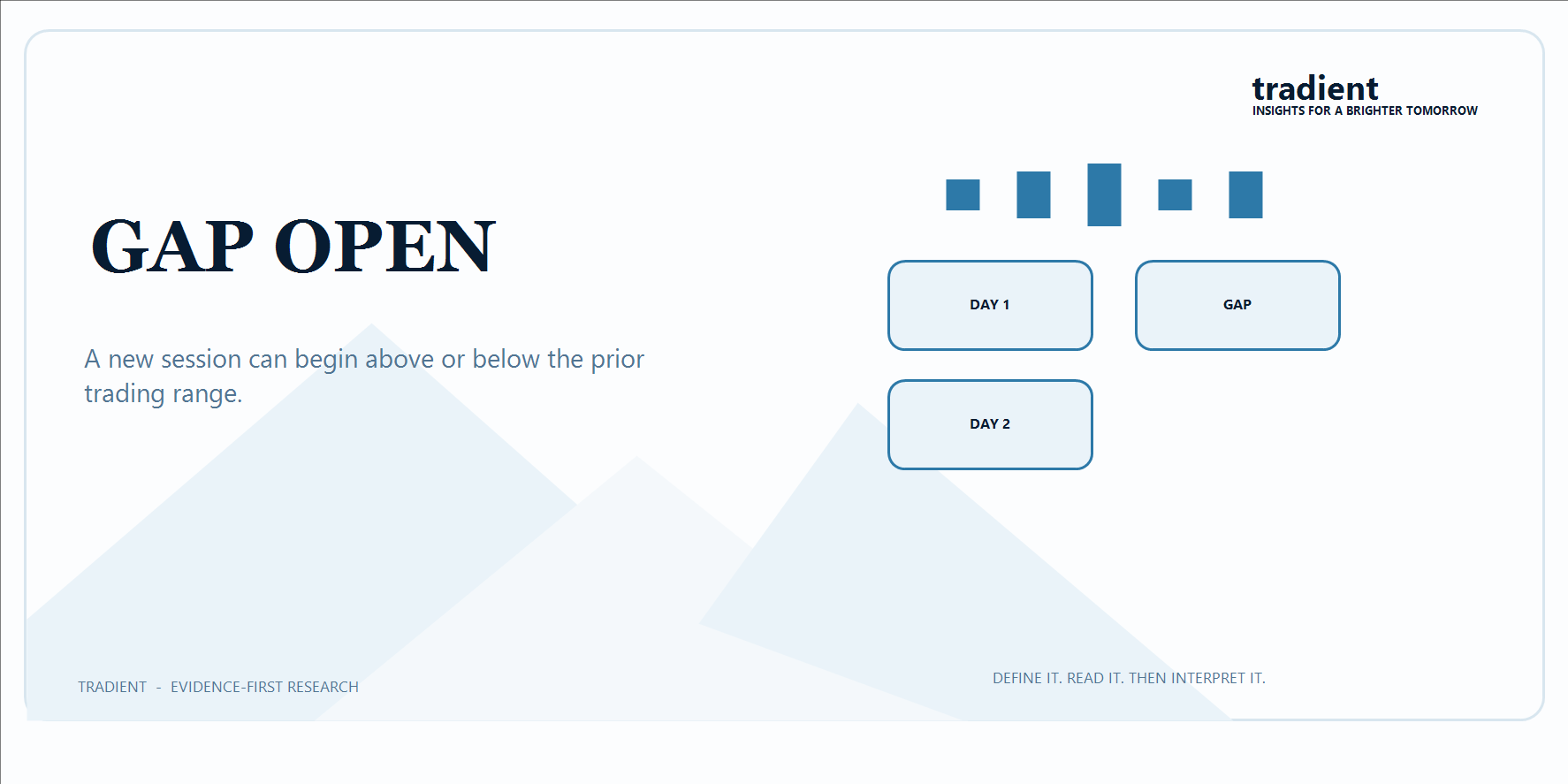
- A gap occurs when a new session opens above the prior session's high/close area or below it, leaving little or no trading in between.
- Gaps can reflect overnight news, global market moves, order imbalances or repricing after information arrives.
- Some gaps fill quickly while others begin sustained trends; there is no universal 'all gaps must fill' rule.
Last reviewed: 17 September 2026
A gap occurs when a new session opens above the prior session's high/close area or below it, leaving little or no trading in between.
The useful way to approach this topic is to separate the definition from the story traders or investors may attach to it. A good analytical framework first asks what is being measured, then checks the relevant timeframe, and only then considers what the observation might imply.
What the concept tells you
Gaps can reflect overnight news, global market moves, order imbalances or repricing after information arrives.
Some gaps fill quickly while others begin sustained trends; there is no universal ‘all gaps must fill’ rule.
Risk is higher around gaps because execution may occur far from a prior stop or reference price.
Worked example
Imagine two observations that look similar at first glance. The correct interpretation depends on the definition above, the measurement period and the surrounding context. Rather than asking whether the concept is automatically bullish or bearish, ask what changed, over what interval, and what other evidence confirms or contradicts it.
This is the habit that turns a market term into a usable analytical tool.
A simple way to use the concept
- Start with the definition before interpreting the chart or number.
- Compare the observation with the correct timeframe and recent context.
- Avoid turning a descriptive measure into a prediction it was never designed to make.
- Use the concept together with risk management and a broader decision process.
How to build the habit
The most useful beginner habit is to describe what the data shows before deciding what it means. Write down the observation in plain language, identify the timeframe, and note what evidence would confirm or contradict your interpretation. This prevents a familiar market term from becoming a shortcut for an unsupported prediction.
Over time, the same disciplined sequence—define, observe, compare, then decide—makes chart reading and return analysis more consistent. It also makes mistakes easier to review because the reasoning is visible rather than hidden inside intuition.
How to check your understanding
A useful test of Gap-Up and Gap-Down Openings Explained is whether you can explain the idea in plain language without relying on jargon. Start by naming what is being measured, then identify the relevant timeframe, and finally state what the observation can and cannot tell you. That sequence matters because many beginner mistakes come from jumping directly from a chart feature or return number to a prediction.
When you practise the concept, use two contrasting examples rather than only one. Ask what would change if the timeframe were shorter, the market were more volatile, or the surrounding price structure were different. For the price, charts & volume topics in this series, the goal is not to memorise a label. It is to build a repeatable reading process that remains useful when the market looks different from the textbook example.
Common mistakes to avoid
- Treating one observation as a complete trading or investing signal.
- Ignoring timeframe, market regime or the definition of the underlying data.
- Using a concept after the fact to justify a decision that was not planned beforehand.
- Assuming that a useful framework removes uncertainty. It does not; it helps organise uncertainty.
Key takeaways
- A gap occurs when a new session opens above the prior session's high/close area or below it, leaving little or no trading in between.
- Gaps can reflect overnight news, global market moves, order imbalances or repricing after information arrives.
- Some gaps fill quickly while others begin sustained trends; there is no universal 'all gaps must fill' rule.
- Risk is higher around gaps because execution may occur far from a prior stop or reference price.
This article is for educational purposes only and is not investment advice or a recommendation to buy or sell any security.
Sources and further reading
- NSE India — Exchange and market-structure conventions.
- SEBI Investor resources — Investor education and market basics.