
AT A GLANCE
- Checklists reduce reliance on memory when attention is narrow or the market is moving quickly.
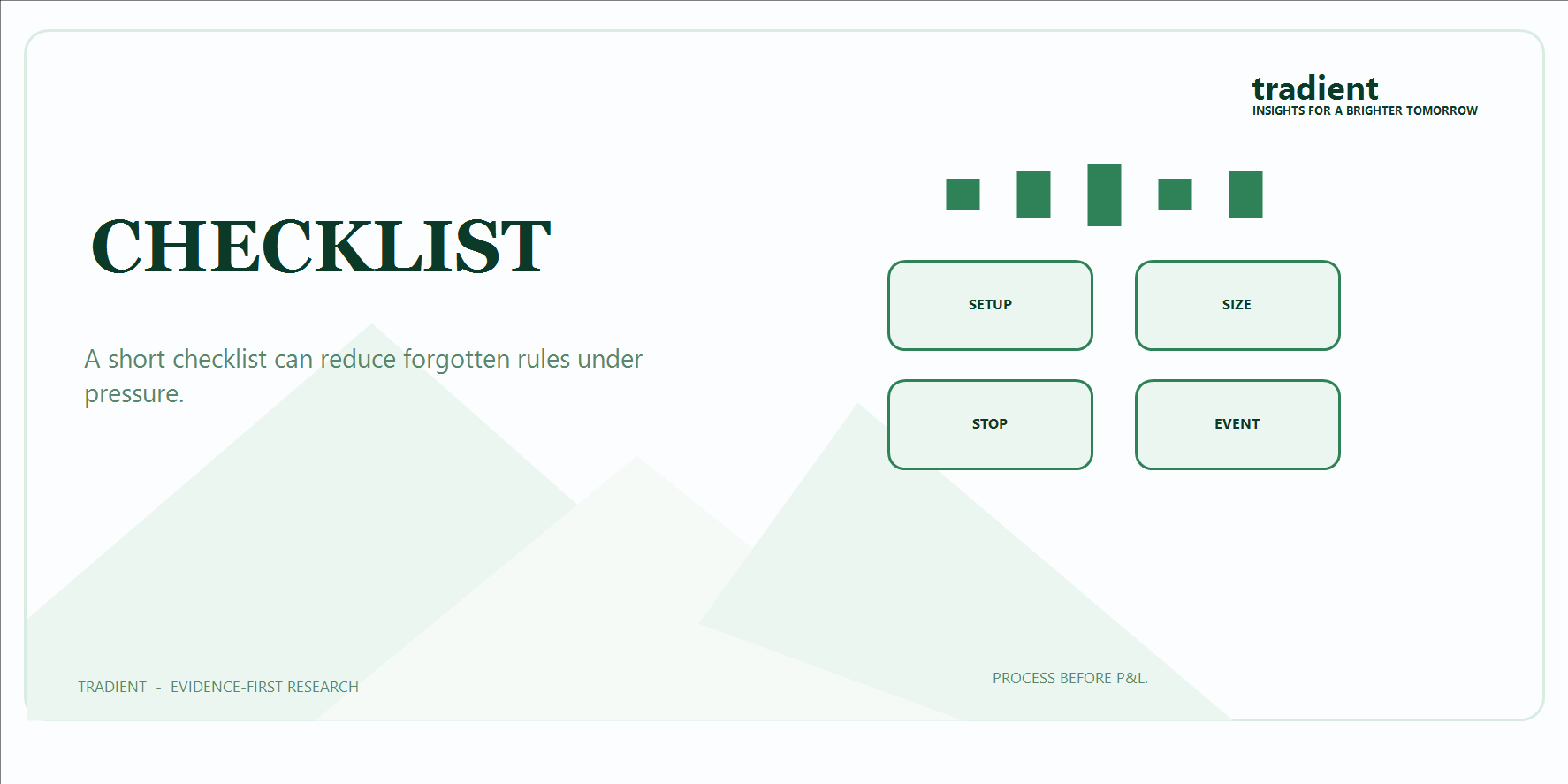
- A practical checklist should be short: setup valid, risk defined, size correct, invalidation known, event risk checked.
- Too many items can turn a checklist into paperwork that traders ignore.
Last reviewed: 17 September 2026
Checklists reduce reliance on memory when attention is narrow or the market is moving quickly.
The useful way to approach this topic is to separate the definition from the story traders or investors may attach to it. A good analytical framework first asks what is being measured, then checks the relevant timeframe, and only then considers what the observation might imply.
Why this matters for decision quality
A practical checklist should be short: setup valid, risk defined, size correct, invalidation known, event risk checked.
Too many items can turn a checklist into paperwork that traders ignore.
The value comes from consistent use and post-trade review of missed steps.
Example: separating outcome from process
Suppose a trader follows the written plan, sizes correctly and takes a valid setup that loses. The P&L is negative, but the process can still score well. Now compare that with an impulsive rule-breaking trade that happens to make money. The second result is financially positive today but behaviourally dangerous because it rewards a process that may not be repeatable.
A practical process rule
- Define the trigger before the trading session starts.
- Write the required action in observable terms: pause, size cap, checklist or stop-for-the-day rule.
- After the session, score whether the rule was followed regardless of P&L.
- Change the rule only during review, not while emotionally reacting to an open trade.
How to make the rule observable
Behavioural rules work best when another person could tell whether you followed them. “Stay disciplined” is vague; “do not place another order for 20 minutes after the daily loss threshold is hit” is observable. The same principle applies to size caps, stop rules, checklists and post-trade reviews.
When the rule is measurable, the review becomes less emotional. You can score whether the process was followed even when the trade outcome was disappointing. That separation is one of the foundations of a repeatable trading process.
Turn the idea into a review question
For How Checklists Improve Trading Consistency, the most useful review question is behavioural: what would I be able to observe if I followed the rule correctly? This keeps the lesson tied to actions rather than intentions. A trader can feel calm and still break a risk rule, or feel uncomfortable and still execute the plan correctly. The process therefore needs evidence that can be reviewed after the session.
One practical method is to record the trigger, the action taken, and whether that action matched the written plan. Over several sessions, this creates a small data set about decision quality. In the discipline & process cluster, the objective is not to eliminate emotion. It is to prevent emotion from quietly changing position size, entry quality, stop behaviour or the decision to keep trading after the process has deteriorated.
Review discipline: Before using this idea in a real decision, write down the definition, the evidence you are relying on and the condition that would make you change your interpretation. That small step helps keep the framework testable instead of turning it into an after-the-fact explanation.
Common mistakes to avoid
- Treating one observation as a complete trading or investing signal.
- Ignoring timeframe, market regime or the definition of the underlying data.
- Using a concept after the fact to justify a decision that was not planned beforehand.
- Assuming that a useful framework removes uncertainty. It does not; it helps organise uncertainty.
Key takeaways
- Checklists reduce reliance on memory when attention is narrow or the market is moving quickly.
- A practical checklist should be short: setup valid, risk defined, size correct, invalidation known, event risk checked.
- Too many items can turn a checklist into paperwork that traders ignore.
- The value comes from consistent use and post-trade review of missed steps.
This article is for educational purposes only and is not investment advice or a recommendation to buy or sell any security.
Sources and further reading
- SEBI Investor resources — Risk awareness and investor/trader education.
- Tradient editorial framework — Process-based behavioural education; non-diagnostic framing.