
AT A GLANCE
- Investment risk is the possibility that the outcome of an investment differs materially from what you need or expect. A falling price is one form of risk, but it is not the whole idea. Permanent loss of capital, inflation, poor liquidity, concentration, business failure and even a mismatch between the investment and your time horizon can matter just as much.
Last reviewed: 18 September 2026
Beginners often hear that “higher return means higher risk” and assume risk simply means that prices move up and down. That is useful as a first approximation, but it can become misleading if volatility is treated as the only thing that matters.
A better starting point is this: risk is the possibility that an investment fails to do the job you need it to do. That failure can happen in several ways.
Risk depends on the objective
Imagine two investors holding the same equity fund. One is investing for retirement 20 years away. The other needs the money for a house payment next year. The fund has the same market price for both investors, but the practical risk is not the same.
The long-horizon investor may be able to tolerate a temporary market decline because there is time for the portfolio to recover. The short-horizon investor may be forced to sell during that decline. In that case, the important risk is not merely volatility; it is the mismatch between a volatile asset and a near-term liability.
This is why risk should always be connected to three questions: What is the money for? When will it be needed? How much loss or fluctuation can the investor realistically tolerate?
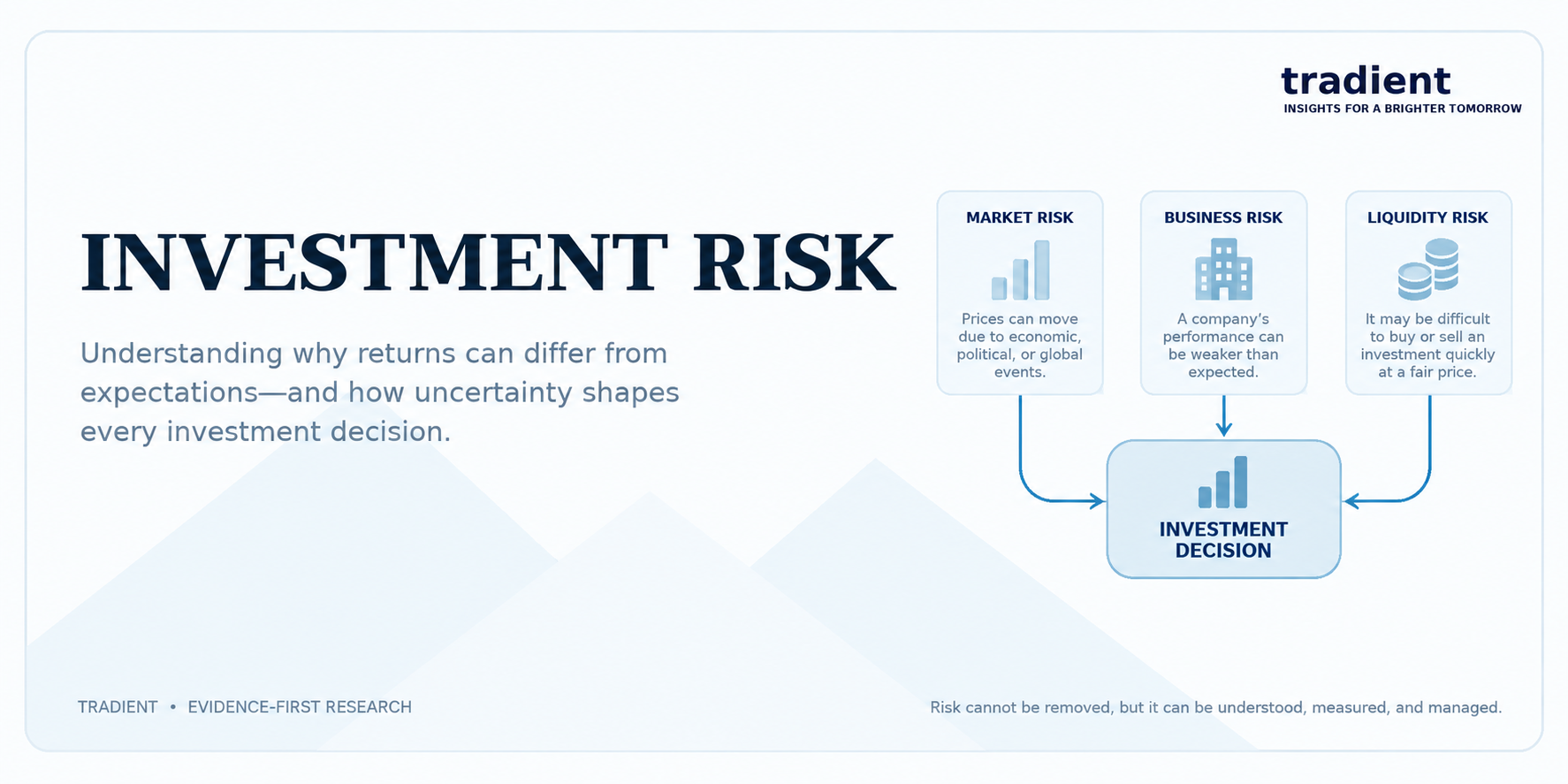
Market risk: when the whole market moves
Market risk, also called systematic risk, is the risk that broad economic or financial conditions pull down a large part of the market together. Recession fears, interest-rate shocks, financial stress or geopolitical disruption can affect many securities at the same time.
Owning many stocks can reduce the damage from one company failing, but diversification cannot make broad market risk disappear. This distinction is important: diversification is powerful, but it is not a guarantee against loss.
Business risk: when the company itself disappoints
A company can lose customers, face stronger competition, carry too much debt, misallocate capital, suffer governance failures or see its industry economics deteriorate. These are examples of business-specific risk.
Unlike broad market risk, a meaningful part of company-specific risk can often be reduced through diversification. A portfolio that depends heavily on one company, one promoter group, one sector or one investment thesis can be fragile even when the overall market looks healthy.
Liquidity risk: when you cannot exit easily
An investment may look valuable on paper but still be difficult to sell quickly at a fair price. Liquidity risk becomes important when trading volumes are thin, bid–ask spreads are wide or market stress causes buyers to disappear.
For investors with near-term cash needs, liquidity can matter as much as expected return. An asset that cannot be converted into usable cash at the required time may fail the objective even if its long-term economics remain sound.
Inflation risk: when money loses purchasing power
Risk is not always visible as a negative account balance. A very conservative investment can preserve nominal rupees yet still lose purchasing power if its return fails to keep pace with inflation.
For long-term goals, this creates a different trade-off. Avoiding all price fluctuation may reduce short-term discomfort while increasing the risk that the portfolio does not grow enough to meet the future cost of the goal.
Credit and counterparty risk
When you lend money through a bond or other debt instrument, you depend on the borrower to make promised payments. Credit risk is the possibility that the issuer cannot meet those obligations on time or in full.
Counterparty risk is broader: it arises whenever your financial outcome depends on another party performing its side of a transaction. The details vary by instrument, which is why investors should understand the product structure instead of relying only on the advertised return.
Currency risk
Foreign assets introduce another variable: exchange rates. An overseas investment may rise in its home currency but deliver a weaker result in rupees if the currency movement works against the investor. The opposite can also occur.
Currency exposure is neither automatically good nor bad. It is simply another source of return and risk that should be understood rather than ignored.
Concentration risk
Concentration can come from more than holding one stock. A portfolio may look diversified because it contains many securities, yet still depend on the same underlying driver.
For example, several companies can all be sensitive to the same interest-rate cycle, commodity price, export market, regulation or consumer segment. Effective diversification therefore looks at economic exposure, not only the number of holdings.
Behavioural risk: when the investor becomes part of the problem
An investment plan can be technically sound and still fail because of behaviour. Buying after a euphoric rise, selling during panic, doubling down to avoid admitting a mistake, following unverified tips or changing the strategy after every short-term outcome can convert manageable market risk into avoidable decision risk.
This is one reason a written process matters. Risk management is not only about choosing assets; it is also about defining how decisions will be made when markets become uncomfortable.
Volatility is a risk measure, not the whole definition of risk
Volatility measures how widely prices or returns fluctuate. It is useful because large fluctuations can create uncertainty and can be especially harmful when money is needed soon.
But volatility should not automatically be equated with permanent loss. A temporary decline in a high-quality, diversified long-term portfolio is different from a permanent impairment caused by fraud, insolvency or a broken investment thesis.
The next article in this series separates volatility from broader investment risk in more detail. For now, the key idea is that risk has several dimensions, and the relevant dimension depends on the investor’s objective.
A practical risk checklist before investing
| Question | Why it matters |
|---|---|
| What is this money for? | Defines the consequence of loss or delay. |
| When will I need it? | Determines how much short-term volatility can be tolerated. |
| What could cause permanent loss? | Focuses attention on business quality, leverage, structure and valuation. |
| How liquid is the investment? | Shows whether cash can be raised when required. |
| What risk is diversified and what is not? | Separates company-specific exposure from market-wide exposure. |
| What would make me sell? | Prevents emotional decisions from replacing a pre-defined process. |
| Can I understand the product? | Complexity can hide leverage, liquidity or counterparty risk. |
Risk capacity and risk tolerance are not identical
Risk tolerance is psychological: how much uncertainty or loss you feel comfortable accepting. Risk capacity is financial: how much loss your plan can actually absorb without damaging the goal.
An investor may feel comfortable taking large risks but have low capacity because the money is needed soon. Another investor may dislike volatility emotionally but have high capacity because the goal is decades away and the portfolio is well funded.
A sound plan respects both.
Key takeaways
- Investment risk is broader than day-to-day price movement.
- The same investment can carry different practical risk for different investors.
- Market, business, liquidity, inflation, credit, currency, concentration and behavioural risks can all matter.
- Diversification can reduce many company-specific risks but cannot eliminate broad market risk.
- Time horizon, goal and risk capacity should shape the investment choice.
- Volatility is useful information, but it is not a complete definition of risk.
Frequently asked questions
Is a fixed deposit risk-free?
No investment is literally free of every form of risk. A bank deposit may have very low price volatility, but an investor should still consider inflation, liquidity conditions, institution-specific safeguards and whether the return is sufficient for the goal.
Does diversification remove investment risk?
No. Diversification can reduce the impact of company- or sector-specific problems, but broad market risk and some macroeconomic risks remain.
Is a volatile investment always a bad investment?
No. Volatility must be judged in context. A volatile asset may be unsuitable for money needed soon but potentially appropriate within a diversified long-term plan for an investor who can tolerate the fluctuations.
What is the first step in managing investment risk?
Define the goal, time horizon and amount of loss or fluctuation the plan can withstand. Product selection should come after those questions, not before them.
This article is for educational purposes only and is not investment advice or a recommendation to buy or sell any security.