
AT A GLANCE
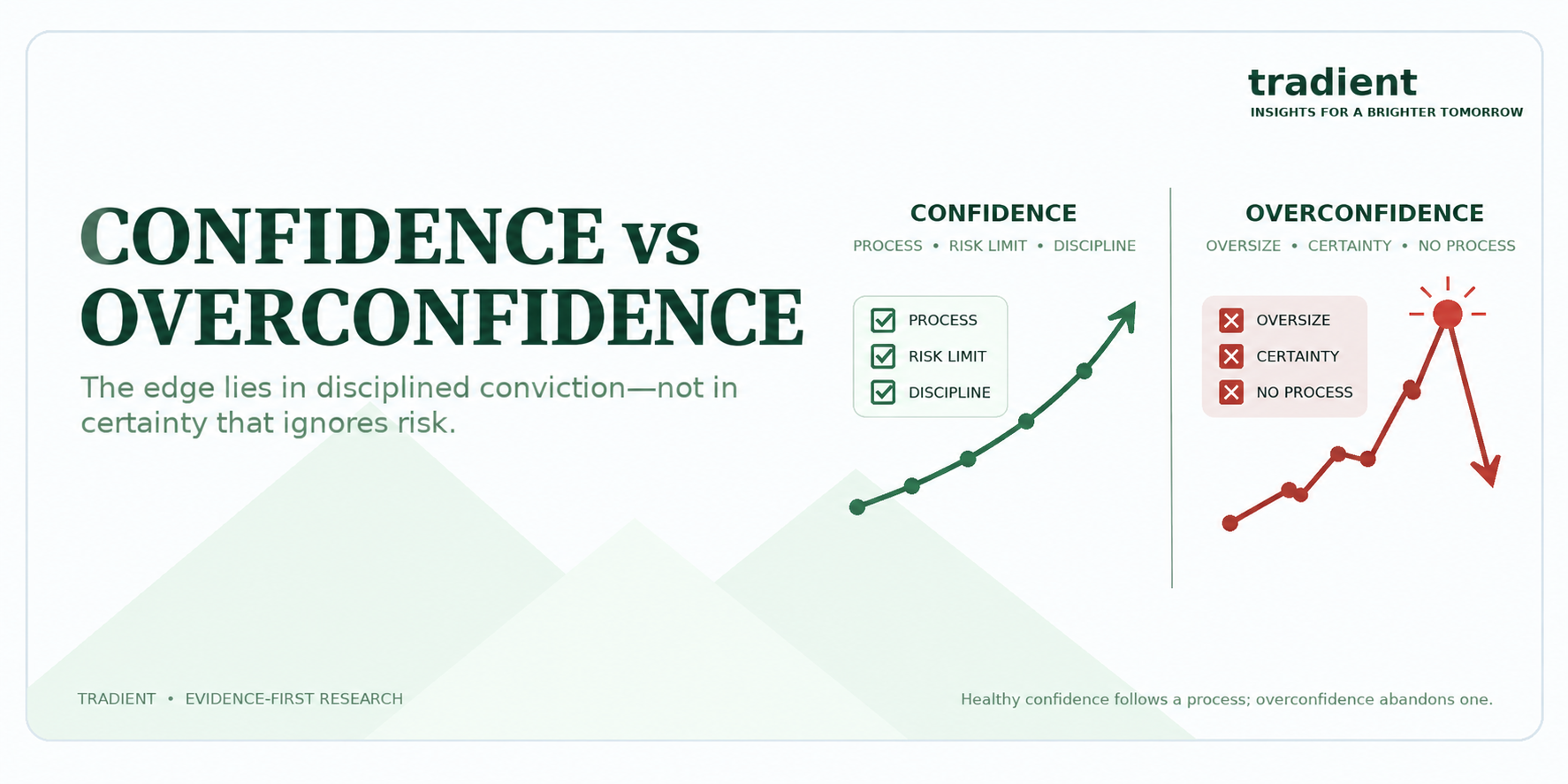
- Healthy confidence is trust in a process while accepting that any individual trade can fail. Overconfidence begins when certainty about your own judgment becomes stronger than the evidence supporting it.
Last reviewed: 18 September 2026
Trading requires enough confidence to act. A trader who doubts every setup may hesitate, enter late, cut valid trades prematurely or abandon a tested plan after a small losing streak.
But confidence can also become dangerous. After a series of correct calls, a trader may start believing that recent success proves superior forecasting ability. Position size rises, confirmation becomes selective and normal uncertainty starts to feel like something that has been “solved.”
The goal is therefore not low confidence. It is calibrated confidence: conviction proportional to evidence.
Healthy confidence is confidence in the process
Healthy confidence sounds like this: “This setup meets my criteria, the risk is defined, and I am willing to accept either outcome.”
The focus is not on being certain about the market. It is on knowing what you will do before, during and after the trade.
A process-confident trader can take a valid loss without treating it as proof of incompetence. The trade was one sample from a strategy whose quality must be judged over many comparable decisions.
Overconfidence is confidence in the forecast
Overconfidence often shifts attention away from the process and toward personal certainty: “I know this is going up,” “I understand this stock better than the market,” or “I cannot be wrong after reading this much.”
That difference matters because markets are uncertain even when the analysis is careful. The trader can control research quality, entry criteria, size and exit discipline. The trader cannot control the next price move.
Five signs confidence may be becoming overconfidence
1. Position size increases faster than evidence quality
If a normal setup receives twice the normal size mainly because the trader “feels very sure,” confidence is starting to alter risk rather than simply support execution.
2. Contrary information becomes irritating rather than useful
Healthy confidence can examine evidence against the thesis. Overconfidence often treats disagreement as noise, stupidity or manipulation.
3. Recent wins are interpreted as proof of skill
A short winning streak can occur because of skill, favourable market conditions, luck or some mixture of all three. The smaller the sample, the harder it is to separate those explanations.
4. Rules are relaxed for “special” trades
The trader keeps normal risk controls for ordinary setups but makes exceptions for the one that feels obvious. Those exceptions are often where hidden overconfidence becomes expensive.
5. Forecast language becomes absolute
Words such as “definitely,” “cannot miss” and “guaranteed” are warnings in a probabilistic environment. Strong evidence can justify higher conviction, but not certainty about an unknowable outcome.
Confidence should be calibrated to evidence
A practical way to calibrate confidence is to separate setup quality from outcome confidence.
You may rate a setup highly because it meets every predefined criterion. That is different from assigning a high probability to a specific short-term price path without evidence.
The first is process evaluation. The second is a forecast. Mixing them can create oversized positions after emotionally compelling setups.
Use base rates instead of stories
Suppose a trader believes a particular pattern is “one of the best.” The useful question is not how persuasive the current chart looks. The useful question is: how has this setup performed across a meaningful historical sample under comparable conditions?
Base rates force confidence to interact with evidence. They also reveal when a strong narrative is supported by very little data.
Separate skill from a favourable market regime
Some environments make many strategies look better. A strong trend can reward aggressive entries. A low-volatility period can make tight stops look brilliant. A broad bull market can make weak stock selection appear skilled.
Healthy confidence asks whether the process still works when the regime changes. Overconfidence assumes the recent environment is proof of personal forecasting power.
Risk sizing is the best reality check
One of the simplest questions is: “Would I take this same position size if my previous three trades had lost?”
If the answer is no, recent P&L may be influencing confidence more than the setup itself.
Stable risk sizing does not mean every trade must be identical. Some systems legitimately vary exposure by volatility or setup quality. The key is that the sizing rule should exist before the emotional excitement of the current trade.
A confidence-calibration checklist
| Question | Healthy answer | Warning sign |
|---|---|---|
| Why am I taking this trade? | Named setup with explicit criteria | “It just looks obvious” |
| What would disprove the thesis? | Defined invalidation condition | No clear answer |
| How was size determined? | Rule-based risk process | Based on how sure I feel |
| What evidence disagrees with me? | Actively considered | Dismissed automatically |
| What is my sample size? | Meaningful historical evidence | A few recent wins |
| Can this trade lose? | Yes, even if valid | “Not this one” |
Confidence after a loss is also important
Overconfidence is not the only problem. Some traders swing from excessive confidence after wins to near-total self-doubt after losses.
Both reactions place too much weight on recent outcomes. A better standard is to review whether the process was followed. A well-executed losing trade can be evidence of discipline; a profitable rule-breaking trade can be evidence of a dangerous process.
A practical review drill
For the next 20 relevant trades, record five fields:
- Setup grade before entry
- Planned rupee risk
- Confidence score before entry
- Whether any rule changed after entry
- Process grade after exit, independent of P&L
Then compare high-confidence trades with normal-confidence trades. Did higher confidence actually correspond to better setup quality, or mainly to bigger positions and stronger emotions?
The purpose is not to eliminate confidence. It is to make confidence measurable enough that it can be corrected.
Key takeaways
- Healthy confidence accepts uncertainty; overconfidence underestimates it.
- Confidence should come from a repeatable process, not from recent P&L.
- Strong conviction does not justify abandoning position-sizing rules.
- Contrary evidence is part of good analysis, not an attack on the thesis.
- Base rates and a meaningful sample help distinguish skill from luck or market regime.
- Judge decisions by process quality as well as outcome.
Frequently asked questions
Is confidence necessary for trading?
Yes. A trader needs enough confidence to execute a valid plan. The objective is not hesitation; it is confidence that remains proportional to evidence.
Can a profitable trader still be overconfident?
Yes. Profit over a short sample does not prove that position size, forecasting certainty or rule changes were justified.
How do I know whether confidence is calibrated?
Compare confidence scores with objective setup quality and later process reviews. If high confidence consistently appears after recent wins rather than after stronger evidence, it may be outcome-driven.
What is the simplest protection against overconfidence?
Keep risk sizing and invalidation rules explicit. Confidence can influence attention and preparation, but it should not silently rewrite the maximum loss you were willing to accept.
This article is for educational purposes only and is not investment advice or a recommendation to buy or sell any security.