
At a glance: The outcome of one trade is noisy. Process quality is judged by whether the decision followed a tested edge and risk plan using the information available at the time. Confusing the two rewards luck and punishes discipline.
A trader follows the plan perfectly and loses. Another breaks the rules, doubles size and makes a large profit. If the journal labels the first trade ‘bad’ and the second ‘good’, the learning system is upside down.
Markets are probabilistic. A sound process cannot guarantee the outcome of an individual trade, which is why review must score decisions separately from P&L.
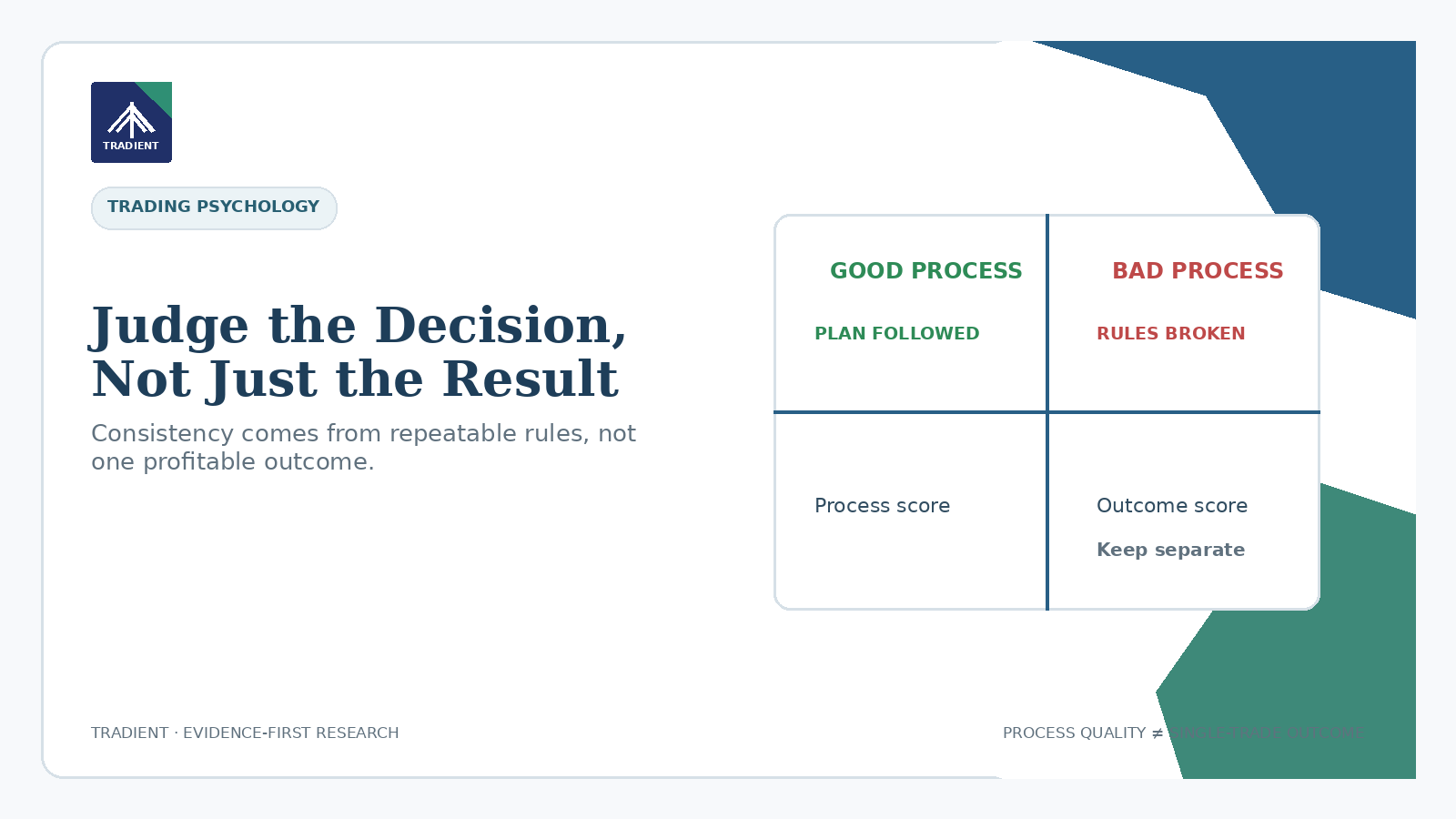
Use a two-by-two framework
Every trade can be placed into one of four broad cells: good process/win, good process/loss, bad process/win, bad process/loss.
The most dangerous cell is often bad process/win because profit rewards the exact behaviour that can later create a large loss. The most emotionally difficult cell is good process/loss because correct behaviour receives a negative outcome.
Define process criteria before the review
- Did the setup meet the written conditions?
- Was position size within the risk rule?
- Was the order executed as intended?
- Were stop, target or thesis-invalidation rules followed?
- Were any unplanned additions or exits made?
- Did emotion change the rule after entry?
Outcome still matters—over a sample
Process scoring does not mean ignoring profit. A strategy that is executed perfectly and loses persistently may have no edge or may have degraded.
The distinction is timescale. One trade is too noisy to judge the strategy, while a sufficiently large and relevant sample can test whether good process is producing acceptable outcomes after costs.
Do not use hindsight information to grade the entry
After the trade, the chart reveals what happened next. That future information was unavailable at entry. A fair process review uses only the evidence that could actually have been known at the decision time.
Otherwise every losing trade looks obviously avoidable and every winning trade looks obvious in retrospect, which destroys honest learning.
Score severity of process errors
Not every deviation deserves the same response. A minor documentation omission is different from doubling risk or cancelling a hard stop.
Classify violations by potential damage. High-severity errors should trigger stronger controls, reduced size or a pause even if the specific trade happened to profit.
Build confidence from repeatability
Process confidence comes from knowing what a valid decision looks like and seeing it executed consistently across different outcomes.
That confidence is more durable than confidence based only on a winning streak because it does not disappear every time variance produces a loss.
A practical drill for the next 20 trades
Do not try to change the behaviour after one observation. For the next 20 relevant trades, record the trigger, the emotion or urge, the planned action and the action actually taken. Keep the form short enough that it is completed consistently.
At the end of the sample, look for repeated conditions rather than isolated stories. The purpose is to discover whether the behaviour appears after losses, after wins, at a particular time of day, at larger size or in fast-moving instruments. A repeated pattern is easier to redesign than a vague belief that discipline is weak.
- Setup grade before entry
- Planned rupee risk
- Dominant emotion or urge
- Any rule change after entry
- Process grade independent of P&L
What improvement should look like
Improvement does not require the emotion to disappear. A better standard is behavioural: a losing trade can come from a good process; a winning trade can come from a bad process. The trader should be able to recognise the relevant state without automatically converting it into an order.
Track fewer rule violations, more stable position sizing and a smaller gap between planned and actual actions. Profitability is important over a meaningful sample, but process improvement can be observed earlier than the equity curve.
When to step back from live risk
If the behaviour repeatedly produces outsized losses, cancelled stops, uncontrolled leverage or an inability to follow a daily risk limit, the appropriate response may be to reduce or pause live exposure while the process is rebuilt.
Psychology work is not a justification for enduring unsafe risk. A trader should also investigate whether strategy design, platform mechanics, sleep, workload or position size is creating a problem that self-talk alone cannot solve.
Key takeaways
- A losing trade can come from a good process; a winning trade can come from a bad process.
- Use explicit setup, sizing, execution and exit criteria to grade process.
- Evaluate strategy profitability over a relevant sample, not one outcome.
- Avoid hindsight by grading decisions using information available at the time.
- High-severity rule violations deserve action even if the trade made money.
- Durable confidence comes from repeatable process, not recent P&L.
Frequently asked questions
If a good process keeps losing, is it still good?
Only temporarily. Process quality and strategy edge are different questions. A large enough sample of poor outcomes should trigger research into whether the edge still exists.
How should I grade a profitable rule-breaking trade?
Record the profit, but grade the process violation honestly. Lucky outcomes should not earn process credit.
Should every trade have a numerical score?
It can help if the scoring rubric is simple and consistent. Qualitative notes can also work if they capture the same criteria.
What is the best first metric to track?
Start with whether the setup qualified and whether planned risk was respected. Those two fields catch many costly process failures.
This article is for educational purposes only and is not investment advice or a recommendation to buy or sell any security.
Sources and further reading