
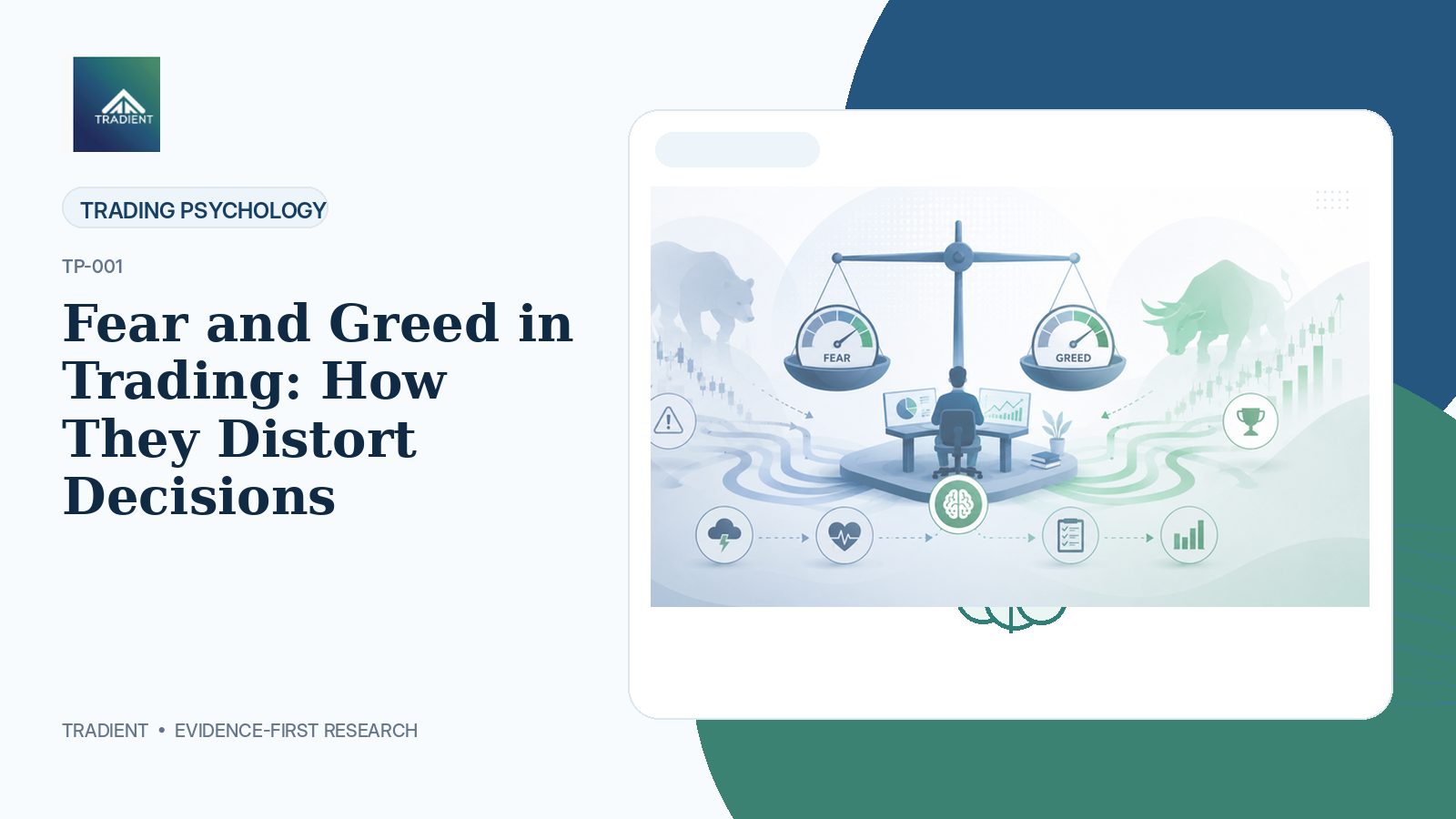
At a glance: Fear and greed are not mysterious market forces; they are emotional states that can change how traders interpret risk, information and probability. The goal is not to eliminate emotion, but to prevent emotion from hijacking process.
Two traders can look at the same chart, the same news and the same price level — and make completely different decisions.
One sees danger and exits too early. The other sees opportunity and doubles the position. A third refuses to act because the previous trade was a loss.
This is where trading psychology matters.
“Fear and greed” are often used as shorthand for market emotion, but the phrase becomes useful only when we connect it to specific behaviours: loss aversion, FOMO, overconfidence, the disposition effect, revenge trading, anchoring and impulsive risk taking.
The practical objective is not to become emotionless. That is unrealistic. The objective is to build a decision process strong enough that emotion does not get to rewrite your rules in the middle of a trade.
Fear and greed are not opposites — they are distortions of risk perception
Fear usually makes potential loss feel larger and more immediate than it objectively is. Greed can make potential reward feel larger and risk feel less important.
Both can distort probability.
A fearful trader may interpret an ordinary pullback as evidence that the entire thesis has failed. A euphoric trader may interpret a fast rally as proof that the price “has to keep going.”
In both cases, the trader stops asking the right question:
“What does my process say given the current evidence?”
and starts asking:
“How do I make this uncomfortable feeling go away?”
How fear changes trading decisions
Fear can be useful. It is one of the mechanisms that stops people from taking reckless risk. A trader who feels no fear at all may simply be underestimating what can go wrong.
The problem begins when fear becomes disproportionate to the planned risk.
Common fear-driven behaviours include:
– exiting a valid trade long before the planned stop because the position briefly moves against you;
– refusing to take a valid setup after two recent losses;
– reducing size dramatically on the best setups but taking normal size on mediocre ones;
– moving a stop too close because you cannot tolerate normal price noise;
– checking every tick and converting a planned swing trade into a nervous intraday trade;
– avoiding a strategy after a normal drawdown even though its underlying edge has not changed.
Fear often narrows the trader’s time horizon. A plan built using hourly or daily data can suddenly be judged using a two-minute candle simply because the trader wants immediate reassurance.
Loss aversion: why a ₹10,000 loss can hurt more than a ₹10,000 gain feels good
Behavioural finance has long studied the idea that people can be more sensitive to losses than to equivalent gains.
In markets, this can appear in several ways. A trader may avoid taking a small planned loss because accepting it feels like admitting failure. The position is then given “a little more room,” the stop is moved, and a manageable loss becomes a large one.
At the same time, the trader may book a winning position too quickly because turning an unrealised profit into a realised profit feels emotionally satisfying.
That combination is closely related to what researchers call the disposition effect — the tendency to realise gains more readily than losses.
The important lesson is not that every trader behaves this way every time. It is that the emotional experience of profit and loss can change decisions even when the original trading logic has not changed.
How greed changes trading decisions
Greed is not simply “wanting to make money.” Every rational trader wants the strategy to be profitable.
Greed becomes dangerous when the desire for a larger outcome overrides the risk framework.
Typical examples include:
– increasing position size after a winning streak without a rule-based reason;
– taking a breakout far from the planned entry because “this one is going to run”;
– refusing to take a planned profit because the trader suddenly wants twice as much;
– selling options with excessive leverage because several recent expiries were profitable;
– averaging into a trade because conviction has become emotional rather than analytical;
– adding multiple correlated positions that are effectively the same bet.
Greed often presents itself as confidence. That makes it harder to identify.
The trader may say, “I understand this market now,” when the real message is, “Recent profits have made risk feel smaller.”
FOMO: when greed and fear appear together
Fear of missing out is a useful example because it contains both emotions simultaneously.
You see an index move rapidly after a breakout. Greed says: “There is a lot of money to be made.” Fear says: “If I do not enter now, the opportunity will disappear.”
Together they create urgency.
Urgency is dangerous because it compresses the time available for analysis. Entry criteria become negotiable. Risk-reward deteriorates. Stops become wider because the entry is worse. The trader often ends up buying after the easy part of the move has already occurred.
A simple defence is to distinguish between:
“I missed the setup”
and
“I missed the move.”
Missing a setup means your process failed to identify or execute an opportunity you were supposed to take. That deserves review.
Missing a move simply means price moved without giving you your setup. That is normal. Markets are not obligated to provide you with a trade.
Overconfidence: the psychological tax after success
Winning streaks can be more dangerous than losing streaks because they can reduce the perceived need for discipline.
After several profitable trades, a trader may begin to attribute outcomes entirely to skill. Position size rises. Setup quality falls. More trades are taken. Protective rules start to feel unnecessarily conservative.
Research on behavioural biases commonly identifies overconfidence as an important issue in investment decision-making. A 2026 study in IIMB Management Review also reported evidence consistent with overconfidence and disposition-effect patterns in the Indian stock market, with the strength of those effects varying across trading-volume regimes and sectors.
The practical response is not to distrust every winning streak. It is to keep risk rules independent of recent P&L.
If your position-sizing rule says 0.5% account risk per trade, five winners should not silently convert it into 2%.
Why recent outcomes can hijack the next trade
Traders rarely approach each trade with a perfectly clean mental slate.
The previous trade changes the emotional starting point.
After a loss, the next setup may feel less trustworthy even if it is statistically identical to the previous 100 setups. After a large profit, an average setup may feel unusually attractive.
This creates two common errors:
Revenge behaviour after losses — increasing urgency, frequency or size in an attempt to recover money.
House-money behaviour after gains — treating recent profit as if it is less valuable and therefore safer to risk.
A strong process forces every new trade to earn its own place in the portfolio. The previous outcome should not determine whether the next setup meets the rules.
Fear and greed also affect how we interpret information
Emotion does not only change execution. It changes attention.
When you are afraid, bearish information becomes easier to notice. When you are euphoric, positive information feels more credible.
This can interact with confirmation bias: once a trader has formed a position, information supporting the position receives more weight than information contradicting it.
That is why professional decision systems often separate thesis formation from execution rules. A trader should know in advance what evidence would invalidate the trade rather than inventing the invalidation rule after money is already at risk.
A practical anti-emotion trading framework
You cannot remove fear and greed from the nervous system, but you can reduce the number of decisions they are allowed to influence.
A robust framework has several layers.
1. Define the trade before entering it
Before clicking Buy or Sell, write down:
– setup;
– entry condition;
– invalidation level;
– stop;
– target or exit logic;
– position size;
– maximum acceptable loss;
– conditions under which you will not take the trade.
If these items are being decided after entry, emotion has already been given too much authority.
2. Size the position so the stop is emotionally tolerable
A technically correct stop is useless if the monetary loss is so large that you know you will interfere with it.
Position size should convert the technical invalidation level into an account-level risk you can actually tolerate.
Smaller size often produces better execution because it makes it easier to follow the original plan.
3. Separate process quality from trade outcome
A profitable trade can be badly executed. A losing trade can be perfectly executed.
Judge each trade on two axes:
Outcome: profit or loss.
Process: did I follow the plan?
Your long-term goal is not “never lose.” It is to increase the percentage of trades that are process-correct.
4. Use a mandatory cool-off trigger
Define conditions under which you stop trading temporarily.
Examples:
– two consecutive rule-breaking trades;
– daily loss limit reached;
– unusually high anger or urgency;
– position size entered incorrectly;
– major unexpected news invalidates the day’s plan.
A cool-off rule removes the need to negotiate with yourself when emotions are already elevated.
5. Keep a decision journal, not just a P&L journal
A trading journal should record more than entry, exit and profit.
Useful fields include:
– setup quality;
– planned versus actual risk;
– emotional state before entry;
– whether entry was late;
– whether stop or target was changed;
– reason for exit;
– whether the trade followed the playbook;
– lesson for the next occurrence.
After 50 or 100 trades, patterns become visible. You may discover that your largest losses occur after late entries, or that most rule violations happen after two winners rather than two losers.
A five-question checklist before every discretionary trade
- Would I still take this setup if my previous trade had been a loss?
- Would I still take it if my previous trade had been a large winner?
- Is my entry based on a predefined condition or on urgency?
- Has my risk changed because the market changed — or because my emotion changed?
- If this trade loses exactly as planned, will I still consider it a valid trade?
The goal is not emotional suppression
Trying to suppress emotion can itself become counterproductive.
Fear can alert you to position sizes that are too large. Discomfort can signal that you are trading outside your tested playbook. Excitement can reveal that you are becoming attached to an outcome.
The better skill is emotional recognition.
“I feel FOMO” is information.
“I must therefore enter now” is a decision.
Those are not the same thing.
A mature trader learns to notice the emotional signal without automatically obeying it.
Key takeaways
- Fear and greed distort how traders perceive risk, reward and probability.
- Loss aversion can encourage traders to hold losers too long and take winners too quickly.
- FOMO combines greed for profit with fear of being left behind.
- Winning streaks can produce overconfidence and hidden risk escalation.
- The best defence is not willpower; it is a predefined process that reduces discretionary decisions.
- Position sizing, journaling, cool-off rules and process-based review are practical psychological risk controls.
- Emotions are data. They should not automatically become trade instructions.
Frequently asked questions
Can a trader eliminate fear and greed completely?
Probably not, and that should not be the objective. The practical goal is to prevent emotional states from overriding predetermined risk and execution rules.
Is fear always bad in trading?
No. Appropriate fear can improve caution and risk awareness. The problem is disproportionate fear that causes rule-breaking or avoidance of valid setups.
How do I know if I am overconfident?
Warning signs include increasing size without a predefined rule, taking lower-quality setups, trading more frequently after wins and feeling that normal risk controls are suddenly unnecessary.
What is the fastest way to reduce emotional trading?
Reduce position size and predefine the trade before entry. Smaller, known risk makes it easier to follow a plan.
Should I stop trading after a loss?
Not automatically. A normal planned loss is part of trading. A cool-off is more useful after a rule violation, loss-limit breach, emotional escalation or other condition specified in your playbook.
From Emotion to a Repeatable Decision Process
Fear and greed are useful starting points, but trading psychology is broader than two emotions. A durable framework connects emotion, cognitive bias, position sizing, execution rules and post-trade feedback. The objective is not to become emotionless. It is to build a process in which emotion has less authority over the final decision.
Loss aversion changes how traders treat winners and losers
A trader can become unusually reluctant to realise a loss while taking profits too quickly. This asymmetry is one reason process rules matter. See Loss Aversion: Why a ₹1 Loss Can Hurt More Than a ₹1 Gain Feels Good.
FOMO is a decision-pressure problem
Fear of missing out compresses the time available for analysis and makes a late entry feel safer simply because many others are participating. The deeper discussion is in FOMO Trading: Why Late Entries Feel So Compelling.
Overtrading can disguise itself as effort
Activity feels productive, especially after losses or during boredom, but more trades do not automatically mean more opportunity. See Overtrading: When Activity Feels Like Productivity.
Revenge trading converts a financial loss into an emotional objective
Once the goal shifts from executing a valid setup to recovering money quickly, the trader is no longer solving the original market problem. Start the recovery cluster with What Is Revenge Trading?.
Discipline is measurable behaviour
Discipline is not a personality trait. It can be expressed as observable behaviours: following the planned entry, respecting the stop, sizing correctly, accepting no-trade decisions and recording deviations. See Trading Discipline: What It Actually Means.
Process goals improve feedback quality
Profit and loss are noisy over small samples. Process goals make it possible to judge whether the decision itself followed the plan. Continue with Process Goals vs Profit Goals.
Checklists reduce memory and emotion dependence
A checklist cannot eliminate uncertainty, but it can force the same critical questions to be asked before every trade. See How Checklists Improve Trading Consistency.
Confidence Must Be Calibrated
Confidence is useful when it reflects evidence and process. It becomes dangerous when certainty grows faster than the evidence supporting it. Batch04 develops this theme through Healthy Confidence vs Overconfidence in Trading, Why a Winning Streak Can Increase Risk, Calibrating Confidence with Evidence and the bias series from Confirmation Bias through Survivorship Bias.
A Four-Layer Psychology Framework
- Awareness: identify the emotion or bias operating now.
- Pre-commitment: define size, invalidation, exit and no-trade conditions before pressure rises.
- Execution discipline: follow the rule even when the short-term outcome is uncomfortable.
- Review: grade the decision process separately from the trade outcome.
This article is educational and discusses trading psychology and risk-management concepts. It is not investment advice or a recommendation to trade any instrument.
Sources and further reading
- CFA Institute — The Behavioral Biases of Individuals
- NBER — What Drives the Disposition Effect?
- NBER — Myopic Loss Aversion and the Equity Premium Puzzle
- IIMB Management Review — Turnover tales: Investigating investor biases through return-volume dynamics in the Indian stock market
- International Journal of Emerging Markets — How fear beats greed