
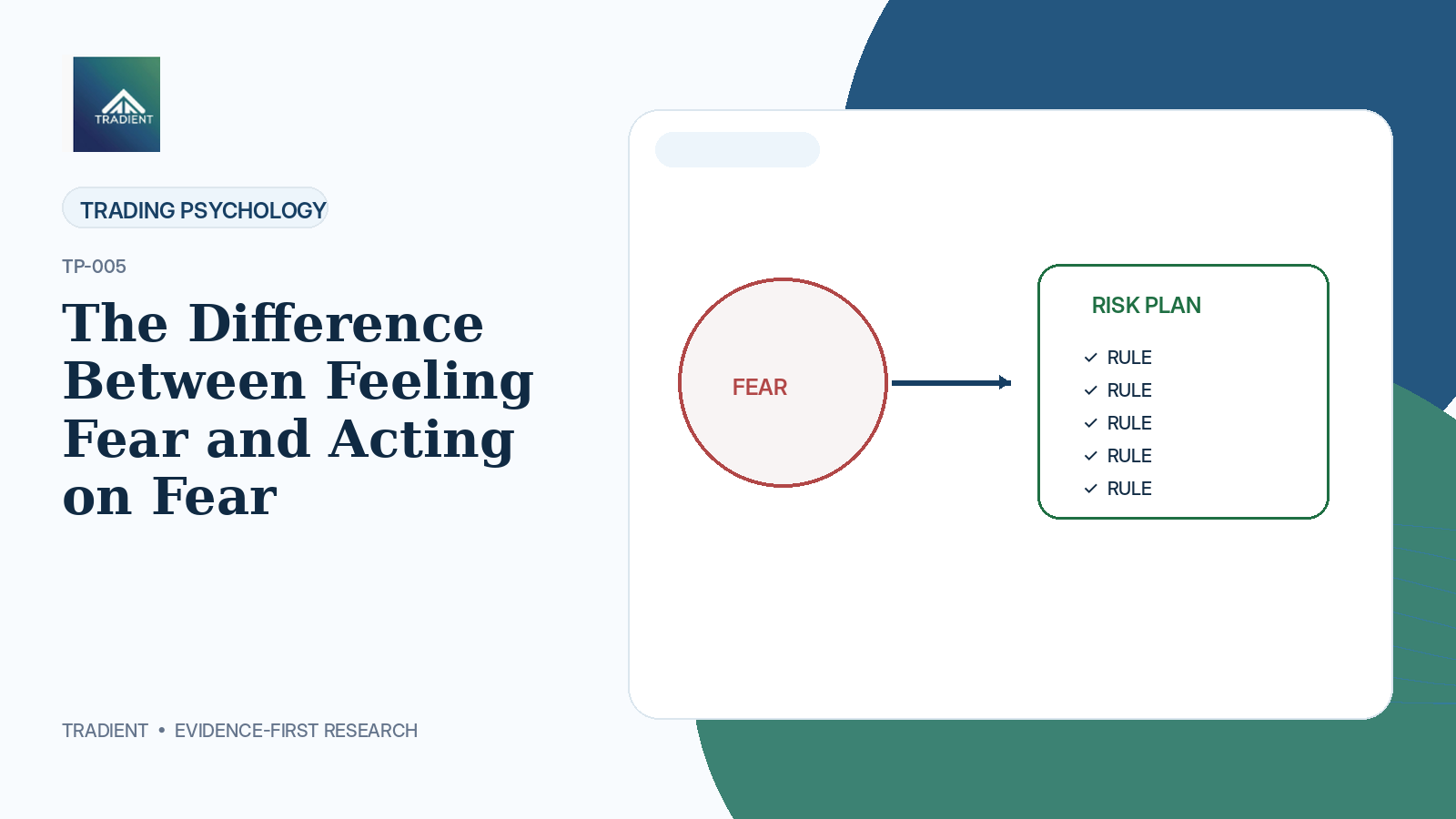
At a glance: Fear is not a trading error. Acting on fear without reference to the plan can be. The objective is to let emotion inform attention while keeping the final action anchored to pre-defined evidence and risk.
A trader can understand a setup, size it correctly and still feel fear after entry. That feeling becomes particularly strong when money is at risk and the future cannot be known.
Trying to eliminate fear entirely can create a second problem: the trader begins to treat emotional numbness as confidence. A healthier goal is to distinguish the feeling from the action.
Fear can contain useful information
Fear may signal that position size is too large, the setup is poorly understood or current volatility exceeds the conditions in which the strategy was tested.
The signal deserves examination. But fear can also arise simply because uncertainty is uncomfortable. The trader needs a method for separating a genuine change in evidence from an emotional response to ordinary risk.
Ask: what changed in the market?
Before changing a trade because you feel afraid, identify the observable fact that changed. Did price breach the invalidation level? Did a material announcement alter the thesis? Did liquidity collapse?
If nothing in the planned evidence changed, exiting solely to stop discomfort may teach the brain that anxiety is the exit signal. That can make future execution even harder.
Position size determines how loud fear becomes
A strategy can be financially acceptable at one size and psychologically unmanageable at another. The same 1% price move has a very different emotional effect when the position is twice as large.
Sizing is therefore part of psychological risk management. A position should be small enough that the trader can still process information and follow rules under normal adverse movement.
Separate a protective stop from a comfort stop
A protective stop is tied to a price, volatility or thesis condition defined by the strategy. A comfort stop is moved closer simply because the current loss feels unpleasant.
Both may exit the position, but they reflect different processes. If the strategy needs a tighter stop, test that rule across many trades rather than improvising it only when fear is high.
Use language that separates self from sensation
Instead of ‘I am terrified, so this trade is wrong’, use a more precise statement: ‘I notice fear; the trade is still above the invalidation level; risk remains within the planned amount.’
This kind of wording does not suppress emotion. It prevents the emotion from becoming the entire analysis.
When fear should end the trade
If fear is caused by a real process failure—excessive size, misunderstood instrument, operational error or an event outside the strategy’s risk envelope—the correct response may be to reduce or exit.
Discipline is not blindly staying in every planned trade. It is responding to evidence under a consistent framework rather than changing the framework to escape discomfort.
A practical drill for the next 20 trades
Do not try to change the behaviour after one observation. For the next 20 relevant trades, record the trigger, the emotion or urge, the planned action and the action actually taken. Keep the form short enough that it is completed consistently.
At the end of the sample, look for repeated conditions rather than isolated stories. The purpose is to discover whether the behaviour appears after losses, after wins, at a particular time of day, at larger size or in fast-moving instruments. A repeated pattern is easier to redesign than a vague belief that discipline is weak.
- Setup grade before entry
- Planned rupee risk
- Dominant emotion or urge
- Any rule change after entry
- Process grade independent of P&L
What improvement should look like
Improvement does not require the emotion to disappear. A better standard is behavioural: fear is a normal response to uncertainty and capital at risk. The trader should be able to recognise the relevant state without automatically converting it into an order.
Track fewer rule violations, more stable position sizing and a smaller gap between planned and actual actions. Profitability is important over a meaningful sample, but process improvement can be observed earlier than the equity curve.
When to step back from live risk
If the behaviour repeatedly produces outsized losses, cancelled stops, uncontrolled leverage or an inability to follow a daily risk limit, the appropriate response may be to reduce or pause live exposure while the process is rebuilt.
Psychology work is not a justification for enduring unsafe risk. A trader should also investigate whether strategy design, platform mechanics, sleep, workload or position size is creating a problem that self-talk alone cannot solve.
Key takeaways
- Fear is a normal response to uncertainty and capital at risk.
- Ask what observable evidence changed before changing the trade.
- Excessive size amplifies fear and degrades decision quality.
- A protective stop should be strategy-based, not merely a comfort stop.
- Precise self-talk can separate emotion from analysis.
- Real process failures can justify reducing risk; discipline is not stubbornness.
Frequently asked questions
Is a fearless trader a better trader?
Not necessarily. Lack of fear can encourage excessive risk. The useful skill is acting consistently despite normal emotion.
What if I always feel fear after entry?
Review size, strategy clarity and whether you understand normal adverse movement. Persistent fear may indicate a design problem rather than a personality problem.
Should I ignore intuition?
No, but translate intuition into testable observations where possible. Ask what the feeling is responding to and whether it belongs in the strategy.
Can fear be useful?
Yes. It can highlight unclear risk, unfamiliar conditions or excessive exposure. Use it as a prompt to check evidence, not as an automatic order.
This article is for educational purposes only and is not investment advice or a recommendation to buy or sell any security.
Sources and further reading