
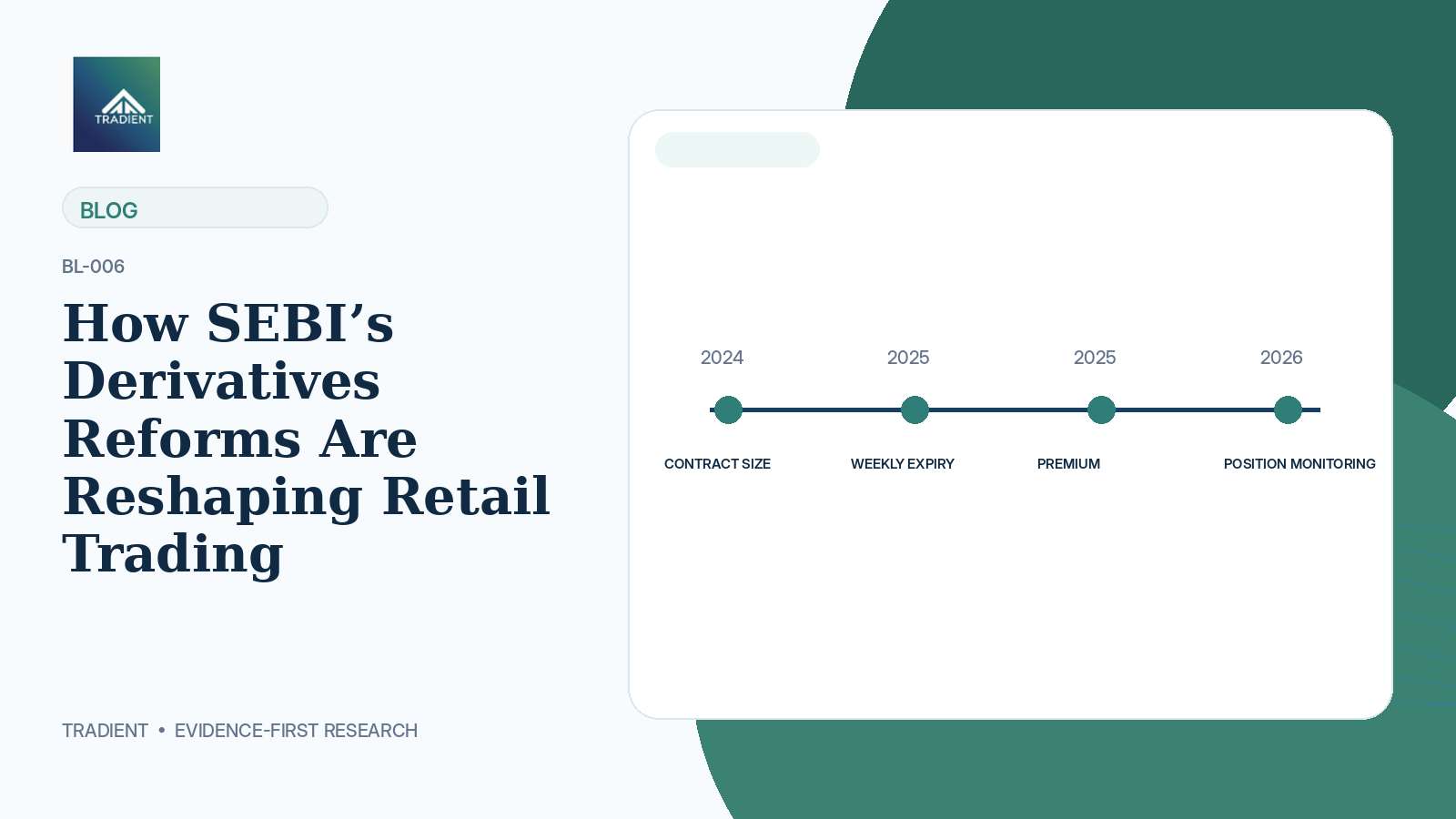
At a glance: SEBI has not addressed retail derivatives risk with a single rule. It has changed several parts of the system at once: product design, contract size, premium funding, expiry structure and position-risk monitoring.
The Indian equity-derivatives market that exists in 2026 is not the same regime that produced the rapid retail expansion of the early 2020s. Traders who use old assumptions about expiries, lot sizes or intraday leverage can misread both opportunity and risk.
A useful way to understand the reforms is to separate what they are trying to change: how often short-dated bets can be placed, how large a contract is, when funds must be available, and how concentrated risk is monitored.
Reform 1: rationalising weekly expiries
SEBI restricted exchanges to one weekly benchmark index-options contract. This reduces the number of recurring expiry events available across multiple benchmarks.
The reform does not eliminate weekly options, but it changes the concentration of liquidity and speculative activity.
Reform 2: larger contract values
Minimum index-derivative contract values were increased so that a single lot represents a more meaningful exposure. Exchanges adjust lot sizes as index levels evolve.
For retail traders, the rupee risk of a position can therefore change even if the option premium appears inexpensive.
Reform 3: upfront option-premium collection and margin changes
The framework tightened premium collection and expiry-day risk treatment. This reduces scope for taking exposures without the required funding being visible to the risk system.
Calendar-spread and expiry-day margin treatment has also been reviewed, reflecting the fact that correlations and offsets can behave differently as contracts approach settlement.
Reform 4: stronger intraday position monitoring
SEBI and exchanges have moved toward more granular intraday monitoring of position limits rather than relying only on end-of-day snapshots.
That matters because very large exposures can be created and closed within one session. A system that sees only the closing position may miss the peak risk actually carried during the day.
What the 2025–2026 studies suggest
SEBI’s comparative work showed moderation in parts of derivatives activity after the measures, and the 2026 studies showed a decline in individual participation alongside persistently high loss rates.
That is consistent with the reforms changing behaviour without eliminating the underlying challenge of retail profitability.
The strategic implication: backtests need regulatory regimes
A strategy spanning several years should tag contract-size changes, expiry structures, transaction-cost changes and margin rules. Treating the full history as one homogeneous regime can produce misleading estimates of turnover, capacity and risk.
Regulatory awareness is therefore part of quantitative research, not merely a compliance footnote.
How to use this framework without making a one-variable trade
The subject in How SEBI’s Derivatives Reforms Are Reshaping Retail Trading should be treated as one input into a wider market process. Before taking a position, separate the policy or structural variable from earnings, valuation, positioning, liquidity and what the market had already priced.
A useful discipline is to write a base case, an upside case and a downside case. Identify which observable data would move the probability of each case. This prevents a headline—whether a circular, RBI operation or yield move—from becoming a complete investment thesis.
- What was expected before the event?
- What actually changed?
- Which cash-flow or risk channel is affected?
- What is already reflected in valuation?
- What evidence would make the current interpretation wrong?
What to verify before acting
Use primary sources for the rule or policy itself and current exchange specifications for contract-level details. Secondary reporting can be useful for context, but a trading system should not rely on a news summary when the operative circular or specification is available.
Also check the effective date. Indian market reforms are frequently phased, and an announcement date is not always the date on which every operational provision becomes active.
Key takeaways
- SEBI’s derivatives reforms are a multi-part change to market structure, not one isolated rule.
- Weekly expiry availability, contract value and premium funding have tightened.
- Intraday monitoring makes peak risk more visible to the control system.
- Retail participation moderated, but high loss rates persisted in the 2026 studies.
- Old trading tutorials and backtests can become structurally stale.
- Current contract and regulatory data should be part of every derivatives strategy’s inputs.
Frequently asked questions
Did SEBI ban retail F&O trading?
No. Equity derivatives remain available subject to current product, margin and broker eligibility rules.
Why increase contract size?
A larger minimum contract value reduces the ability to take very large index exposure through tiny lot notionals and makes leverage more explicit.
Do reforms guarantee lower volatility on expiry?
No. Market behaviour still depends on positioning, news, liquidity and hedging. The reforms change structure rather than guarantee a price pattern.
How often should a derivatives strategy review regulations?
Continuously enough to catch circulars and exchange specifications before they affect live trading. A pre-market data/config validation is useful for automated systems.
Regulatory positions, exchange specifications and macroeconomic conditions can change. This article was fact-checked against the cited sources available on 3 September 2026. It is intended for educational purposes only and does not constitute legal, compliance, financial or investment advice. Readers should verify the latest official documentation before acting.
Sources and further reading