
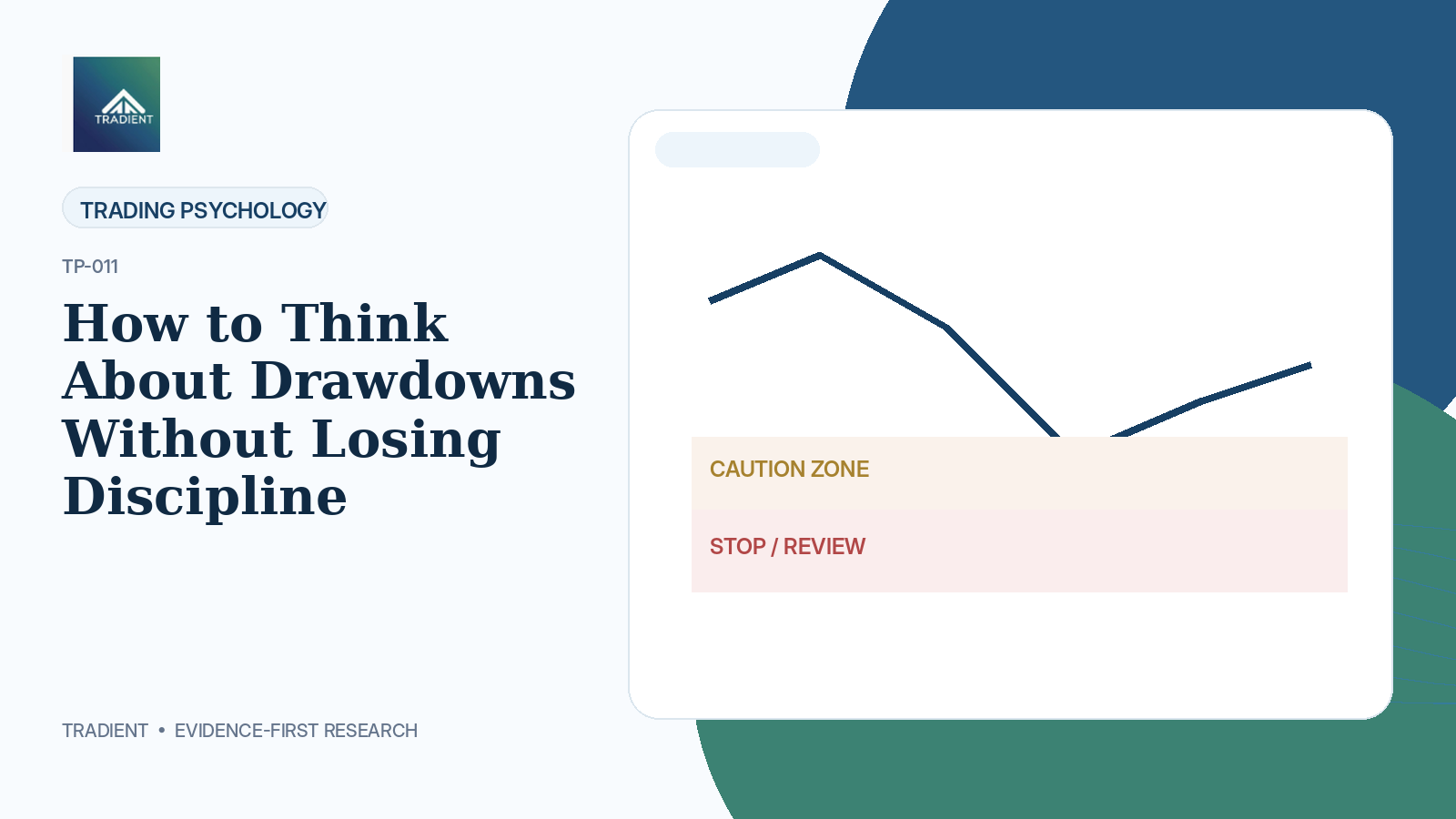
At a glance: Drawdowns are inevitable in risky strategies, but they should never be treated casually. The disciplined response is to compare the drawdown with pre-defined expectations and process evidence rather than reacting to pain alone.
An equity curve reaches a new high and then falls. The trader begins to question the strategy, reduce good trades, chase bad ones or search for a completely new system.
Some of that concern is appropriate. A drawdown can signal a broken edge, but it can also be ordinary variance. The challenge is building rules that distinguish the two before the account is under stress.
Define drawdown before you experience it
Drawdown is commonly measured from a prior equity peak to a subsequent trough. It can be expressed in rupees, percentage terms or risk units.
Before trading real capital, estimate what historical or simulated drawdowns looked like, including duration. Those estimates are imperfect, but they create a reference for deciding when live performance has moved outside expectations.
Size and duration tell different stories
A 10% drawdown over two days may reflect a very different strategy problem from a 10% drawdown spread over six months. Depth measures capital decline; duration measures how long the strategy has remained below its prior peak.
Both affect psychology. Long shallow drawdowns can erode confidence through boredom and doubt even when the financial loss is manageable.
Separate strategy drawdown from process drawdown
If the strategy is being executed exactly as tested and still loses, that is strategy performance. If losses are enlarged by missed stops, extra trades or size errors, part of the drawdown is a process failure.
These require different remedies. Strategy deterioration calls for research; process deterioration calls for execution controls and possibly reduced risk.
Use pre-defined drawdown tiers
- Normal zone: continue at planned risk while monitoring
- Caution zone: reduce size or increase review frequency under the written policy
- Review zone: pause new risk and investigate model, data and execution
- Hard stop: cease live trading if a predefined capital or risk threshold is breached
Avoid strategy hopping at the point of maximum pain
A common reaction is to abandon a strategy after a losing period and adopt the method that has recently performed best. That can lead to buying one strategy after its strong period and selling another after its weak period.
Any strategy change should have evidence: changed market structure, degraded signal statistics, execution costs, data issues or a better-tested alternative—not simply relief from current discomfort.
Risk reduction can be rational without being emotional
Reducing size during an abnormal drawdown is not weakness if it is part of the governance plan. Lower risk can protect capital while preserving enough live data to assess whether the edge remains intact.
The key is that thresholds are established before the drawdown. Otherwise every reduction or increase becomes vulnerable to hindsight and mood.
A practical drill for the next 20 trades
Do not try to change the behaviour after one observation. For the next 20 relevant trades, record the trigger, the emotion or urge, the planned action and the action actually taken. Keep the form short enough that it is completed consistently.
At the end of the sample, look for repeated conditions rather than isolated stories. The purpose is to discover whether the behaviour appears after losses, after wins, at a particular time of day, at larger size or in fast-moving instruments. A repeated pattern is easier to redesign than a vague belief that discipline is weak.
- Setup grade before entry
- Planned rupee risk
- Dominant emotion or urge
- Any rule change after entry
- Process grade independent of P&L
What improvement should look like
Improvement does not require the emotion to disappear. A better standard is behavioural: drawdown should be defined and expected before live trading. The trader should be able to recognise the relevant state without automatically converting it into an order.
Track fewer rule violations, more stable position sizing and a smaller gap between planned and actual actions. Profitability is important over a meaningful sample, but process improvement can be observed earlier than the equity curve.
When to step back from live risk
If the behaviour repeatedly produces outsized losses, cancelled stops, uncontrolled leverage or an inability to follow a daily risk limit, the appropriate response may be to reduce or pause live exposure while the process is rebuilt.
Psychology work is not a justification for enduring unsafe risk. A trader should also investigate whether strategy design, platform mechanics, sleep, workload or position size is creating a problem that self-talk alone cannot solve.
Key takeaways
- Drawdown should be defined and expected before live trading.
- Depth and duration both matter.
- Separate losses caused by the strategy from losses caused by execution violations.
- Use pre-defined normal, caution, review and hard-stop tiers.
- Do not switch strategies merely to escape the discomfort of recent underperformance.
- Rule-based risk reduction during abnormal drawdowns can be prudent governance.
Frequently asked questions
What is an acceptable drawdown?
There is no universal number. It depends on the strategy’s historical behaviour, leverage, investor objectives and capital tolerance.
Does a new maximum drawdown mean the strategy is broken?
Not automatically, because future variance can exceed history. It does mean the evidence deserves deeper review.
Should I stop trading during a drawdown?
Only according to a pre-defined policy or when process integrity is compromised. Some strategies need continued execution through normal losing periods.
How can I prepare psychologically?
Use realistic simulations, size conservatively and know the review thresholds in advance. Surprise magnifies emotional response.
This article is for educational purposes only and is not investment advice or a recommendation to buy or sell any security.
Sources and further reading