
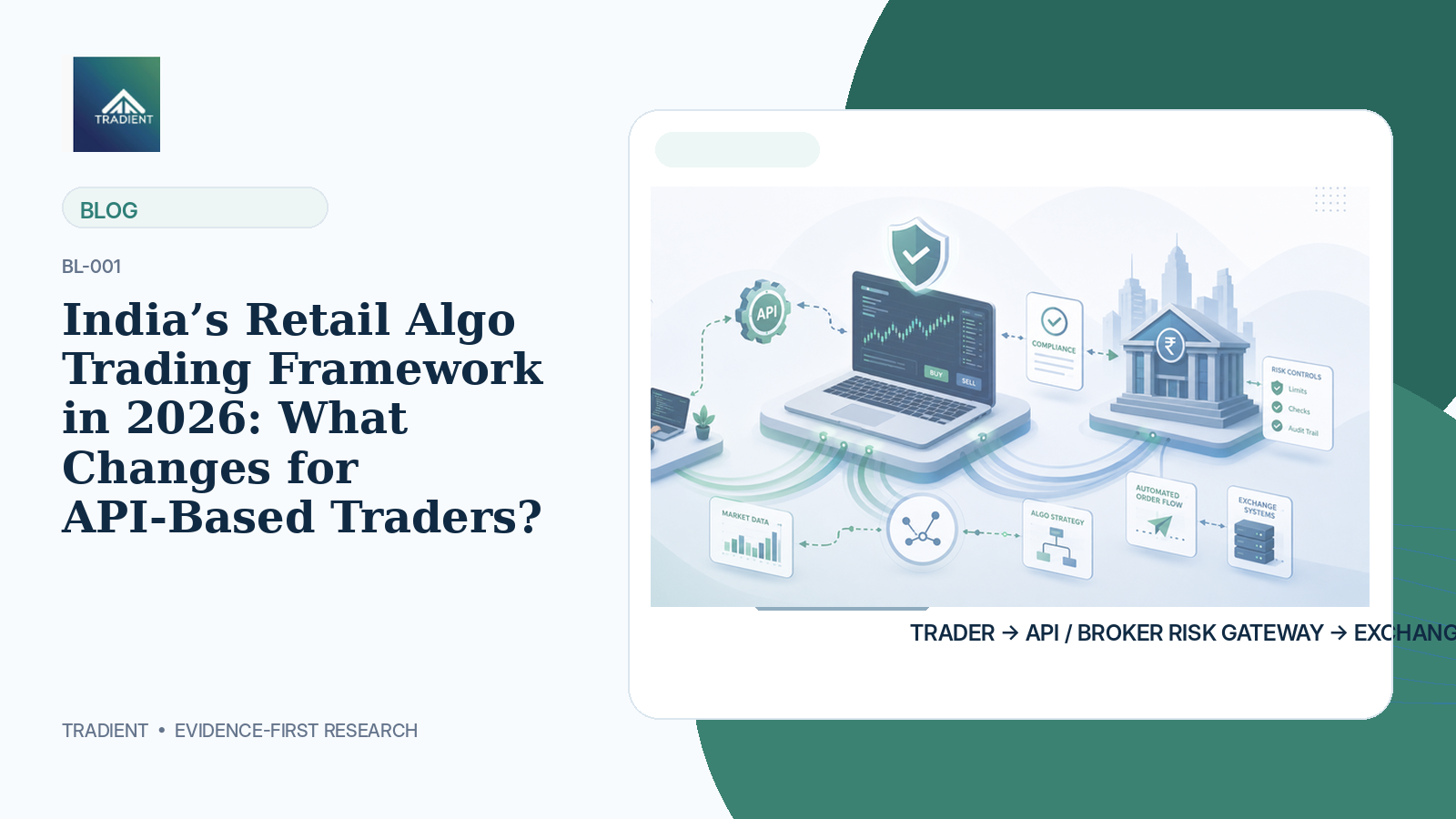
At a glance: India’s retail algo-trading regime moved from a largely broker-specific API ecosystem to a formal exchange-supervised framework. From static IP whitelisting to order-rate thresholds and algo IDs, API traders now operate inside a much more traceable structure.
For years, a technologically inclined retail trader in India could connect a Python script, spreadsheet tool or third-party platform to a broker API and focus mainly on whether the code worked.
In 2026, that is no longer enough.
India now has a formal regulatory and exchange-supervised framework for retail algorithmic trading. The framework began with SEBI’s February 4, 2025 circular on safer participation of retail investors in algorithmic trading, was followed by exchange implementation standards, and — after an implementation extension — became applicable to all stock brokers from April 1, 2026.
The objective is not to ban retail automation. It is to make automated order flow more identifiable, traceable and controllable.
For an API-based trader, the practical implications are significant: static IP whitelisting, unique API credentials, authentication controls, order-rate thresholds, algo tagging, and — above specified thresholds — exchange registration.
This article explains the framework from the trader’s point of view, using the rules and implementation standards available as of September 3, 2026.
Why did SEBI create a specific retail algo framework?
Algorithmic trading has existed in Indian markets for years, particularly among institutional and professional participants. Retail API access, however, expanded rapidly through discount brokers, fintech platforms and do-it-yourself coding.
That created a regulatory gap.
An order placed manually through a broker terminal is easy to associate with a user session. Automated order flow can be generated by a client’s own code, by a third-party platform, by an algo provider, or by a broker’s strategy engine. Without a consistent framework, identifying the actual origin, logic category and accountability chain becomes harder.
SEBI’s 2025 circular therefore formalised the roles of investors, brokers, algo providers and exchanges, with brokers positioned as the principal gatekeepers of API-based retail algo access.
The most important date: April 1, 2026
SEBI initially prescribed an earlier implementation path, but the timeline was extended in September 2025.
The extension established implementation milestones for brokers and stated that, with effect from April 1, 2026, the retail algo framework in the February 2025 circular — together with exchange implementation standards and operational modalities — would apply to all stock brokers.
That means the framework is not merely a future proposal in 2026. It is an operating compliance regime.
For traders, however, implementation details can still vary by broker and exchange. Your broker may impose stricter operational controls than the exchange-level minimum.
Change #1: API access is tied to static IP addresses
One of the biggest practical changes is static-IP whitelisting.
NSE’s implementation standards state that clients using API access must provide the stock broker with a static IP address that is mapped to the API key used to connect to the broker’s trading platform.
A client can provide a primary static IP and may provide a secondary static IP for redundancy.
This is a major change for traders who previously ran strategies from ordinary consumer internet connections where the public IP could change.
Why does the regulator want static IPs?
Traceability.
If every API key is linked to a known client and a whitelisted network address, the broker has a much stronger basis for identifying where automated order flow originated.
Can the static IP be changed?
Yes, but it is not intended to behave like a constantly rotating access credential.
NSE’s May 2025 standards say clients may update mapped static IP addresses as needed, but ordinarily not more than once in a calendar week. The standards also allow a client to approach the broker in extraordinary circumstances if another change is necessary.
The practical message for a serious API trader is clear: network infrastructure is now part of the trading setup, not an afterthought.
Change #2: multiple API keys are possible — but mapping matters
The implementation standards allow multiple API keys for the same client, for example when trading different segments or running different algorithms.
Those keys can be mapped to the client’s primary and secondary static IPs, or separate permitted static IP mappings can be used for different keys.
This matters because API architecture should now be designed with identity and segregation in mind.
A trader running several strategies should not assume that an unlimited collection of anonymous API connections will remain acceptable. The framework is built around traceable client-specific access.
Change #3: open APIs are not the intended model
The exchange standards require brokers to maintain controls so that API access is not simply exposed as an open, untraceable interface.
NSE’s standards refer to unique vendor/client-specific API keys, whitelisted static IPs, OAuth-based authentication or other mechanisms permitted by the exchange/SEBI, and two-factor authentication for client access.
In practical terms, the regulated model is:
identified client → authenticated access → broker risk controls → traceable API/order flow.
For traders building automated systems, security design is therefore part of compliance design.
Change #4: the 10 orders-per-second threshold
The most discussed number in the implementation standards is the Threshold Order Per Second, or TOPS.
NSE initially set this at not exceeding 10 orders per second per exchange/segment, while reserving the ability for exchanges to revise the threshold after notice.
The threshold helps distinguish lower-speed client-generated automation from higher-speed algo activity that requires individual exchange registration.
For a tech-savvy client running a self-developed algorithm, order flow below the specified threshold does not require the client to complete the same individual algorithm-registration process required above the threshold.
However, “below threshold” does not mean “outside the algo framework.” API algo orders are still subject to broker controls and exchange tagging/audit requirements.
What happens above 10 OPS?
If a client wants to place orders above the specified threshold, the algorithm must be registered with each exchange where it is intended to be used.
The client provides the necessary information to the broker, the broker submits it to the exchange, and the exchange issues the relevant registration identifier.
The broker must also control the order rate. NSE’s standards state that orders exceeding the applicable threshold can be rejected or not processed according to the broker’s policy.
So a strategy architect should not think of 10 OPS as merely a coding-performance benchmark. It is a regulatory boundary with registration and operational consequences.
Change #5: algo orders are tagged
The framework is designed to make automated order flow auditable.
NSE’s implementation standards state that registered and registration-free algo orders are to be tagged using exchange-provided identifiers so that an audit trail exists.
This matters because regulators and exchanges need to answer questions such as:
Which client generated the order?
Was the order automated?
Which algorithm category did it belong to?
Which broker gateway processed it?
Was a third-party algo provider involved?
Traceability is one of the central themes of the entire framework.
Change #6: brokers are not just connectivity vendors
Under the new framework, the broker is a central control point.
The broker is expected to implement risk-management checks, monitor applicable order-rate limits, maintain audit trails and control API access. Exchange standards also make brokers responsible for orders emanating from their API systems.
For retail traders, that means broker-specific API policies matter more than before.
Two brokers can operate under the same SEBI and exchange framework while offering different operational experiences — different onboarding workflows, static-IP processes, API-key structures, throttling rules, strategy-registration support and internal risk limits.
Change #7: third-party algo providers enter a formal ecosystem
The framework also formalises third-party algo providers.
Exchange implementation standards require algo providers to be empanelled with exchanges under the applicable criteria, and their algorithms are subject to registration requirements.
NSE maintains an empanelment framework and, as of its page update dated July 31, 2026, provides information for algo providers seeking exchange empanelment.
This changes the due-diligence question for a retail trader.
Instead of asking only, “Does this platform have a good strategy?”, the trader should also ask:
Is the provider operating through the required broker/exchange framework?
How are the algorithms registered?
Where does execution occur?
What access does the provider have to my account?
What are the fees, conflicts and risk controls?
What the framework means for four common types of retail trader
Scenario 1: You trade manually through the broker terminal
If you are simply placing orders manually through the normal broker interface, the retail algo framework is not the centre of your workflow. Your broker’s normal trading, authentication and risk rules continue to apply.
Scenario 2: You run your own Python/API strategy below the threshold
This is the classic “tech-savvy retail client” use case.
Expect the API relationship to be identifiable and controlled: static IP mapping, authenticated API access, broker RMS checks, order tagging, and the exchange/broker’s applicable order-rate controls.
Below the current registration threshold, your self-developed strategy does not require the same individual exchange-registration process as a strategy that exceeds the threshold, but the order flow remains within the regulated API-algo framework.
Scenario 3: Your strategy exceeds the threshold
Now registration becomes central.
A client-generated algorithm operating above the applicable threshold must be registered through the broker with the relevant exchange, and its order flow is associated with the appropriate algo identifier.
This is not an area where a trader should improvise. The broker’s current API/algo onboarding documentation should be treated as part of the deployment checklist.
Scenario 4: You use a third-party algo platform
The key question shifts from “Can the software connect to my broker?” to “Is the complete provider-broker-exchange arrangement compliant?”
Algo providers operate inside an empanelment and registration framework, while the broker remains an important accountability and risk-control layer.
For a trader, regulatory status and technical architecture should now be part of vendor due diligence.
A practical migration checklist for API traders
- Confirm whether your broker has enabled you under its current retail API/algo framework.
- Obtain a suitable static public IP and understand your broker’s primary/secondary IP process.
- Review how API keys are issued, rotated and mapped to IP addresses.
- Confirm OAuth/2FA and session-expiry requirements.
- Identify your maximum possible order-message rate — not just average trades per minute.
- Determine whether your strategy can ever cross the applicable OPS threshold during bursts, modifications or cancellations.
- Ask the broker how below-threshold algo IDs/tagging are handled.
- If above threshold, complete the exchange-registration process through the broker before deployment.
- If using a third-party provider, verify the provider’s current exchange/broker status and the specific strategy’s registration treatment.
- Maintain logs of signals, orders, modifications, cancellations, broker responses and failures.
- Test failure modes: internet outage, IP change, API logout, rejected order, duplicate signal, throttling and broker RMS rejection.
- Re-check the latest exchange and broker circulars before deploying material changes.
The hidden engineering implication: compliance now affects system architecture
For serious API traders, the regulation is not just paperwork.
Static-IP whitelisting influences where the strategy can run. Daily session logout affects reconnect logic. API-key segregation affects deployment design. TOPS affects order-routing and throttling. Algo-ID tagging affects the broker-exchange message chain. Audit requirements increase the value of durable logs.
A robust retail algo stack in 2026 should therefore be designed as a controlled production system rather than a script that happens to send orders.
That means:
version-controlled strategy logic;
deterministic configuration;
risk limits independent of the strategy signal;
order-rate controls;
idempotency to prevent duplicate orders;
health monitoring;
reconciliation against broker order/trade books;
and an emergency stop mechanism.
Regulation and good engineering increasingly point in the same direction: more traceability, fewer hidden states and better control over automated actions.
Does this make retail algo trading impossible?
No.
The framework increases operational friction, particularly for casual API experimentation, but it also gives retail automation a clearer formal structure.
A disciplined trader can still automate. The difference is that automation now sits inside a more explicit accountability chain.
That may ultimately be healthy for the ecosystem. A trading strategy can fail because the idea is wrong, because the code is wrong, because risk controls are poor, because connectivity breaks, or because a third-party platform behaves unexpectedly. Traceability and broker-level controls cannot remove market risk, but they can reduce ambiguity about how orders entered the market.
What should API traders watch next?
The framework is not static.
Exchanges can revise operational standards, order-rate thresholds and registration procedures. Brokers can also impose internal controls that are stricter than the exchange minimum.
API traders should therefore monitor:
- SEBI circulars and clarifications
- NSE/BSE and other relevant exchange circulars
- Broker API documentation and migration notices
- Changes to OPS limits
- Algo-registration procedures
- Empanelled-provider lists
- Authentication and cybersecurity requirements
A strategy that is technically unchanged can still require operational changes if the regulatory or broker interface changes.
Key takeaways
- SEBI’s retail algo framework became applicable to all stock brokers from April 1, 2026 after an extended implementation timeline.
- API-based retail algo access is designed to be identifiable and traceable, including static-IP and API-key controls.
- NSE’s initial TOPS threshold is 10 orders per second per exchange/segment, subject to future revision.
- Self-developed client algos above the threshold require exchange registration through the broker.
- Below-threshold automation is still inside the framework and remains subject to broker controls and algo tagging/audit requirements.
- Algo providers operate within an exchange-empanelment and strategy-registration ecosystem.
- For API traders, compliance is now part of systems engineering: networking, authentication, logging, throttling and failure handling all matter.
Frequently asked questions
Is every API trader required to register an algorithm with the exchange?
Not in the same way. Under NSE’s implementation standards, client-generated algos below the applicable TOPS threshold do not require individual algo registration, while strategies above the threshold do. API order flow still remains subject to the wider framework and tagging/control requirements.
What is the current NSE threshold?
The implementation standards initially set the threshold at not exceeding 10 orders per second per exchange/segment. Exchanges may revise the threshold after notice.
Do I need a static IP for broker API access?
NSE’s retail algo implementation standards require static-IP mapping for API access. Your broker’s current onboarding process should be checked for the exact operational steps.
Can I use two static IPs?
The NSE standards allow a primary static IP and an additional secondary IP for redundancy.
Can my broker impose stricter limits than 10 OPS?
Yes. NSE’s standards allow a broker to set a client-level threshold that does not exceed the exchange-prescribed threshold.
Does this article replace my broker’s API documentation?
No. Broker and exchange procedures can change. Treat this article as an explanatory guide and verify the latest official circulars and your broker’s current requirements before deploying an automated strategy.
Regulatory position and exchange/broker procedures can change. This article was fact-checked against official SEBI and NSE sources available on 3 September 2026. It is educational, not legal, compliance or investment advice. Readers should verify the latest SEBI, exchange and broker documentation before acting.
Sources and further reading
- SEBI — Safer participation of retail investors in Algorithmic trading, Circular dated 4 February 2025
- SEBI — Extension of timeline for implementation, Circular dated 30 September 2025
- NSE — Implementation Standards for safer participation of retail investors in Algorithmic trading, 5 May 2025
- NSE — Decision Support Tools / Algorithms trading, updated 27 May 2026
- NSE — Empanelled Algo Providers of the Exchange, updated 31 July 2026