
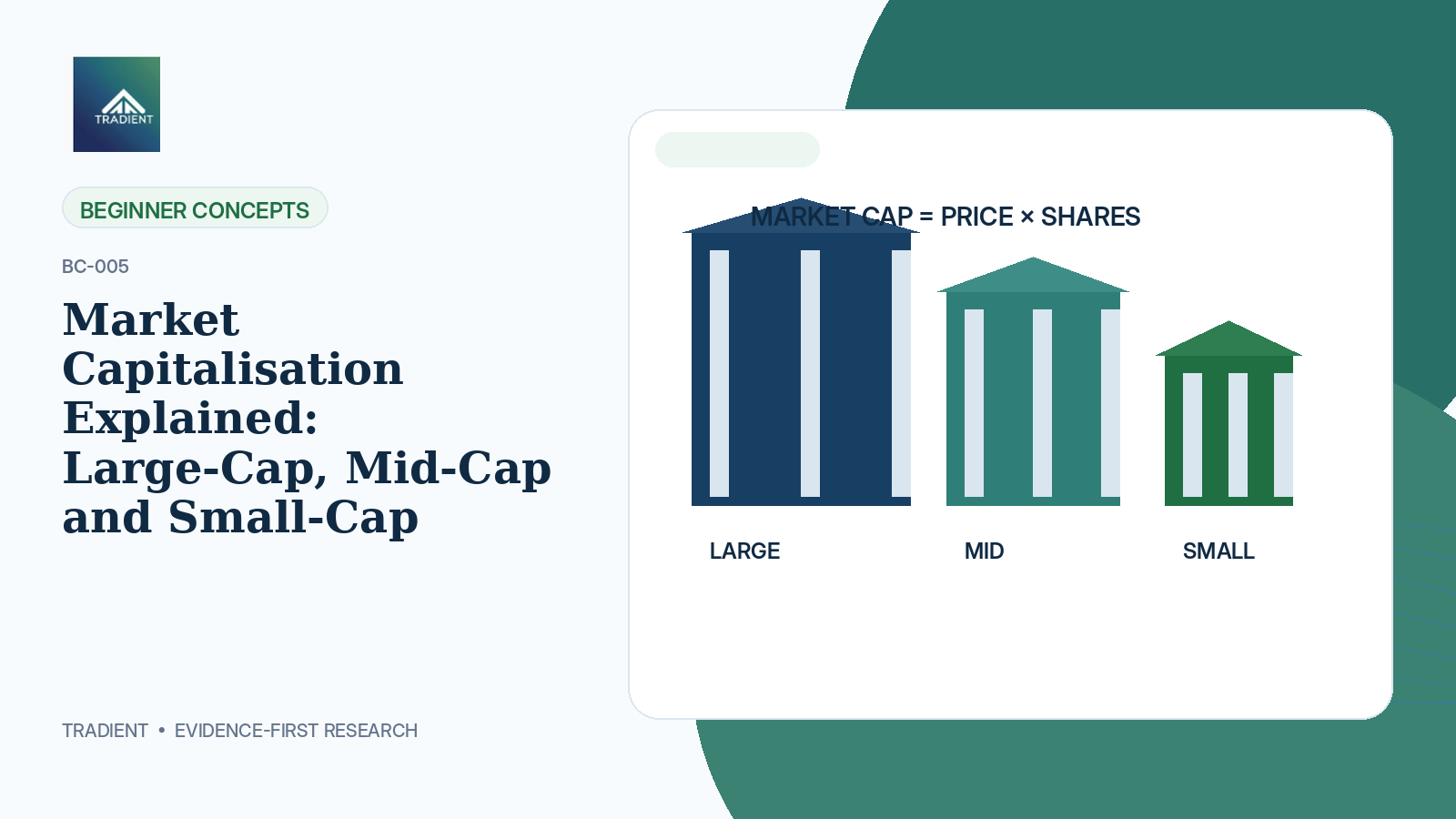
At a glance: Market capitalisation equals market price per share multiplied by the number of shares outstanding. It is a measure of the market value of a company’s equity, not a measure of revenue, profit, enterprise value or how ‘expensive’ the stock is.
A ₹3,000 share can belong to a smaller company than a ₹300 share. The price of one share tells you almost nothing about the overall size of the company unless you also know how many shares exist.
Market capitalisation solves that problem by combining price and share count. It is one of the simplest and most useful ways to compare the equity size of listed companies, and it also influences index construction, portfolio classification and investment mandates.
The market-cap formula
Market capitalisation = share price × shares outstanding.
If Company A has 100 crore shares trading at ₹200, its market capitalisation is ₹20,000 crore. If Company B has 10 crore shares trading at ₹1,000, its market capitalisation is ₹10,000 crore. Company A has the lower share price but the larger market cap.
Because the share price changes every day, market capitalisation changes every day even if the share count remains unchanged.
What market cap tells you
Market cap gives a market-based measure of the equity value assigned to a listed company. It can be useful for comparing scale, constructing indices, defining investment universes and understanding portfolio concentration.
Larger companies often have deeper trading liquidity, broader analyst coverage and more diversified businesses, but those are tendencies rather than guarantees. A large market cap does not automatically mean a company is financially strong, well governed or attractively valued.
Large-cap, mid-cap and small-cap are classification labels
In India, investment products and market participants use size classifications based on defined methodologies. The exact classification framework can depend on the regulator, index provider or investment mandate, and constituents can move from one bucket to another as rankings change.
The useful beginner lesson is that ‘large’, ‘mid’ and ‘small’ refer to relative equity-market size, not to whether a company’s share price is high or whether the business is old. A fast-growing company can migrate upward over time; a former large company can fall in rank.
Market cap is not enterprise value
Market capitalisation values the equity. Enterprise value is a broader analytical concept that adjusts for financing items such as debt and cash to approximate the value of the operating business to all capital providers.
Two companies with the same market cap can have very different debt loads. For business comparison, acquisition analysis or valuation, market cap alone can therefore be incomplete.
Free-float market capitalisation
Many equity indices use free-float or float-adjusted market capitalisation rather than total market cap. The logic is to weight shares based on the portion considered available for public trading rather than strategic holdings that are not normally part of the tradable float.
Nifty 50, for example, is calculated using a free-float market-capitalisation weighted method. BSE Indices similarly describes investable weight factors used to adjust total shares for strategic holdings.
This is why a company’s weight in an index may differ from what you would infer from its total market capitalisation alone.
Does smaller mean riskier and larger mean safer?
Smaller companies can have higher business concentration, lower liquidity, less access to capital and greater sensitivity to economic shocks. They can also offer more room for growth. Larger companies may have stronger franchises and financing access, but they can still be overvalued, disrupted or poorly managed.
Size is therefore a risk characteristic, not a substitute for analysis. Balance sheet, business quality, valuation, governance and liquidity still matter.
How to use this concept when reading the market
Treat market capitalisation explained: large-cap, mid-cap and small-cap as a framework rather than a prediction. When you see the concept mentioned in a market headline, identify the exact variable being measured, the relevant time period and the institution or methodology behind the number.
Then connect it to the decision you are actually making. A benchmark concept may help you compare performance; a market-structure concept may explain how an order is processed; a valuation concept may help you interpret a ratio. The concept is useful only when it improves the quality of a specific question.
- Market cap is share price multiplied by shares outstanding.
- A high share price does not necessarily mean a large company.
- Check the current official methodology or rule when the definition can change.
- Separate what the measure tells you from what it does not tell you.
Common beginner mistakes to avoid
A common mistake is converting a descriptive market concept into a buy-or-sell signal. Indices, liquidity measures, exchange rules and return calculations describe part of the system; they do not by themselves establish expected return.
Another mistake is memorising a current constituent count, lot size, weight or operational rule and treating it as permanent. Market infrastructure and index methodologies are maintained over time. Build the habit of checking the latest primary source when precision matters.
A five-minute verification routine
- Identify the official source: SEBI, NSE, BSE/NSE Indices, depository or issuer as relevant.
- Confirm the date of the factsheet, circular or methodology.
- Check whether the figure is price return, total return, free-float weighted or another defined measure.
- Write one sentence describing what the number does not prove.
- Only then connect the concept to a portfolio, trading or research decision.
Key takeaways
- Market cap is share price multiplied by shares outstanding.
- A high share price does not necessarily mean a large company.
- Large-cap, mid-cap and small-cap are relative size classifications that can change over time.
- Market cap values equity; enterprise value is a broader capital-structure concept.
- Free-float market cap adjusts for the portion of shares considered available to public investors.
- Company size is useful context but not a complete measure of quality, valuation or safety.
Frequently asked questions
Can market cap change without the company issuing new shares?
Yes. A change in market price changes market cap even when the number of shares is unchanged.
Does a stock split reduce market cap?
A normal stock split increases the number of shares while proportionately reducing the price per share, so it should not by itself change the company’s economic equity value.
Is a small-cap stock always cheap?
No. ‘Small-cap’ describes relative company size, not valuation. A small company can trade at an extremely high valuation multiple.
Why do indices use free-float market cap?
Free-float weighting seeks to reflect the portion of a company’s equity that is reasonably available to public investors rather than strategic holdings that are not normally traded.
This article is for educational purposes only and is not investment advice or a recommendation to buy or sell any security.
Sources and further reading