
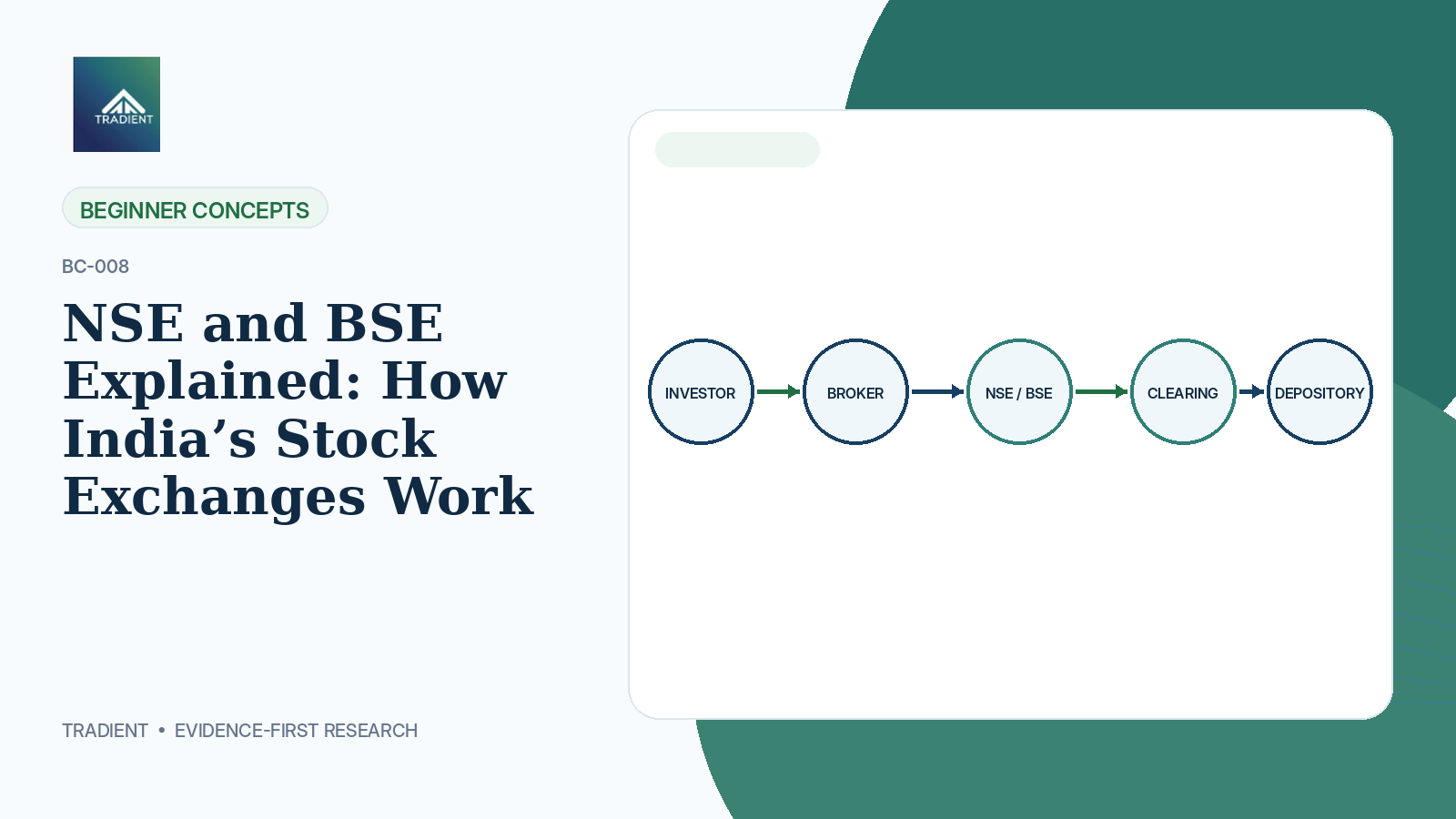
At a glance: NSE and BSE are regulated stock exchanges that organise trading in listed securities and derivatives. They are part of a larger infrastructure that includes brokers, clearing corporations and depositories; the exchange itself is not your broker or your demat account.
When an investor taps ‘Buy’ in a broker app, several institutions work together before the security finally appears as a settled holding. The exchange is central to that process, but it is only one part of the architecture.
India’s two best-known equity exchanges are the National Stock Exchange of India (NSE) and BSE Ltd. Both provide electronic markets and operate within a regulatory framework overseen by SEBI.
What a stock exchange actually does
An exchange provides an organised marketplace and rulebook for trading eligible securities. It operates trading systems, disseminates market data, defines contract specifications for permitted products, monitors trading and coordinates with clearing and settlement infrastructure.
For the investor, the visible output is an order book and market price. Behind that screen are controls designed to support fair access, surveillance, risk management and orderly markets.
Your broker is the access layer
Retail investors generally do not send orders directly to an exchange as independent members. They use a registered stock broker that provides the trading interface, performs required client checks, applies risk controls and routes orders to the exchange.
This distinction matters when troubleshooting an order. A rejected order may be caused by broker-level risk controls, exchange rules, product eligibility, available margin or account status. ‘The exchange rejected it’ is not always the correct explanation.
Clearing and settlement happen after the trade
Once a trade is executed, obligations must be determined and settled. Clearing corporations stand between market participants and manage the financial and delivery obligations according to the applicable framework.
Depositories and depository participants maintain securities in dematerialised form. Funds and securities move through the settlement process rather than directly from a stranger’s personal bank account to yours.
India’s cash-equity market operates on a T+1 rolling settlement cycle as the standard framework, alongside an optional T+0 mechanism for eligible activity under the evolving framework.
NSE and BSE can list many of the same companies
A company can be listed on more than one recognised exchange. The same company’s shares may therefore trade on NSE and BSE, often with slightly different order-book depth and prices at a particular instant.
Arbitrage and market participation generally keep prices closely related in liquid securities, but execution quality can differ. Investors should pay attention to liquidity rather than assuming one exchange is always better for every security.
Indices are not exchanges
Nifty 50 is an index associated with NSE Indices; Sensex is a BSE benchmark. Neither is an exchange. An index is a rules-based statistical portfolio used to measure a market segment.
This distinction is important because people sometimes say ‘Nifty went up’ as shorthand for the market. The exchange contains far more securities than the headline index, and many stocks can fall even on a day when the index rises.
What an exchange does not guarantee
Exchange listing does not guarantee that a company will be profitable, that the share price will rise or that investors cannot suffer losses. Regulation and market infrastructure aim to support integrity and disclosure; they do not remove business risk, valuation risk or market volatility.
How to use this concept when reading the market
Treat nse and bse explained: how india’s stock exchanges work as a framework rather than a prediction. When you see the concept mentioned in a market headline, identify the exact variable being measured, the relevant time period and the institution or methodology behind the number.
Then connect it to the decision you are actually making. A benchmark concept may help you compare performance; a market-structure concept may explain how an order is processed; a valuation concept may help you interpret a ratio. The concept is useful only when it improves the quality of a specific question.
- NSE and BSE are stock exchanges, not brokers or depositories.
- Brokers provide client access and risk controls; exchanges operate trading markets.
- Check the current official methodology or rule when the definition can change.
- Separate what the measure tells you from what it does not tell you.
Common beginner mistakes to avoid
A common mistake is converting a descriptive market concept into a buy-or-sell signal. Indices, liquidity measures, exchange rules and return calculations describe part of the system; they do not by themselves establish expected return.
Another mistake is memorising a current constituent count, lot size, weight or operational rule and treating it as permanent. Market infrastructure and index methodologies are maintained over time. Build the habit of checking the latest primary source when precision matters.
A five-minute verification routine
- Identify the official source: SEBI, NSE, BSE/NSE Indices, depository or issuer as relevant.
- Confirm the date of the factsheet, circular or methodology.
- Check whether the figure is price return, total return, free-float weighted or another defined measure.
- Write one sentence describing what the number does not prove.
- Only then connect the concept to a portfolio, trading or research decision.
Key takeaways
- NSE and BSE are stock exchanges, not brokers or depositories.
- Brokers provide client access and risk controls; exchanges operate trading markets.
- Clearing corporations and depositories are essential parts of post-trade settlement.
- The same company can trade on more than one exchange.
- Nifty 50 and Sensex are indices, not exchanges.
- A regulated exchange supports market integrity but cannot guarantee investment returns.
Frequently asked questions
Is NSE bigger than BSE?
Different measures can produce different comparisons. For a beginner, the more useful question is which exchange has suitable liquidity and product availability for the security being traded.
Do I need separate demat accounts for NSE and BSE?
No. A demat account holds eligible securities in depository form; exchange choice relates to where the trade executes, not to creating a separate holding account for each exchange.
Can NSE and BSE show different prices for the same stock?
Yes, small differences can occur because each exchange has its own order book. In liquid securities those differences are often small and temporary.
Who regulates stock exchanges in India?
SEBI is the securities-market regulator. Exchanges and other market infrastructure institutions operate within the applicable legal and regulatory framework.
This article is for educational purposes only and is not investment advice or a recommendation to buy or sell any security.
Sources and further reading