
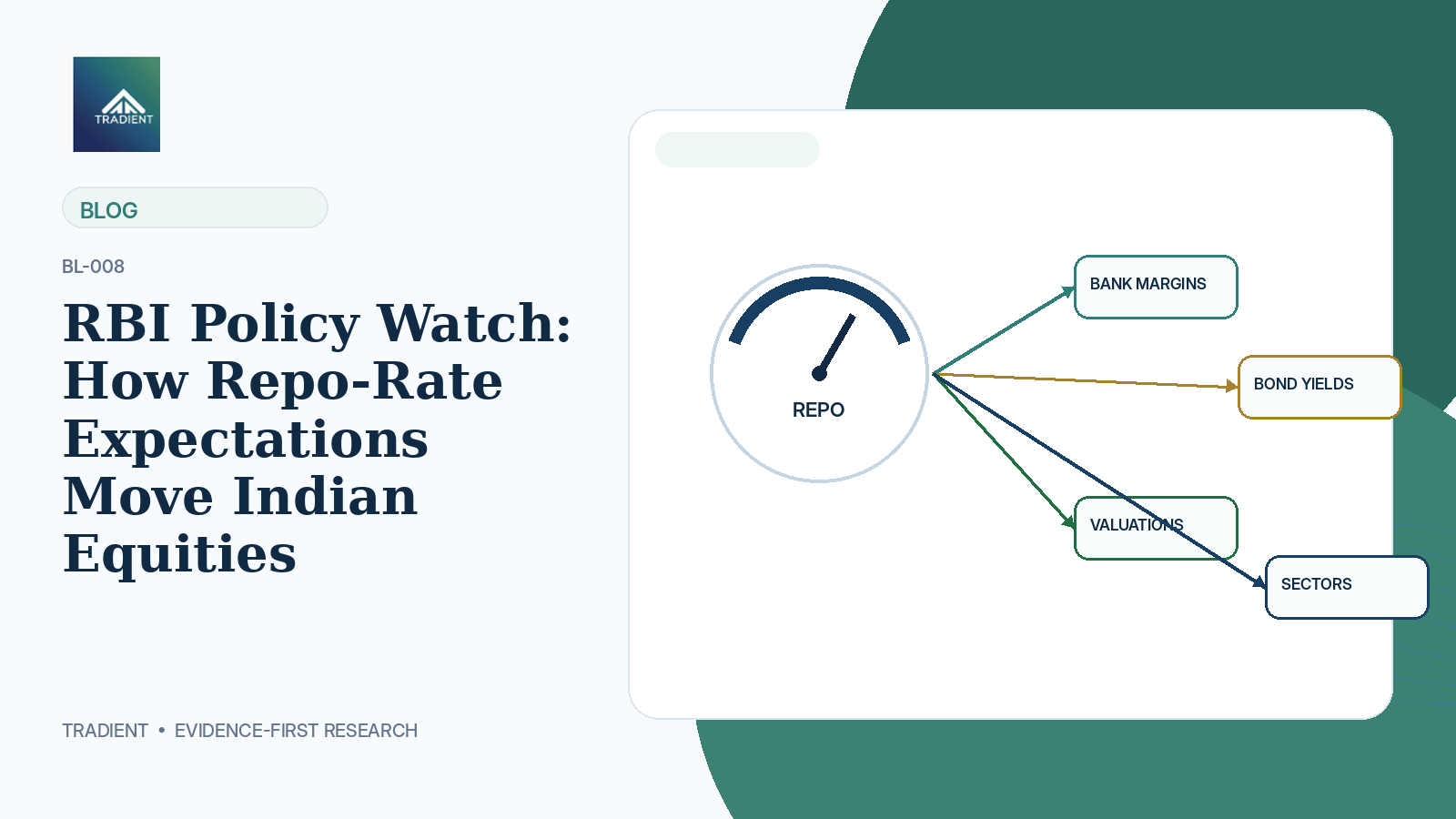
At a glance: As of RBI’s 6 August 2026 published rates, the policy repo rate was 5.25%, with the SDF at 5.00% and MSF at 5.50%. For equities, however, the market reaction depends less on the number alone than on what investors had expected before the announcement.
A repo-rate decision arrives as one headline, but markets price a much larger information set: inflation, growth, liquidity, transmission, currency conditions and the likely policy path.
This is why an unchanged rate can trigger a large market move while a rate cut can produce little reaction—or even a decline. Markets trade surprises and future cash-flow expectations, not labels.
The repo rate is the centre of the policy corridor
The Monetary Policy Committee sets the policy repo rate. The RBI’s operating framework uses liquidity operations to keep short-term money-market conditions aligned with the policy stance.
In the published August 2026 rate snapshot, the repo was 5.25%, the Standing Deposit Facility 5.00% and the Marginal Standing Facility 5.50%, creating a corridor around the policy rate.
Why expectations matter more than direction
Suppose investors strongly expect a 25-basis-point cut. If RBI holds rates unchanged and communicates concern about inflation, bond yields and rate-sensitive equities can react as though policy has tightened relative to expectations.
Conversely, an unchanged rate can be received positively if investors had feared a hike or if guidance implies easier conditions ahead.
Transmission to equities works through several channels
- Discount rates used to value future cash flows
- Bank funding and lending-rate dynamics
- Household borrowing costs and discretionary demand
- Corporate financing and capital expenditure
- Bond yields and the relative attractiveness of equities
- Currency and foreign capital-flow expectations
- Liquidity conditions in the financial system
Banks have a two-sided rate sensitivity
Lower rates can support credit demand and reduce borrower stress, but they can also compress asset yields faster than deposit costs adjust. Higher rates can support asset yields while raising funding costs and credit risk.
Nifty Bank therefore should not be traded from a simple ‘rate cut equals banks up’ rule. The starting margin structure, deposit competition and guidance matter.
Growth and inflation can dominate the rate headline
A cut driven by collapsing growth expectations may be less positive for cyclical equities than a cut delivered into stable growth and moderating inflation.
Likewise, a hike that restores inflation credibility may have different long-run implications from a hike caused by an external shock. Policy context determines the earnings path that the market ultimately values.
Build an RBI-day checklist
- What was priced before the meeting?
- What changed in the policy rate or stance?
- How did inflation and growth projections change?
- What did RBI say about liquidity and transmission?
- How did government-bond yields and the rupee react?
- Which sectors have genuine cash-flow sensitivity rather than a narrative link?
How to use this framework without making a one-variable trade
The subject in RBI Policy Watch: How Repo-Rate Expectations Move Indian Equities should be treated as one input into a wider market process. Before taking a position, separate the policy or structural variable from earnings, valuation, positioning, liquidity and what the market had already priced.
A useful discipline is to write a base case, an upside case and a downside case. Identify which observable data would move the probability of each case. This prevents a headline—whether a circular, RBI operation or yield move—from becoming a complete investment thesis.
- What was expected before the event?
- What actually changed?
- Which cash-flow or risk channel is affected?
- What is already reflected in valuation?
- What evidence would make the current interpretation wrong?
What to verify before acting
Use primary sources for the rule or policy itself and current exchange specifications for contract-level details. Secondary reporting can be useful for context, but a trading system should not rely on a news summary when the operative circular or specification is available.
Also check the effective date. Indian market reforms are frequently phased, and an announcement date is not always the date on which every operational provision becomes active.
Key takeaways
- Equities respond to the policy surprise and future path, not just the direction of the repo move.
- RBI’s August 2026 published repo rate was 5.25%.
- Rates influence equities through discount rates, credit, funding, demand and relative asset valuation.
- Banking-sector responses are two-sided and depend on margins, deposits and credit quality.
- Growth and inflation context can matter more than the headline cut or hike.
- Use bond yields, guidance and liquidity commentary to interpret the equity reaction.
Frequently asked questions
Do rate cuts always make stocks rise?
No. Markets may have priced the cut already, or the cut may signal weaker growth. Sector and valuation starting points matter.
Why can banks fall after a rate cut?
Investors may worry about margin compression, weak credit demand or other factors even when lower rates help borrowers.
What should I watch besides repo rate?
Inflation/growth projections, liquidity, policy stance, bond yields, currency reaction and the guidance for future decisions.
How often is this article refreshed?
It should be reviewed after material RBI policy changes because the current-rate context is time-sensitive.
Regulatory positions, exchange specifications and macroeconomic conditions can change. This article was fact-checked against the cited sources available on 3 September 2026. It is intended for educational purposes only and does not constitute legal, compliance, financial or investment advice. Readers should verify the latest official documentation before acting.
Sources and further reading