
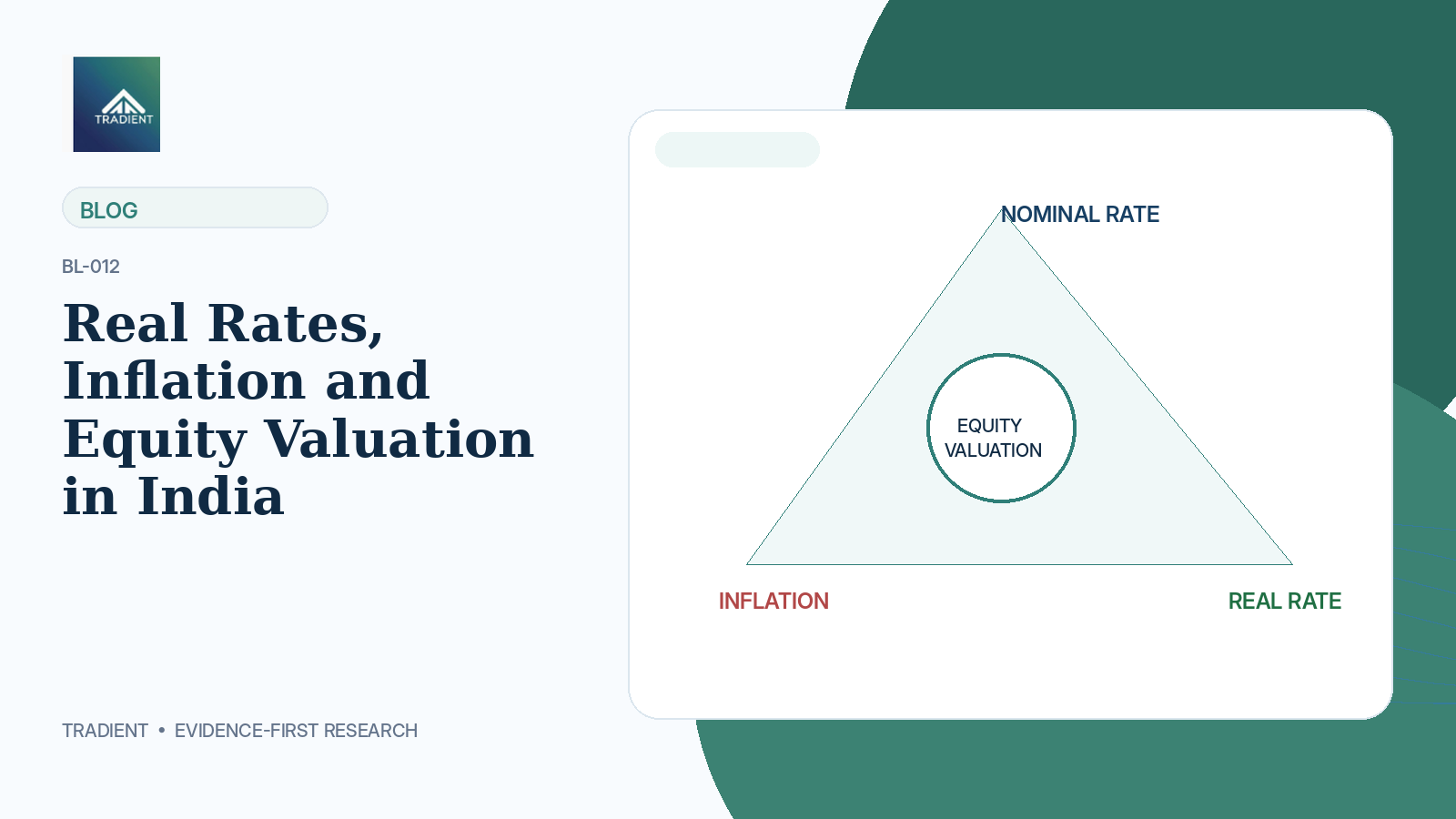
At a glance: Inflation and interest rates should not be analysed separately. A 7% nominal yield in a 6% inflation environment represents a very different real return from the same yield when inflation is 3%.
Equity investors often ask whether inflation is ‘good’ or ‘bad’ for stocks. The more useful framework is to ask how inflation changes nominal growth, input costs, pricing power, interest rates and the real return available from competing assets.
Real rates help connect those forces. They are not directly observable in one perfect number because expected inflation matters, but the concept is valuable for valuation.
Nominal rate versus real rate
A nominal interest rate is quoted in current rupees. A real rate adjusts for inflation or expected inflation to approximate the change in purchasing power.
At a basic level, a higher real risk-free return can increase the hurdle that investors demand from equities. A very low or negative real return on safe assets can have the opposite relative-valuation effect, all else equal.
Inflation can lift revenue and damage margins at the same time
Companies with pricing power may pass higher input costs to customers and report faster nominal revenue growth. Others may face compressed margins because costs rise faster than selling prices.
This is why an index-level inflation story can conceal major sector differences.
Rate response determines the valuation channel
If inflation rises and monetary policy tightens, nominal and real discount rates can move higher. That can compress equity multiples even before earnings slow.
If inflation falls without a collapse in growth, real financial conditions may ease and valuations can receive support. Markets therefore care about the inflation-growth-policy combination.
Sectors have different inflation exposure
- Consumer brands: pricing power versus demand elasticity
- Industrials: commodity and wage inputs versus order-book repricing
- Banks: nominal credit growth, margins and asset quality
- IT exporters: wage inflation, client demand and currency
- Utilities: regulated tariffs and financing cost
- Real estate: construction costs, mortgage rates and nominal asset prices
Use expected inflation carefully
Equity prices discount the future, so realised historical inflation is not the only relevant variable. Bond curves, surveys and market expectations can provide signals about future inflation, but none is perfect.
An investor should therefore test a range of real-rate scenarios rather than relying on one precise forecast.
Valuation still begins with company economics
A macro regime can influence the discount rate, but a stock’s outcome also depends on earnings, competitive advantage, balance sheet and starting price.
Real-rate analysis is best used as a framework for scenario risk, not as a replacement for company-level research.
How to use this framework without making a one-variable trade
The subject in Real Rates, Inflation and Equity Valuation in India should be treated as one input into a wider market process. Before taking a position, separate the policy or structural variable from earnings, valuation, positioning, liquidity and what the market had already priced.
A useful discipline is to write a base case, an upside case and a downside case. Identify which observable data would move the probability of each case. This prevents a headline—whether a circular, RBI operation or yield move—from becoming a complete investment thesis.
- What was expected before the event?
- What actually changed?
- Which cash-flow or risk channel is affected?
- What is already reflected in valuation?
- What evidence would make the current interpretation wrong?
What to verify before acting
Use primary sources for the rule or policy itself and current exchange specifications for contract-level details. Secondary reporting can be useful for context, but a trading system should not rely on a news summary when the operative circular or specification is available.
Also check the effective date. Indian market reforms are frequently phased, and an announcement date is not always the date on which every operational provision becomes active.
Key takeaways
- Real rates adjust nominal returns for inflation and help frame the equity hurdle rate.
- Inflation can raise nominal revenue while compressing margins.
- The policy response to inflation determines much of the valuation effect.
- Sector pricing power and financing dependence create different exposures.
- Expected inflation matters because equity valuation is forward-looking.
- Macro analysis should supplement, not replace, company-level economics and valuation.
Frequently asked questions
How do I calculate a real rate?
A simple approximation subtracts expected inflation from the nominal rate. More exact compounding formulas can be used, and the key challenge is choosing a sensible inflation expectation.
Is high inflation always bad for equities?
No. Some companies can pass through inflation and grow nominal earnings. The impact depends on margins, rates and valuation.
Why do real rates affect growth stocks?
Higher real discount rates reduce the present value of distant future cash flows, all else equal.
Can falling inflation be negative for stocks?
Yes if it reflects collapsing demand or falling pricing power. The growth context matters.
Regulatory positions, exchange specifications and macroeconomic conditions can change. This article was fact-checked against the cited sources available on 3 September 2026. It is intended for educational purposes only and does not constitute legal, compliance, financial or investment advice. Readers should verify the latest official documentation before acting.
Sources and further reading