
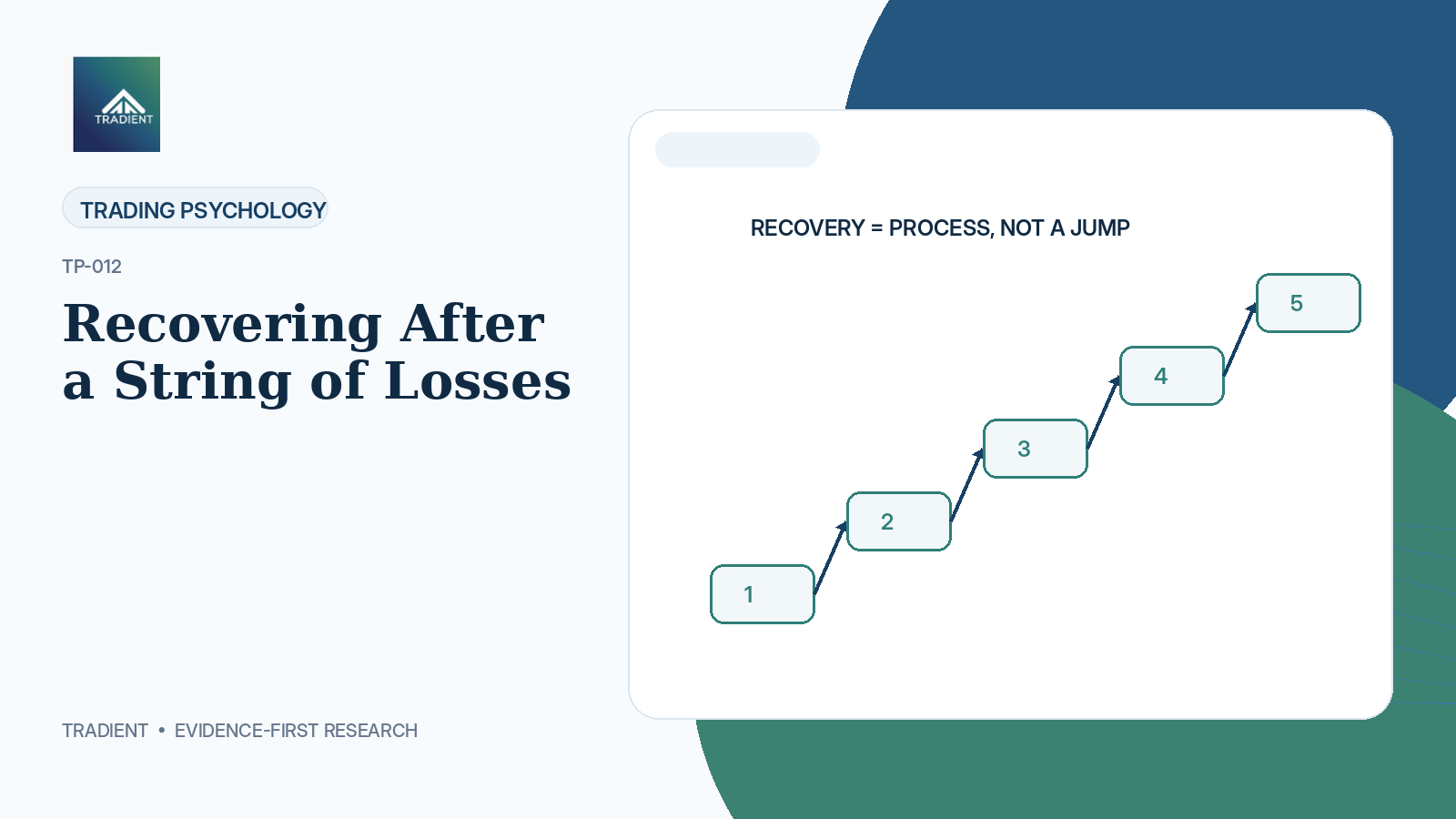
At a glance: The first recovery target after a losing streak is not breakeven. It is restoration of decision quality. Once process quality is stable, financial recovery can be judged on the normal timescale of the strategy.
Consecutive losses change the emotional context of the next trade. A setup that looked routine a week earlier can suddenly feel threatening—or irresistible because it offers a chance to recover.
That makes the post-loss period a special risk regime. The trader needs a recovery protocol that protects both capital and decision quality.
Pause long enough to classify the losses
Review whether the losing trades were valid strategy outcomes, execution errors or a mixture. A string of small planned losses requires a different response from missed stops and impulsive re-entries.
Without classification, the trader may change a good strategy to solve an execution problem or focus on psychology when the signal itself has genuinely deteriorated.
Remove the breakeven deadline
The previous equity high is emotionally salient but it is not a market deadline. Trying to recover by Friday, by month-end or in the next three trades creates artificial urgency.
The market does not offer better opportunities merely because the trader recently lost money. Recovery should occur only when valid opportunities appear.
Rebuild with controlled size
If confidence or process quality has been damaged, temporary size reduction can lower financial and cognitive pressure. The purpose is not to avoid every loss; it is to make correct execution easier to observe.
The rule for returning to normal size should also be explicit—for example, a number of correctly executed trades or completion of a review—not simply the first profitable day.
Focus on behaviour metrics
- Percentage of trades that met setup criteria
- Risk amount versus plan
- Stop and exit adherence
- Number of unplanned trades
- Quality of pre-trade notes
- Whether the daily loss or trade-count limits were respected
Do not demand a winning trade to restore confidence
Confidence built only from a profitable outcome is fragile because the next loss removes it again. Process confidence comes from executing a valid trade correctly even when it loses.
A planned loss can therefore be a successful recovery trade if it proves that discipline has returned.
Escalate the review if the evidence changes
If performance falls outside the strategy’s expected distribution, execution costs change materially or market structure changes, the problem may not be psychological.
Pause live deployment and investigate the model, data and assumptions. ‘Stay disciplined’ is not a substitute for validating that an edge still exists.
A practical drill for the next 20 trades
Do not try to change the behaviour after one observation. For the next 20 relevant trades, record the trigger, the emotion or urge, the planned action and the action actually taken. Keep the form short enough that it is completed consistently.
At the end of the sample, look for repeated conditions rather than isolated stories. The purpose is to discover whether the behaviour appears after losses, after wins, at a particular time of day, at larger size or in fast-moving instruments. A repeated pattern is easier to redesign than a vague belief that discipline is weak.
- Setup grade before entry
- Planned rupee risk
- Dominant emotion or urge
- Any rule change after entry
- Process grade independent of P&L
What improvement should look like
Improvement does not require the emotion to disappear. A better standard is behavioural: recovery begins with classifying losses as strategy variance, process error or both. The trader should be able to recognise the relevant state without automatically converting it into an order.
Track fewer rule violations, more stable position sizing and a smaller gap between planned and actual actions. Profitability is important over a meaningful sample, but process improvement can be observed earlier than the equity curve.
When to step back from live risk
If the behaviour repeatedly produces outsized losses, cancelled stops, uncontrolled leverage or an inability to follow a daily risk limit, the appropriate response may be to reduce or pause live exposure while the process is rebuilt.
Psychology work is not a justification for enduring unsafe risk. A trader should also investigate whether strategy design, platform mechanics, sleep, workload or position size is creating a problem that self-talk alone cannot solve.
Key takeaways
- Recovery begins with classifying losses as strategy variance, process error or both.
- Do not impose a deadline for returning to breakeven.
- Temporary size reduction can help restore decision quality.
- Track behaviour metrics rather than requiring immediate profits.
- A correctly executed losing trade can still show that recovery is working.
- Escalate to strategy research when evidence points to structural deterioration.
Frequently asked questions
How many losses in a row should make me stop?
There is no universal number. Use the distribution and risk thresholds of your strategy, plus any hard daily or weekly limits.
Should I switch to paper trading?
It can be useful for execution practice, but it does not reproduce all emotional and liquidity effects of live trading. Define what the paper phase is meant to test.
When should normal size return?
Use a predefined criterion such as verified process consistency and completed review, not merely one winning trade.
What if the losing streak was statistically normal?
Then the main task may be to maintain correct execution and appropriate sizing rather than redesigning the strategy.
This article is for educational purposes only and is not investment advice or a recommendation to buy or sell any security.
Sources and further reading