
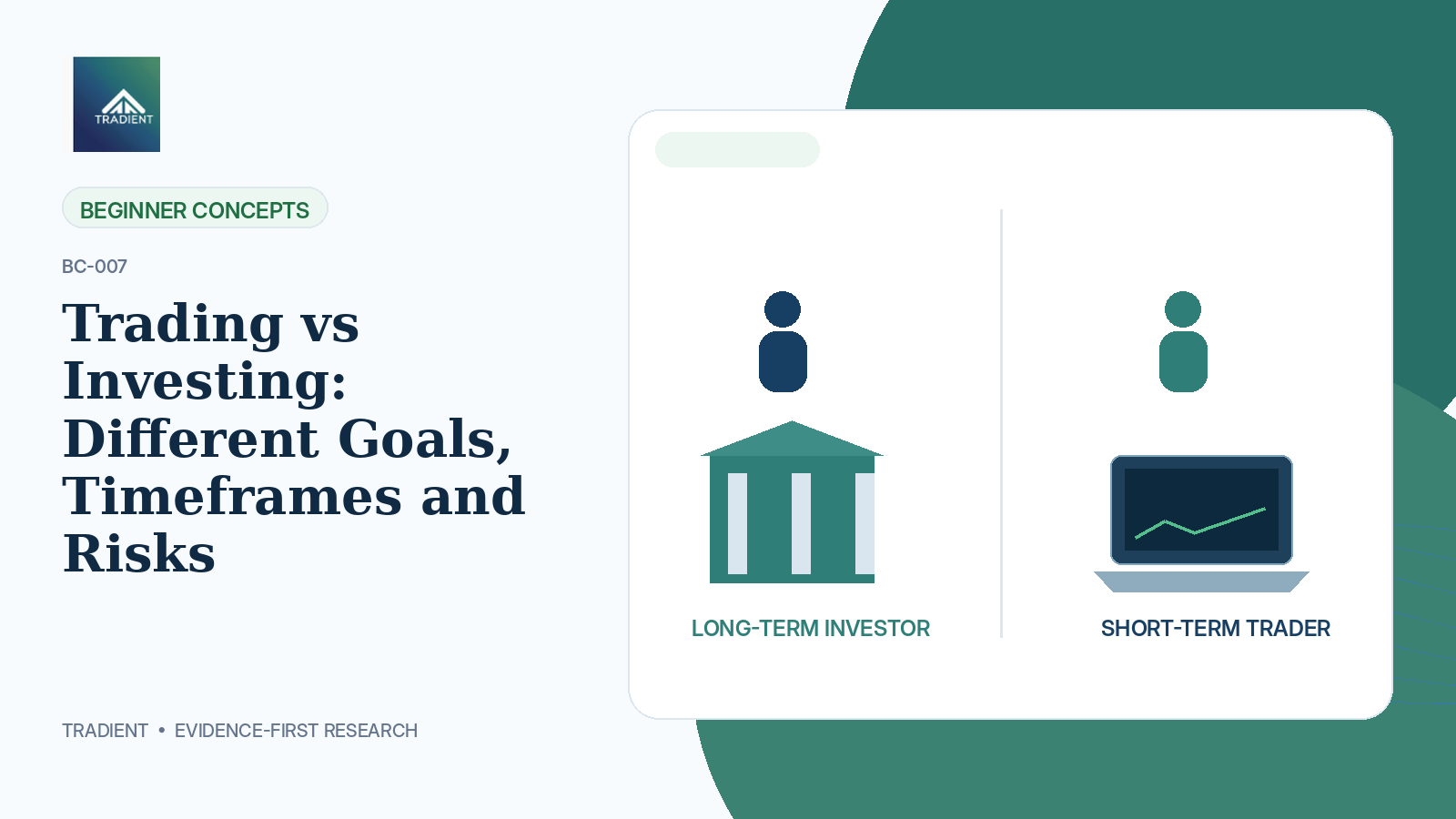
At a glance: Investing generally seeks to compound capital by owning assets whose economic value can grow over time. Trading generally seeks to profit from shorter-horizon price movements. Neither approach is automatically superior; each requires a process matched to its horizon and risks.
Many market mistakes begin when a person enters a position as a trade and, after it falls, quietly calls it a long-term investment. The opposite happens too: someone buys a business for a multi-year thesis but sells after two weak sessions because the price chart looks uncomfortable.
Trading and investing can use the same security, but the thesis, holding period, evidence and risk controls are different. A disciplined participant decides which game is being played before the position is taken.
What makes an activity ‘investing’?
Investing usually focuses on the economics of an asset over a longer horizon. For an equity investor, that can mean analysing the company’s competitive position, growth runway, cash generation, balance sheet, governance, reinvestment opportunities and valuation.
The investor expects much of the return to come from the business creating value over time, although changes in market valuation also matter. A temporary price decline does not automatically invalidate the thesis if the underlying evidence remains intact.
What makes an activity ‘trading’?
Trading generally has a shorter decision horizon and gives greater weight to price behaviour, volatility, catalysts, positioning, liquidity and defined entry-exit conditions.
A trader does not need to believe that the underlying company is a wonderful ten-year compounder. The trader needs a repeatable edge, appropriate risk control and execution that is consistent with the strategy’s statistical assumptions.
Because turnover is usually higher, transaction costs, slippage and taxes can have a larger impact on trading outcomes.
The same stock can be both an investment and a trade
Suppose a bank’s shares are purchased by Investor A because of a five-year thesis on credit growth, asset quality and return on equity. Trader B buys the same shares ahead of a technical breakout with a two-day holding horizon.
Both can be rational. The danger arises if Trader B ignores the stop because ‘the bank is a good company’, or Investor A sells solely because the breakout fails despite no change in the long-term thesis. The decision rule must match the original objective.
Risk management differs by horizon
A trader may define risk through stop levels, volatility, time stops, maximum daily loss and position size. An investor may focus more on diversification, business downside, balance-sheet stress, valuation, thesis invalidation and the possibility of permanent capital loss.
Longer horizon does not mean ‘no risk management’. It means risk is measured against a different set of events. Likewise, a tight stop is not proof of discipline if the underlying strategy has no evidence that such stops improve outcomes.
Turnover is a hidden strategic variable
Every trade creates friction: brokerage where applicable, exchange charges, taxes, bid-ask spread and potential market impact. A high-turnover strategy must generate enough gross edge to overcome those costs.
Academic research on individual investors has repeatedly found that excessive trading can damage realised performance. That does not prove all active trading is futile, but it raises the burden of evidence: more activity is not the same as more skill.
A useful pre-trade classification
- Why am I entering this position?
- What evidence would prove the thesis wrong?
- What is the expected holding period?
- How will the position be sized?
- What costs matter at this turnover level?
- Am I allowed to change the horizon after entry? If yes, under what documented rule?
How to use this concept when reading the market
Treat trading vs investing: different goals, timeframes and risks as a framework rather than a prediction. When you see the concept mentioned in a market headline, identify the exact variable being measured, the relevant time period and the institution or methodology behind the number.
Then connect it to the decision you are actually making. A benchmark concept may help you compare performance; a market-structure concept may explain how an order is processed; a valuation concept may help you interpret a ratio. The concept is useful only when it improves the quality of a specific question.
- Trading and investing differ mainly in horizon, evidence and risk process, not in the ticker symbol used.
- A trade should not become an ‘investment’ merely because it is losing.
- Check the current official methodology or rule when the definition can change.
- Separate what the measure tells you from what it does not tell you.
Common beginner mistakes to avoid
A common mistake is converting a descriptive market concept into a buy-or-sell signal. Indices, liquidity measures, exchange rules and return calculations describe part of the system; they do not by themselves establish expected return.
Another mistake is memorising a current constituent count, lot size, weight or operational rule and treating it as permanent. Market infrastructure and index methodologies are maintained over time. Build the habit of checking the latest primary source when precision matters.
A five-minute verification routine
- Identify the official source: SEBI, NSE, BSE/NSE Indices, depository or issuer as relevant.
- Confirm the date of the factsheet, circular or methodology.
- Check whether the figure is price return, total return, free-float weighted or another defined measure.
- Write one sentence describing what the number does not prove.
- Only then connect the concept to a portfolio, trading or research decision.
Key takeaways
- Trading and investing differ mainly in horizon, evidence and risk process, not in the ticker symbol used.
- A trade should not become an ‘investment’ merely because it is losing.
- Investors still need exit rules based on thesis failure or valuation; traders still need a defensible edge.
- Higher turnover makes costs and execution more important.
- The same market can support multiple rational strategies with different objectives.
- Define the game before entering the position and judge outcomes against that process.
Frequently asked questions
Is trading riskier than investing?
It can be, especially with leverage, high turnover or weak controls, but long-term investing also carries business, valuation and concentration risk. Risk depends on strategy and implementation.
Can I be both a trader and an investor?
Yes, but it is useful to separate capital, rules and records so that one strategy’s rationale is not used to excuse mistakes in the other.
Is holding a stock for years automatically investing?
No. Holding period alone does not create an investment process. A neglected losing trade can be held for years without becoming a sound investment.
Do professional investors trade?
Yes. Portfolio managers may rebalance, hedge or make tactical trades. The distinction is about objective and decision process rather than whether transactions occur.
This article is for educational purposes only and is not investment advice or a recommendation to buy or sell any security.
Sources and further reading