
AT A GLANCE
- The stock market is more than a screen of moving prices. It is an economic system that connects companies that need capital with investors who are willing to own a share of those businesses.
Last reviewed: 3 September 2026
When people first hear the words “stock market,” they often imagine flashing prices, television anchors, intraday charts, and traders shouting “buy” or “sell.” But that picture misses the real purpose of the market.
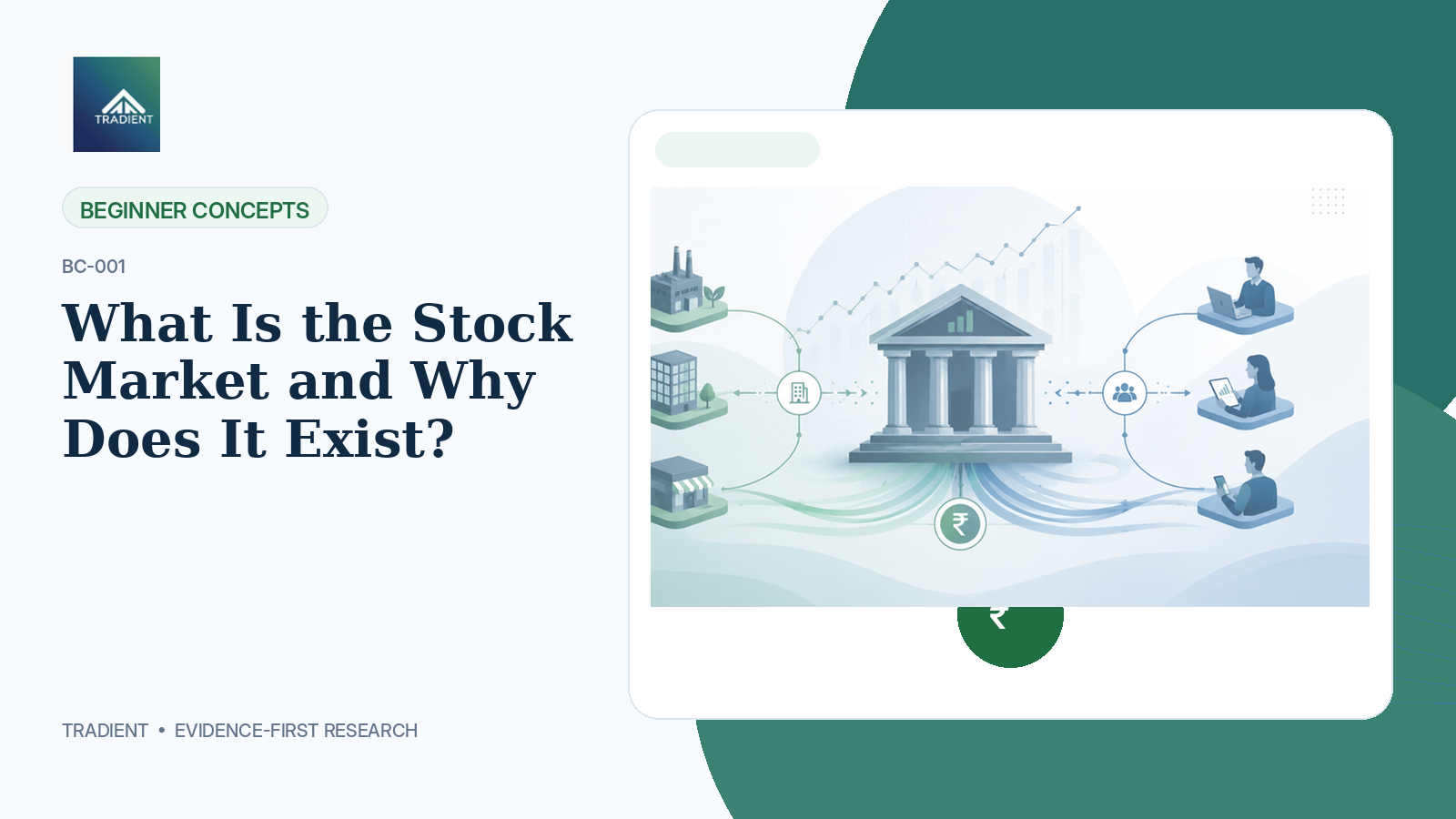
At its core, the stock market is an organised system for connecting two groups. On one side are businesses that need capital to grow. On the other are investors who are willing to provide capital in exchange for ownership and the possibility of future returns.
That simple connection — capital in exchange for ownership — is the reason stock markets exist.
Once you understand that, ideas such as IPOs, share prices, stock exchanges, indices, dividends, market crashes and long-term investing become much easier to understand.
The stock market in one sentence
A stock market is a regulated marketplace where ownership interests in publicly listed companies can be issued, bought and sold.
A “share” represents a fractional ownership interest in a company. If a company has divided its equity into 10 crore shares and you own 1,000 of them, you own a very small part of that business. Your ownership does not mean you can walk into the company’s office and take a chair home, but it does give you economic rights associated with those shares, subject to the company’s structure and applicable law.
Why do companies need a stock market?
Businesses need money to build factories, hire employees, develop products, enter new markets, acquire other businesses, invest in technology and strengthen their balance sheets.
A growing company broadly has several ways to obtain capital. It can use profits generated internally. It can borrow money. Or it can raise equity capital by issuing ownership shares.
Debt and equity are very different. A loan generally creates an obligation to pay interest and repay principal. Equity does not work that way. Equity investors provide capital in exchange for a claim on the future economics of the business.
For sufficiently large companies, the public securities market creates a mechanism for raising equity capital from a broad pool of investors rather than relying only on founders, banks or a small group of private investors.
The primary market: where shares are issued
The first important part of the stock market is the primary market.
The primary market is where new securities are issued. An Initial Public Offer, or IPO, is the best-known example. When an eligible company offers shares to the public, investors can subscribe to the issue. Subject to the structure of the issue, money raised through a fresh issue goes to the company and becomes capital it can use for stated purposes.
This is an important distinction: in the primary market, the transaction can directly help the issuer raise capital.
The primary market therefore performs one of the stock market’s most important economic functions — capital formation.
The secondary market: where investors trade with each other
After shares are listed, they can trade in the secondary market.
Suppose you bought shares in an IPO and, two years later, want to sell. The company should not have to refund your investment every time you want to exit. Instead, you can sell those shares to another investor in the secondary market.
This is what happens every trading day on exchanges such as the NSE and BSE: existing securities change hands between buyers and sellers.
The company is usually not receiving the money from each secondary-market transaction. The trade is mainly between investors.
This ability to sell an investment to another participant is called liquidity. Liquidity is one of the reasons public shares can be attractive: an investor is not necessarily locked into ownership until the company itself decides to return the capital.
Why liquidity matters to companies even when they do not receive the trade money
At first this can look strange. If Company A does not receive money when one investor sells its shares to another investor, why should the company care about the secondary market?
Because a liquid secondary market can make investors more willing to provide capital in the first place.
Imagine two businesses asking you to invest ₹1 lakh. In Business One, your money may be locked for ten years with no clear exit. In Business Two, your ownership can potentially be sold in a transparent marketplace on most trading days. All else equal, the second structure is easier for many investors to accept.
So the primary and secondary markets reinforce each other. The primary market enables capital raising. The secondary market provides liquidity and price discovery for the securities that have already been issued.
How is a stock price decided?
A stock does not have a price because an exchange employee decides what it should be worth.
In an active secondary market, prices emerge from the interaction between buy orders and sell orders. A buyer may be willing to pay ₹500. A seller may want ₹505. Another buyer may be willing to pay ₹503. As orders meet, trades occur and a market price develops.
That process is called price discovery.
Importantly, price and value are not always the same thing.
The market price tells you the price at which participants are currently willing to transact. The intrinsic value of a business is an estimate based on its future cash generation, risk, competitive position, growth and many other assumptions. Investors can disagree substantially about that value — and that disagreement itself is one reason trading exists.
Why do people buy shares?
Investors buy shares because they expect to participate in the future economics of a business.
Returns can potentially come from two broad sources:
1. Capital appreciation — the market value of the shares rises.
2. Cash distributions — for example, dividends declared by the company.
Neither is guaranteed.
A strong company can be a poor investment if bought at an excessively high price. A weak company can occasionally rise sharply because of speculation. A stock can fall despite good quarterly results if investors had expected even better numbers.
This is why stock investing requires more than identifying famous companies. It requires understanding the relationship between business quality, expectations, valuation and risk.
Who participates in the stock market?
The market includes many participants with very different objectives.
Retail investors may invest for retirement or wealth creation. Traders may hold positions for minutes, days or weeks. Mutual funds pool money from many investors. Insurance companies and pension institutions often manage long-duration capital. Foreign portfolio investors participate across markets. Proprietary trading firms may focus on market making, arbitrage or systematic strategies.
Because these participants use different time horizons and methods, the same stock can simultaneously attract a long-term investor, a short-term trader and an arbitrageur — each for a different reason.
What do stock exchanges and regulators do?
A stock market cannot function on trust alone. It needs rules, surveillance, technology, clearing, settlement and mechanisms for investor protection.
Stock exchanges provide organised trading infrastructure and rules for market participation. Clearing and settlement systems help ensure that securities and funds move between parties after trades. Depositories maintain securities in electronic form. Brokers provide investor access to the market.
In India, the Securities and Exchange Board of India — SEBI — regulates the securities market within its statutory mandate. The ecosystem includes exchanges such as NSE and BSE, depositories, clearing corporations, brokers and other regulated intermediaries.
For a beginner, the important point is simple: a modern stock market is not merely a meeting place for buyers and sellers. It is an entire regulated financial infrastructure.
Does the stock market create wealth?
The stock market can help channel savings toward productive businesses, but it is important to use the phrase “wealth creation” carefully.
A company creates economic value by selling useful products or services, allocating capital intelligently, generating cash flows and reinvesting profit at attractive returns. The market then gives investors a mechanism to own a part of that enterprise and continuously reprice that ownership.
Over long periods, successful businesses can grow earnings, assets and cash generation. If that growth is not already overpaid for in the purchase price, shareholders may benefit.
But the stock market is not a machine that automatically turns money into more money. Poor businesses can destroy capital. Overvalued securities can deliver poor returns. Leverage can amplify losses. Fraud, governance failures, industry disruption and macroeconomic shocks can damage investments.
Is the stock market the same as gambling?
No — but people can use the stock market in a gambling-like way.
Owning a share is ownership in a real business. Investing after analysing business economics, financial strength, valuation and risk is fundamentally different from making an uninformed wager.
However, constantly taking oversized positions, chasing rumours, trading without a plan, using leverage one does not understand, or treating random short-term outcomes as skill can make a market participant behave like a gambler even inside a legitimate financial market.
The instrument does not determine the behaviour. The process does.
A simple example: from business idea to listed share
Imagine a fictional company called Sunrise Foods.
The founders start the business with ₹20 lakh. Years later, the company has grown and wants to build two new manufacturing plants. It needs substantially more capital.
It could borrow. It could invite private investors. Or, if it meets the necessary conditions and chooses the public-market route, it could eventually issue shares to the public.
Investors subscribe to the new issue. The company receives equity capital according to the issue structure. The shares are then listed.
Months later, Investor A wants to sell 100 shares. Investor B wants to buy 100 shares at an acceptable price. They trade on the exchange.
Notice the full chain:
Savings → capital → business investment → ownership security → exchange listing → liquidity → continuous price discovery.
That is the economic architecture behind the moving numbers on your screen.
What should a beginner learn before buying the first stock?
A sensible beginner does not need to master every indicator or valuation model before opening a demat account. But a few concepts are worth learning first:
– What a share actually represents.
– Primary market versus secondary market.
– Market order versus limit order.
– Market capitalisation.
– Revenue, profit, cash flow and debt.
– Basic valuation ratios.
– Diversification.
– Position sizing.
– The difference between investing and trading.
– Why leverage can be dangerous.
– How transaction costs and taxes affect returns.
– How to verify information instead of acting on social-media tips.
Understanding these basics will not remove risk. It will, however, reduce the number of avoidable mistakes caused purely by not knowing how the system works.
Key takeaways
- The stock market connects businesses that need capital with investors willing to own securities.
- The primary market is where new securities are issued; the secondary market is where existing securities trade.
- Liquidity allows investors to transfer ownership without requiring the company to repay them directly.
- Market prices emerge through price discovery between buyers and sellers.
- A share is ownership in a business, but ownership does not guarantee profit.
- Stock exchanges are part of a larger regulated infrastructure involving brokers, clearing, settlement and depositories.
- The stock market is not inherently gambling, but undisciplined behaviour can turn trading into gambling-like speculation.
Frequently asked questions
What is the simplest definition of the stock market?
A regulated marketplace and infrastructure through which shares and other securities can be issued and traded.
Does a company receive money every time its shares are bought?
Usually no. In normal secondary-market trading, money moves between the buying and selling investors. The company raises capital in specific primary-market or corporate-finance transactions.
Why do share prices change every day?
Because expectations, information, demand, supply, liquidity, risk perceptions and market conditions change continuously.
Can I lose all my money in a stock?
Yes. Equity carries real risk. A company can fail, a stock can fall dramatically, and leveraged positions can be even more dangerous.
Is an IPO always a good investment?
No. An IPO is simply a route through which securities are offered to investors. Investment quality depends on the business, valuation, issue structure, risks and future performance.
How to Use This Guide as Your Stock-Market Learning Map
The stock market becomes easier to understand when the ideas are learned in the right order. Start with ownership, then learn how markets connect buyers and sellers, how exchanges and accounts support that process, how orders become transactions, how price information is displayed, how returns are measured, and finally how risk changes every decision.
1. Ownership comes first
A share represents a fractional ownership interest in a company. Before thinking about charts, trading screens or indices, understand what ownership means, what shareholders participate in, and why the value of that ownership changes as expectations about the business change. Continue with What Is a Share? Understanding Ownership in a Company.
2. Primary and secondary markets serve different purposes
Companies can raise capital in the primary market, while existing securities trade between investors in the secondary market. Confusing the two makes it harder to understand IPOs, price discovery and liquidity. See Primary Market vs Secondary Market.
3. Exchanges organise trading
In India, organised exchanges provide the infrastructure through which orders meet under defined market rules. A beginner should know what NSE and BSE do before treating a trading app as the market itself. Read NSE and BSE Explained.
4. Indices are measurement tools, not the market itself
Indices such as the Nifty 50 summarise the behaviour of a selected basket of companies. They are useful reference points, but a rising headline index does not mean every stock is rising. Build the index foundation with What Is Nifty 50 and How Is It Constructed?.
5. Accounts and intermediaries connect the investor to the market
A demat account records securities in electronic form, a trading account routes transactions, and a broker provides access to the market infrastructure. Begin with What Is a Demat Account and How Does It Work?.
6. Orders are instructions, not guarantees
A market order prioritises execution while a limit order prioritises price. The difference becomes important when liquidity is thin or prices move quickly. See Market Order vs Limit Order.
7. Learn how price information is represented
Open, high, low and close are the basic building blocks of most price charts. They do not explain why a price moved, but they provide a common language for describing what happened. Read Open, High, Low and Close.
8. Measure returns correctly
A gain of ₹100 means very little without knowing the capital invested. Percentage returns make outcomes comparable across different investments and account sizes. See Absolute Return vs Percentage Return.
9. Risk belongs in the foundation, not at the end
Every market decision involves uncertainty. A beginner should learn risk alongside returns rather than after them. The Tradient risk pillar is Investment Risk & Risk Management.
A Simple Mental Model
Business → ownership → market → exchange → account → order → price → return → risk. If a later concept feels confusing, return to this sequence and identify which layer is missing.
Beginner Checklist
- Can I explain the difference between a company and its share price?
- Do I understand why a secondary market is useful even when the company receives no money from that trade?
- Can I distinguish an exchange, broker, depository, demat account and trading account?
- Do I know the difference between a market order and a limit order?
- Can I calculate a percentage return and distinguish nominal from real return?
- Can I describe at least three different forms of investment risk?
This article is for educational purposes only and is not investment advice or a recommendation to buy or sell any security.