
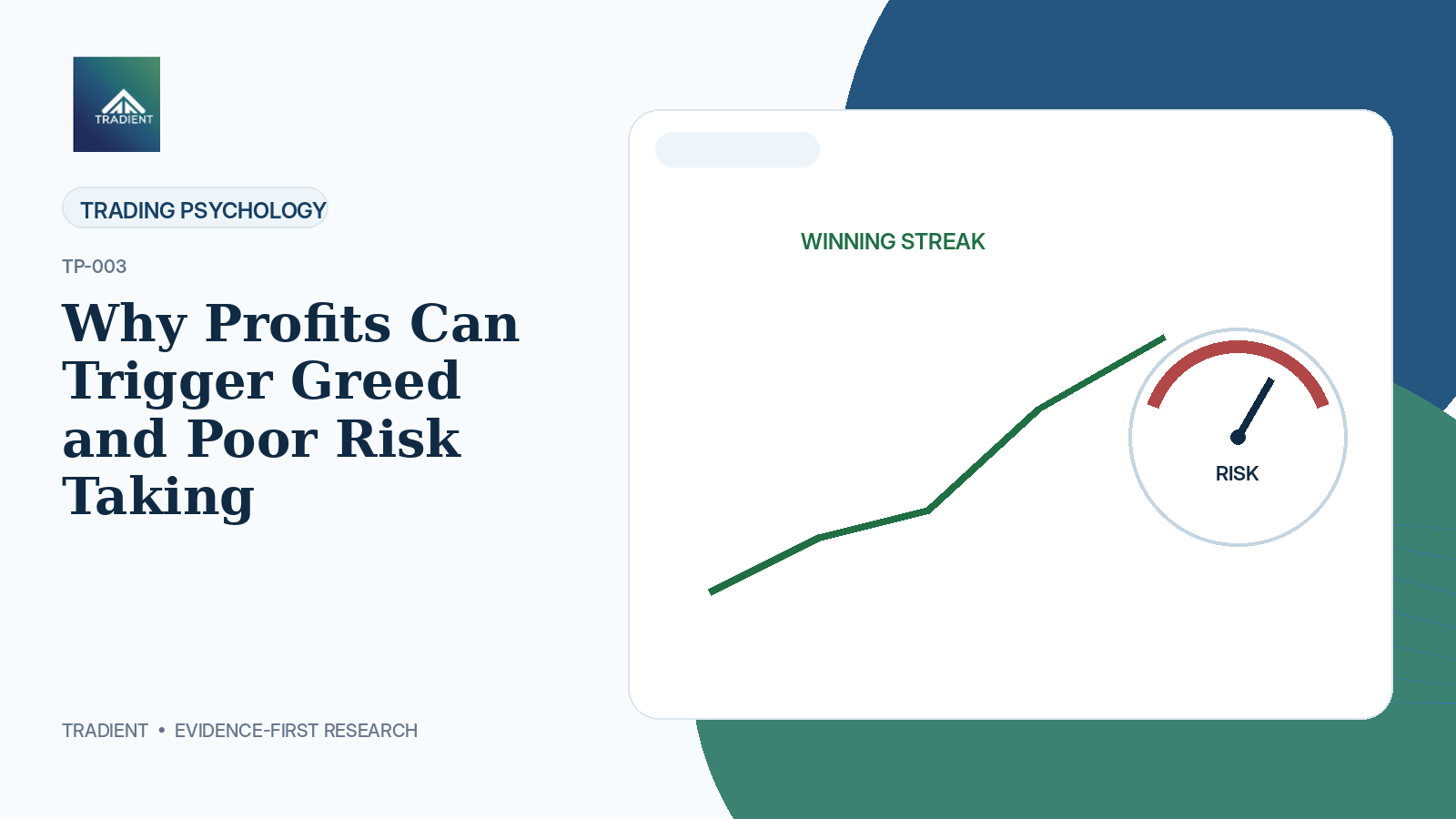
At a glance: Profits can be psychologically dangerous because they feel like evidence of skill and available ‘house money’. The disciplined response is to keep risk tied to a tested process rather than to recent excitement.
Most traders expect their worst psychological decisions to happen after losses. Yet a profitable week can be just as destabilising. Confidence rises, caution falls and ordinary setups begin to look exceptional.
The problem is not confidence itself. The problem is when recent outcomes change risk-taking faster than the evidence about the strategy has changed.
A win changes emotion faster than it changes evidence
One trade can be profitable because of skill, luck or some combination. Even a sequence of wins may occur within the normal variance of a strategy.
If a trader doubles risk simply because the last few trades worked, position size is responding to emotion rather than a statistically justified change in edge.
Overconfidence changes what gets labelled a good setup
After success, traders can become more willing to explain away missing confirmation, enter late or widen a stop because they expect the market to cooperate again.
This is a subtle quality-control failure. The written setup has not changed, but the trader’s threshold for calling something ‘valid’ has weakened.
The house-money feeling is still real money
Profits can feel psychologically separate from starting capital, making them easier to risk. But once a gain is in the account, losing it has the same economic effect on equity as losing any other capital.
A risk framework should therefore use the same sizing logic after a winning streak unless the strategy has an explicit, tested method for scaling with account equity.
Use fixed escalation rules
- Increase size only under a documented account-equity or volatility rule
- Require a minimum sample before changing assumptions about strategy edge
- Do not loosen entry criteria after a winning streak
- Keep daily and weekly loss limits active even when the month is strongly profitable
- Separate celebratory emotion from the next trading decision
Watch for speed and frequency creep
Greed does not always appear as one enormous position. It can appear as more trades, lower-quality trades and repeated re-entry because the trader wants to maximise a favourable day.
Tracking number of trades, average setup grade and risk per trade can reveal this drift earlier than looking only at profit and loss.
A good win should reinforce process, not entitlement
The best post-win review asks which parts of the process were executed correctly and which parts were simply fortunate. That keeps learning anchored to controllable behaviour.
A trader who can follow the same standards after a large win as after a quiet day is building a more durable form of confidence.
A practical drill for the next 20 trades
Do not try to change the behaviour after one observation. For the next 20 relevant trades, record the trigger, the emotion or urge, the planned action and the action actually taken. Keep the form short enough that it is completed consistently.
At the end of the sample, look for repeated conditions rather than isolated stories. The purpose is to discover whether the behaviour appears after losses, after wins, at a particular time of day, at larger size or in fast-moving instruments. A repeated pattern is easier to redesign than a vague belief that discipline is weak.
- Setup grade before entry
- Planned rupee risk
- Dominant emotion or urge
- Any rule change after entry
- Process grade independent of P&L
What improvement should look like
Improvement does not require the emotion to disappear. A better standard is behavioural: recent profits do not prove that the next trade has more edge. The trader should be able to recognise the relevant state without automatically converting it into an order.
Track fewer rule violations, more stable position sizing and a smaller gap between planned and actual actions. Profitability is important over a meaningful sample, but process improvement can be observed earlier than the equity curve.
When to step back from live risk
If the behaviour repeatedly produces outsized losses, cancelled stops, uncontrolled leverage or an inability to follow a daily risk limit, the appropriate response may be to reduce or pause live exposure while the process is rebuilt.
Psychology work is not a justification for enduring unsafe risk. A trader should also investigate whether strategy design, platform mechanics, sleep, workload or position size is creating a problem that self-talk alone cannot solve.
Key takeaways
- Recent profits do not prove that the next trade has more edge.
- Greed often appears as relaxed entry standards, larger size or excessive frequency.
- Treat accumulated profits as real account equity, not disposable house money.
- Scale risk only under documented rules, not mood.
- Track setup quality and trade frequency as well as P&L.
- Use winning trades to reinforce process rather than a sense of entitlement.
Frequently asked questions
Should I never increase size after making money?
Size can increase as equity grows if that is part of a predefined risk model. The warning is against discretionary jumps driven by excitement.
How do I know confidence has become overconfidence?
Look for behavioural changes: more trades, weaker setups, larger discretionary risk or reduced willingness to accept invalidation.
Is taking profit itself greedy?
No. Greed refers to the decision process, not simply wanting returns. A planned profit target or trailing method can be disciplined.
Can a winning streak justify changing a strategy?
Only with sufficient evidence. Small samples are noisy, so structural changes should be based on broader analysis rather than recent outcomes alone.
This article is for educational purposes only and is not investment advice or a recommendation to buy or sell any security.
Sources and further reading