
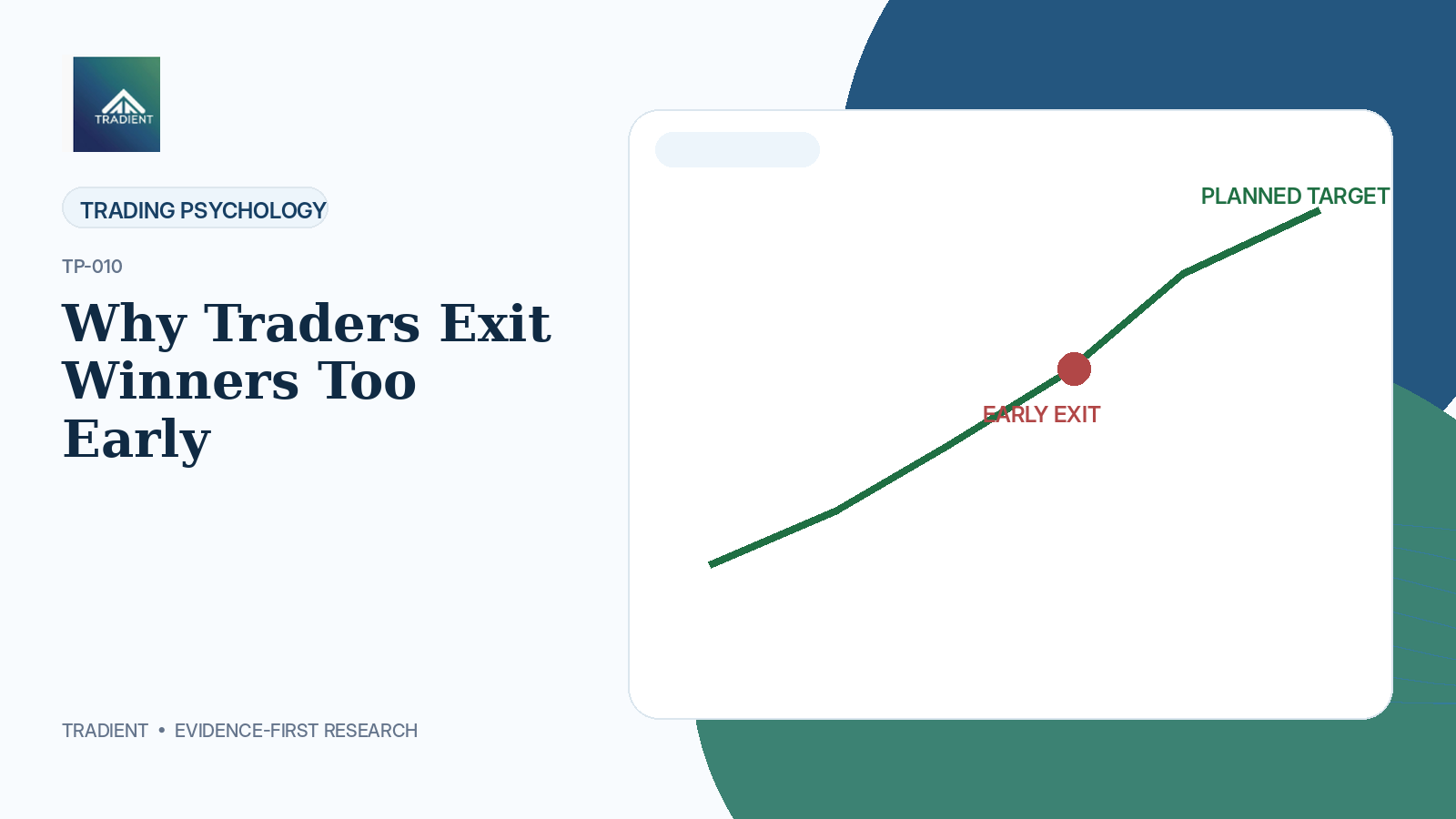
At a glance: Taking a profit is not automatically disciplined. A good exit is one that fits the strategy. If winners are repeatedly cut short simply to stop the anxiety of giving back gains, the payoff structure can deteriorate.
A green position often feels fragile. The trader has something to lose now: an unrealised gain that can shrink if the market reverses.
That creates a temptation to turn uncertainty into certainty by closing the trade. The relief is real, but it may come at the cost of the strategy’s expected payoff.
Unrealised profit becomes a new reference point
Once a position is profitable, the account may mentally ‘own’ the highest unrealised gain. A pullback then feels like losing money even if the trade remains above entry.
This can make the trader respond to the peak-to-current decline rather than to the planned target, trailing rule or market structure.
Small frequent wins can hide poor expectancy
A strategy can win often and still lose money if its average loss is much larger than its average win. Cutting winners early while allowing losers full room makes that imbalance worse.
The relevant metric is not simply win rate. Expected value depends on both probability and payoff size, after costs.
Use an exit framework chosen before the gain exists
Targets, trailing stops, time exits and partial-profit rules should be defined when possible before the emotional attachment to the profit develops.
The method should match the evidence behind the strategy. A trend-following system may need room for winners to run, while a mean-reversion strategy may rationally take smaller, faster profits.
Partial exits can help—but need rules
Scaling out can reduce psychological pressure and lock in some profit while leaving exposure to a larger move. But discretionary partial exits can also become a disguised way of repeatedly under-sizing winners.
If partial exits are used, test when they occur, how much is removed and how the remaining stop is managed.
Do not turn the maximum unrealised profit into a target
After a trade ends, it is easy to compare the actual exit with the highest price that occurred later and conclude that profit was ‘left on the table’. This hindsight standard is impossible to execute consistently.
Judge the exit against the information and rule available at the time. A disciplined trade can exit before the ultimate high and still be correctly managed.
Review payoff distribution, not isolated regret
Across a sample of trades, examine average win, average loss, win rate and the share of total profit produced by the largest winners.
If a few large winners are essential to the strategy, early profit-taking is especially costly. If returns are designed around frequent modest moves, a different exit profile may be appropriate.
A practical drill for the next 20 trades
Do not try to change the behaviour after one observation. For the next 20 relevant trades, record the trigger, the emotion or urge, the planned action and the action actually taken. Keep the form short enough that it is completed consistently.
At the end of the sample, look for repeated conditions rather than isolated stories. The purpose is to discover whether the behaviour appears after losses, after wins, at a particular time of day, at larger size or in fast-moving instruments. A repeated pattern is easier to redesign than a vague belief that discipline is weak.
- Setup grade before entry
- Planned rupee risk
- Dominant emotion or urge
- Any rule change after entry
- Process grade independent of P&L
What improvement should look like
Improvement does not require the emotion to disappear. A better standard is behavioural: profit can create anxiety because unrealised gains become a new reference point. The trader should be able to recognise the relevant state without automatically converting it into an order.
Track fewer rule violations, more stable position sizing and a smaller gap between planned and actual actions. Profitability is important over a meaningful sample, but process improvement can be observed earlier than the equity curve.
When to step back from live risk
If the behaviour repeatedly produces outsized losses, cancelled stops, uncontrolled leverage or an inability to follow a daily risk limit, the appropriate response may be to reduce or pause live exposure while the process is rebuilt.
Psychology work is not a justification for enduring unsafe risk. A trader should also investigate whether strategy design, platform mechanics, sleep, workload or position size is creating a problem that self-talk alone cannot solve.
Key takeaways
- Profit can create anxiety because unrealised gains become a new reference point.
- A high win rate does not compensate automatically for very small winners and large losses.
- Choose exit logic before the profit becomes emotionally salient.
- Partial exits should be rules-based and tested.
- Do not judge exits against the unknowable future maximum price.
- Review the full payoff distribution to see whether winners are being systematically truncated.
Frequently asked questions
Is taking profit early ever correct?
Yes. If the strategy’s evidence or target says exit, taking profit is disciplined. The issue is exiting only because the gain feels vulnerable.
Should I always let winners run?
No. That phrase fits some trend strategies but not every edge. Exit design must match the strategy.
Can trailing stops solve early exits?
They can create a systematic rule, but the distance and trigger still need testing. A trail that is too tight can also cut winners prematurely.
Why do I regret profitable trades?
Hindsight compares the actual exit with later prices that were unknowable. Evaluate whether the exit followed the rule instead of whether it captured the maximum move.
This article is for educational purposes only and is not investment advice or a recommendation to buy or sell any security.
Sources and further reading