
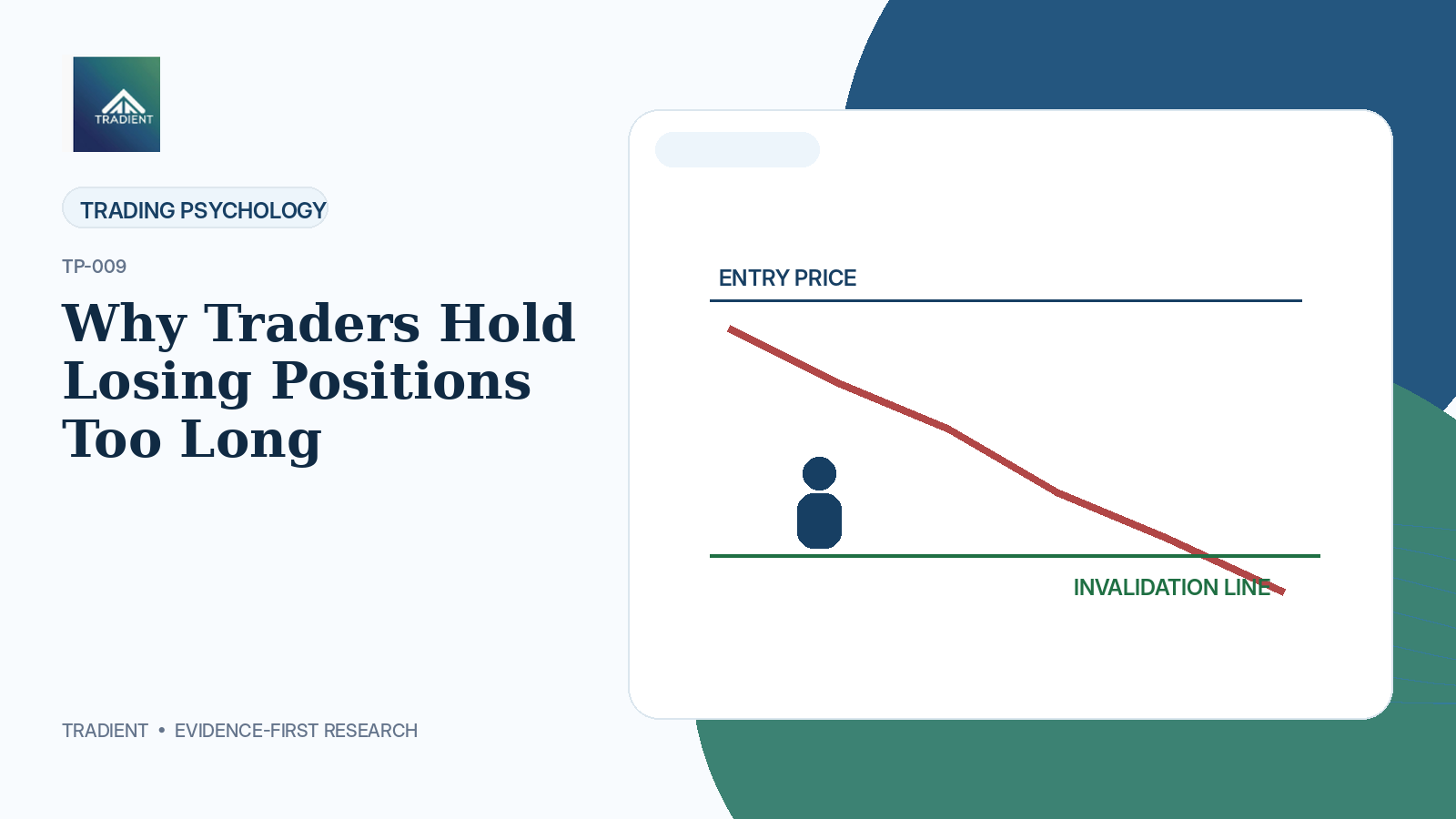
At a glance: Holding a losing trade is not automatically a mistake. Holding it after the strategy’s invalidation condition has been met—because selling feels painful—is a process failure.
Every trading strategy needs room for normal adverse movement. If every red trade is closed immediately, many valid setups would never have a chance to work.
The psychological problem begins when the planned reason for staying in the trade disappears and is replaced by hope, anchoring or a desire to avoid recognising the loss.
Realising the loss feels final
An unrealised loss preserves a story: the market may come back and the decision may still be proven right. Selling ends that story and creates a definite result in the account history.
That finality can make delay emotionally attractive. The trader begins evaluating the trade by the possibility of returning to the entry price rather than by the current evidence.
Entry price becomes an anchor
The market does not know a trader’s entry price, but the trader does. Once the entry becomes the psychological reference point, ‘getting back to breakeven’ can replace the original thesis.
A better exit framework asks what price or condition invalidates the setup, regardless of where the trade happened to be entered.
Sunk cost encourages escalation
Time, attention and prior losses can create a sense that more commitment is justified because so much has already been invested. This can lead to averaging down without a defined strategy.
Additional risk should be treated as a new decision. If you would not initiate the larger combined position at the current price under current evidence, adding merely to improve the average cost is difficult to justify.
Distinguish planned patience from hope
Planned patience has boundaries: the thesis remains intact, risk is within limits and the strategy expects noise around the entry. Hope has no clear invalidation point and often expands the time horizon after the loss appears.
A useful journal field is ‘Would I still enter this position today?’ It is not a mechanical exit rule, but it exposes when ownership has changed the analysis.
Use exit rules that match the strategy
A technical trader may use price structure, volatility or time stops. A fundamental investor may exit when earnings power, balance-sheet assumptions, governance or valuation logic changes.
The exact rule varies. What matters psychologically is that the rule exists before the loss becomes emotionally salient.
Review the losers you kept, not only the losers you sold
Post-trade review should include maximum adverse excursion, time held after invalidation and whether any unplanned averaging occurred.
This reveals whether the system is giving trades necessary room or simply converting small planned losses into large discretionary ones.
A practical drill for the next 20 trades
Do not try to change the behaviour after one observation. For the next 20 relevant trades, record the trigger, the emotion or urge, the planned action and the action actually taken. Keep the form short enough that it is completed consistently.
At the end of the sample, look for repeated conditions rather than isolated stories. The purpose is to discover whether the behaviour appears after losses, after wins, at a particular time of day, at larger size or in fast-moving instruments. A repeated pattern is easier to redesign than a vague belief that discipline is weak.
- Setup grade before entry
- Planned rupee risk
- Dominant emotion or urge
- Any rule change after entry
- Process grade independent of P&L
What improvement should look like
Improvement does not require the emotion to disappear. A better standard is behavioural: a losing position can be valid; a violated invalidation rule is the key distinction. The trader should be able to recognise the relevant state without automatically converting it into an order.
Track fewer rule violations, more stable position sizing and a smaller gap between planned and actual actions. Profitability is important over a meaningful sample, but process improvement can be observed earlier than the equity curve.
When to step back from live risk
If the behaviour repeatedly produces outsized losses, cancelled stops, uncontrolled leverage or an inability to follow a daily risk limit, the appropriate response may be to reduce or pause live exposure while the process is rebuilt.
Psychology work is not a justification for enduring unsafe risk. A trader should also investigate whether strategy design, platform mechanics, sleep, workload or position size is creating a problem that self-talk alone cannot solve.
Key takeaways
- A losing position can be valid; a violated invalidation rule is the key distinction.
- Entry price is psychologically salient but not market evidence.
- Sunk costs should not justify adding new risk.
- Planned patience has explicit boundaries; hope usually does not.
- Exit logic must match the strategy’s horizon and evidence.
- Review time held after invalidation and unplanned averaging as process metrics.
Frequently asked questions
Should I always use a stop loss?
A strategy needs a risk-control method, but it may be a price stop, time stop, thesis invalidation or another explicit rule. The appropriate mechanism depends on the strategy.
Is averaging down always bad?
No. Some strategies deliberately scale into positions. It becomes problematic when additional size is a spontaneous attempt to rescue a losing trade.
Why does breakeven feel so important?
Entry price becomes a reference point. Emotionally it can feel like proof of being right or wrong, even though the market has no obligation to revisit it.
How can I tell whether I am being patient or stubborn?
Ask whether the original thesis remains intact, the risk is still within plan and the exit rule has not been violated. If those answers are unclear, ownership may be distorting the decision.
This article is for educational purposes only and is not investment advice or a recommendation to buy or sell any security.
Sources and further reading