
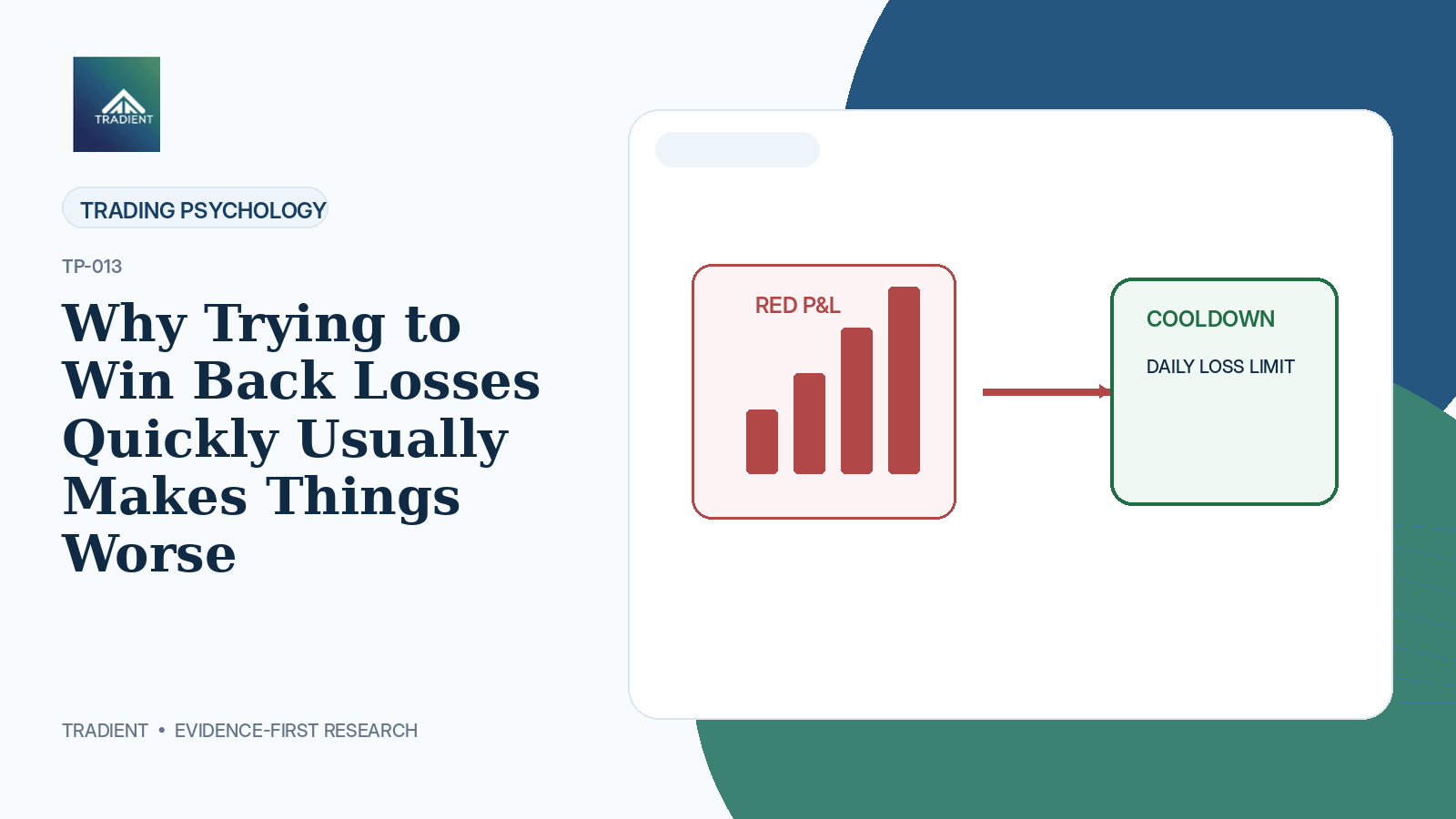
At a glance: A loss creates no obligation for the market to provide a recovery opportunity. When the next trade is chosen mainly to repair the previous P&L, the trader is no longer following the original strategy.
The most dangerous sentence after a loss is often ‘I just need one good trade to get it back.’ It sounds modest, but it changes the objective from executing an edge to recovering a specific amount of money.
That personal target can make ordinary risk controls feel inconvenient. Size increases, marginal setups become acceptable and the trader stays active long after the planned session should have ended.
The loss changes the objective function
Before the loss, the objective may have been to take only qualified setups with fixed risk. After the loss, the objective quietly becomes ‘end the day flat’ or ‘recover half the drawdown’.
The second objective depends on past P&L, not on current market opportunity. That creates a mismatch between what the market offers and what the trader emotionally demands.
Risk tends to rise when decision quality falls
Frustration and urgency can reduce selectivity at the same time the trader increases size. That combination is especially damaging because the worst-qualified trades receive the most capital.
A daily loss limit exists partly to prevent this feedback loop. It creates a point where the system stops asking the stressed trader to make more risk decisions.
More trades do not create more edge
If a strategy generates three valid opportunities in a session, taking ten trades does not multiply the edge. The additional seven are likely to come from lower-quality or different setups.
This is one reason excessive turnover can damage outcomes even before considering costs: activity expands faster than opportunity quality.
Use cooldown rules that are mechanical
- Mandatory break after a defined loss or process violation
- No size increase after a losing trade
- Maximum number of attempts on the same setup
- Hard daily loss limit
- No new trade whose main written rationale is recovery of prior P&L
Breakeven is not a risk-management level
Traders often continue because the account is ‘only’ a small amount below the day’s starting value. But being close to breakeven does not improve the probability of the next setup.
The correct question is whether the next trade independently meets the strategy criteria and fits the remaining risk budget.
Recovery happens over a sample, not a heroic trade
A robust strategy recovers through repeated application of an edge across many opportunities. Trying to compress that process into one oversized trade changes the strategy’s risk profile.
The psychologically mature response to a loss is to protect the ability to participate in the next valid opportunity, whenever it occurs.
A practical drill for the next 20 trades
Do not try to change the behaviour after one observation. For the next 20 relevant trades, record the trigger, the emotion or urge, the planned action and the action actually taken. Keep the form short enough that it is completed consistently.
At the end of the sample, look for repeated conditions rather than isolated stories. The purpose is to discover whether the behaviour appears after losses, after wins, at a particular time of day, at larger size or in fast-moving instruments. A repeated pattern is easier to redesign than a vague belief that discipline is weak.
- Setup grade before entry
- Planned rupee risk
- Dominant emotion or urge
- Any rule change after entry
- Process grade independent of P&L
What improvement should look like
Improvement does not require the emotion to disappear. A better standard is behavioural: past losses do not make a new setup more attractive. The trader should be able to recognise the relevant state without automatically converting it into an order.
Track fewer rule violations, more stable position sizing and a smaller gap between planned and actual actions. Profitability is important over a meaningful sample, but process improvement can be observed earlier than the equity curve.
When to step back from live risk
If the behaviour repeatedly produces outsized losses, cancelled stops, uncontrolled leverage or an inability to follow a daily risk limit, the appropriate response may be to reduce or pause live exposure while the process is rebuilt.
Psychology work is not a justification for enduring unsafe risk. A trader should also investigate whether strategy design, platform mechanics, sleep, workload or position size is creating a problem that self-talk alone cannot solve.
Key takeaways
- Past losses do not make a new setup more attractive.
- Revenge trading changes the objective from executing an edge to recovering a specific amount.
- Urgency can increase size and lower selectivity at the same time.
- Daily loss limits and cooldowns interrupt the feedback loop mechanically.
- Breakeven is an account reference point, not a market signal.
- Financial recovery should come from a sample of valid trades, not one heroic bet.
Frequently asked questions
Is it always wrong to trade again after a loss?
No. The next setup may be valid. The key is whether it would be taken with the same size and logic if the previous trade had not occurred.
What is revenge trading?
It is trading primarily to recover a recent loss, often with changed size, frequency or standards rather than the normal strategy.
Do daily loss limits reduce opportunity?
They can cause you to miss later trades, but that is the intended trade-off: limiting tail damage when process quality may be impaired.
How long should a cooldown last?
Use a rule that fits the strategy—minutes, the rest of the session or until a review is complete. Mechanical consistency matters more than a universal duration.
This article is for educational purposes only and is not investment advice or a recommendation to buy or sell any security.
Sources and further reading